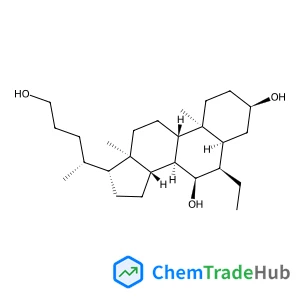
(3alpha,5beta,6alpha,7alpha)-6-Ethylcholane-3,7,24-triol
CAS Number:
1537866-49-1
Molecular Formula:
C26H46O3
Ze-lin Li, Kang-kang Sun, Chun Cai
A cobalt-catalyzed regioselective C–H halogenation methodology is reported herein. The highlight of this work is the highly selective C–H functionalization of anilides, which results in high-yielding, versatile, and practical halogenated products. Thereby, brominations, chlorinations and iodinations of many electron-rich and electron-deficient anilides were achieved in a highly selective fashion. Mechanistic studies with respect to the pathway of the reaction are also described.
Heli A. Brahmbhatt, Alexander Surtees, Cavan Tierney, Oluwabukunmi A. Ige, Elena V. Piletska, Thomas Swift
DOI: 10.1039/D0PY00921K
Elena Gabirondo, Ainara Sangroniz, Agustin Etxeberria, Sergio Torres-Giner, Haritz Sardon
DOI: 10.1039/D0PY90135K
Ian Roszak, Laurence Oswald, Abdelaziz Al Ouahabi, Eline Laurent, Olivier Felix, Isaure Carvin-Sergent, Laurence Charles, Jean-François Lutz
DOI: 10.1039/D1PY01052B
David K. Tran, Ahmed Z. Rashad, Donald J. Darensbourg
DOI: 10.1039/D1PY00784J
Keito Hagiwara
DOI: 10.1039/D0PY00648C
Fang Guo, Ming Deng, Fan Li, Shoulong Chen
DOI: 10.1039/D1PY00938A
N-(4-Methoxybenzyl)-2-pyridinamine (CAS: 52818-63-0) is increasingly being used ...
When handling Ethyl 4-(2-chlorophenyl)-1,3-thiazole-2-carboxylate, appropriate p...
Diethyldiselane (CAS: 628-39-7) is classified under the Globally Harmonized Syst...
The market for oxocopper (CAS: 12053-18-8) is primarily driven by its use in cat...
The market for 5-{[(2-Methyl-2-propanyl)oxy]carbonyl}-5-azaspiro[2.4]heptane-7-c...
2-(1-Pyrrolidinyl)-4-pyridinamine is a chemical compound with the CAS number 359...
2-(3-Pyridinyl)-1-azabicyclo[2.2.2]octane (CAS: 91556-75-1) is a crystalline sol...
(S)-Alpha-allyl-proline hydrochloride is usually synthesized via a Wittig reacti...
3-Methyl-1,2-oxazole-5-carboxylic acid (CAS: 4857-42-5) is an organic compound w...
Lys-SMCC-DM1 is synthesized via a multi-step process involving the coupling of S...

Organic & Biomolecular Chemistry (OBC) publishes original and high impact research and reviews in organic chemistry. We welcome research that shows new or significantly improved protocols or methodologies in total synthesis, synthetic methodology or physical and theoretical organic chemistry as well as research that shows a significant advance in the organic chemistry or molecular design aspects of chemical biology, catalysis, supramolecular and macromolecular chemistry, theoretical chemistry, mechanism-oriented physical organic chemistry, medicinal chemistry or natural products. Articles published in the journal should report new work which makes a highly-significant impact in the field. Routine and incremental work is generally not suitable for publication in the journal. More details about key areas of our scope are below. In all cases authors should include in their article clear rationale for why their research has been carried out.