












Highly selective fluorescence ‘turn off’ sensing of picric acid and efficient cell labelling by water-soluble luminescent anthracene-bridged poly(N-vinyl pyrrolidone)
Literature Information
Publication Date
2019-04-25
DOI
10.1039/C8AN02417K
Impact Factor
4.616
Authors
Rajshree Singh, Kheyanath Mitra, Shikha Singh, Sudipta Senapati, Vijay Kumar Patel, Sambhav Vishwakarma, Archana Kumari, Jaydeep Singh, Susanta K. Sen Gupta, Nira Misra, Pralay Maiti, Biswajit Ray
View Original
Abstract
A novel, water-soluble, luminescent anthracene-bridged AA-type bi-arm poly(N-vinylpyrrolidone) (ATC-PNVP) was synthesized using a click reaction between alkyne-terminated PNVP and 9,10-bis(azidomethyl)anthracene. The resultant anthracene-bridged PNVP (ATC-PNVP) was characterized using 1H NMR, FTIR, UV-Vis, and fluorescence spectroscopic methods and GPC analysis. ATC-PNVP showed effective fluorescence properties in an aqueous medium. It showed highly selective “turn off” sensing behaviour towards picric acid, a common nitro-aromatic explosive, with a wide linear range of detection of 0.01–0.3 mM and LOD value of 0.006 mM in water. ATC-PNVP-based paper sensors also showed very effective detection of picric acid in the concentration range 0.001–1.0 mM. Its binding with bovine serum albumin (BSA) was studied using steady-state, synchronous and 3D fluorescence spectroscopy and this study showed effective quenching of the intrinsic fluorescence of BSA and occurrence of a FRET-type interaction. Furthermore, this luminescent ATC-PNVP was efficiently used as a fluorescence microscopy labelling agent in NIH-3T3 and HeLa cells, and showed greater uptake and hence better fluorescent labelling in the cytosols of the tested cells than free 9,10-bis(azidomethyl) anthracene. The cell viability study also showed a very good biocompatible and non-toxic nature of ATC-PNVP at lower working concentrations towards each of the types of cells tested.
Related Literature
Effects of electrospray mechanisms and structural relaxation on polylactide ion conformations in the gas phase: insights from ion mobility spectrometry and molecular dynamics simulations
Haidy Metwally, Vincent Lemaur, Jérôme Cornil, Julien De Winter, Lars Konermann, Pascal Gerbaux
2020-02-04
Paper
DOI: 10.1039/C9CP06391A
Correction: Isomer-specific cryogenic ion vibrational spectroscopy of the D2 tagged Cs+(HNO3)(H2O)n=0–2 complexes: ion-driven enhancement of the acidic H-bond to water
Sayoni Mitra, Chinh H. Duong, Mark A. Johnson
2020-03-04
Correction
DOI: 10.1039/D0CP90054K
First principles study on hydrogen doping induced metal-to-insulator transition in rare earth nickelates RNiO3 (R = Pr, Nd, Sm, Eu, Gd, Tb, Dy, Yb)
Pilsun Yoo, Peilin Liao
2020-03-10
Paper
DOI: 10.1039/C9CP06522A
Biological control of S-nitrosothiol reactivity: potential role of sigma-hole interactions
Niloufar Hendinejad, Qadir K. Timerghazin
2020-03-02
Paper
DOI: 10.1039/C9CP06377C
Water plays a dynamical role in a hydrogen-bonded, hexameric supramolecular assembly
Ankita Katiyar, Julia C. Freire Sovierzoski, Paul B. Calio, Anthony A. Vartia, Ward H. Thompson
2020-02-24
Paper
DOI: 10.1039/C9CP06874K
Modelling the bulk properties of ambient pressure polymorphs of zirconia
2020-02-25
Paper
DOI: 10.1039/D0CP00032A
Lithium migration pathways at the composite interface of LiBH4 and two-dimensional MoS2 enabling superior ionic conductivity at room temperature
Zhixiang Liu, Mengyuan Xiang, Yao Zhang, Huaiyu Shao, Yunfeng Zhu, Xinli Guo, Liquan Li, Hui Wang, Wanqiang Liu
2020-01-27
Paper
DOI: 10.1039/C9CP06090A
Effects of local geometry distortion at the Al/Al2Cu interfaces on solute segregation
2020-01-17
Paper
DOI: 10.1039/D0CP00067A
A molecular device providing a remarkable spin filtering effect due to the central molecular stretch caused by lateral zigzag graphene nanoribbon electrodes
Xiaoyue Liu, Jueming Yang, Xingwu Zhai, Hongxia Yan, Yanwen Zhang, Long Zhou
2020-02-28
Paper
DOI: 10.1039/D0CP00238K
You might also like
Compound Q&A
What is the market or research trend for N-(4-Methoxybenzyl)-2-pyridinamine (CAS: 52818-63-0)?
N-(4-Methoxybenzyl)-2-pyridinamine (CAS: 52818-63-0) is increasingly being used ...
52818-63-0N-(4-Methoxybenzyl)-...
Compound Q&A
What precautions should be taken when handling Ethyl 4-(2-chlorophenyl)-1,3-thiazole-2-carboxylate (CAS: 1050507-06-6)?
When handling Ethyl 4-(2-chlorophenyl)-1,3-thiazole-2-carboxylate, appropriate p...
1050507-06-6Ethyl 4-(2-chlorophe...
Compound Q&A
What regulatory guidelines apply to diethyldiselane (CAS: 628-39-7)?
Diethyldiselane (CAS: 628-39-7) is classified under the Globally Harmonized Syst...
628-39-7Diethyldiselane
Compound Q&A
What is the market or research trend for oxocopper (CAS: 12053-18-8)?
The market for oxocopper (CAS: 12053-18-8) is primarily driven by its use in cat...
12053-18-8oxocopper; oxo-(oxoc...
Compound Q&A
What is the market or research trend for 5-{[(2-Methyl-2-propanyl)oxy]carbonyl}-5-azaspiro[2.4]heptane-7-carboxylic acid?
The market for 5-{[(2-Methyl-2-propanyl)oxy]carbonyl}-5-azaspiro[2.4]heptane-7-c...
1268519-54-55-{[(2-Methyl-2-prop...
Compound Q&A
What is 2-(1-Pyrrolidinyl)-4-pyridinamine (CAS: 35981-63-6)?
2-(1-Pyrrolidinyl)-4-pyridinamine is a chemical compound with the CAS number 359...
35981-63-62-(1-Pyrrolidinyl)-4...
Compound Q&A
What are the physical and chemical properties of 2-(3-Pyridinyl)-1-azabicyclo[2.2.2]octane (CAS: 91556-75-1)?
2-(3-Pyridinyl)-1-azabicyclo[2.2.2]octane (CAS: 91556-75-1) is a crystalline sol...
91556-75-12-(3-Pyridinyl)-1-az...
Compound Q&A
How is (S)-Alpha-allyl-proline hydrochloride (CAS: 129704-91-2) typically synthesized?
(S)-Alpha-allyl-proline hydrochloride is usually synthesized via a Wittig reacti...
129704-91-2(S)-Alpha-allyl-prol...
Compound Q&A
What is 3-Methyl-1,2-oxazole-5-carboxylic acid (CAS: 4857-42-5)?
3-Methyl-1,2-oxazole-5-carboxylic acid (CAS: 4857-42-5) is an organic compound w...
4857-42-53-Methyl-1,2-oxazole...
Compound Q&A
How is Lys-SMCC-DM1 (CAS: 1281816-04-3) typically synthesized?
Lys-SMCC-DM1 is synthesized via a multi-step process involving the coupling of S...
1281816-04-3Lys-SMCC-DM1
Source Journal
Analyst

CiteScore:
7.8
Self-citation Rate:
5.6%
Articles per Year:
653
Analyst publishes analytical and bioanalytical research that reports premier fundamental discoveries and inventions, and the applications of those discoveries, unconfined by traditional discipline barriers.
Recommended Compounds
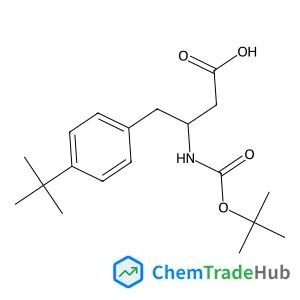
(S)-3-((tert-Butoxycarbonyl)amino)-4-(4-(tert-butyl)phenyl)butanoic acid
CAS Number:
403661-85-8
Molecular Formula:
C19H29NO4
Recommended Suppliers



Disclaimer
This page provides academic journal information for reference and research purposes only. We are not affiliated with any journal publishers and do not handle publication submissions. For publication-related inquiries, please contact the respective journal publishers directly.
If you notice any inaccuracies in the information displayed, please contact us at support@chemtradehub.com. We will promptly review and address your concerns.