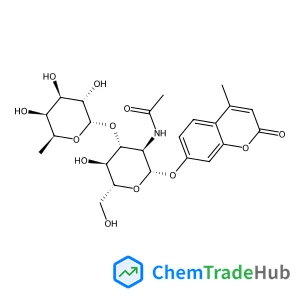
4-Methyl-2-oxo-2H-chromen-7-yl 2-acetamido-2-deoxy-3-O-(6-deoxy-alpha-L-galactopyranosyl)-beta-D-glucopyranoside
CAS Number:
383160-12-1
Molecular Formula:
C24H31NO12
Pilsun Yoo, Peilin Liao
Rare earth nickelates (RNiO3), consisting of a series of correlated transition metal oxides, have received increasing attention due to their sharp metal-to-insulator transition (MIT). Previous reports focused on understanding the origin and modulation of thermally driven MIT by strain effects, cation doping, or external electric field. Recently, it was reported that isothermal chemical doping of hydrogen can induce MIT and increase resistivity by ∼8 orders of magnitude, which opens up the possibility of utilizing these oxides to develop advanced electronic and sensing devices. In this study, we applied first principles methods to study geometric and electronic structures of MIT driven by hydrogen doping in a series of rare earth nickelates RNiO3 (R = Pr, Nd, Sm, Eu, Gd, Tb, Dy, Yb). Hybrid functional HSE06 calculations predict that all oxides under study exhibit sharp MIT, opening up an ∼3 eV band gap after hydrogen doping, with band gap values slightly increasing from Pr to Yb. We find that the R site elements play a key role in determining hydrogen adsorption energies and hydrogen migration barriers, which controls how difficult it would be for the hydrogen atoms to migrate inside the oxides. Detailed information on geometries, electronic structures, migration barriers and adsorption energies of hydrogen provides guidance for further optimizing these materials for future experiments and applications.
Binnur Aydogan, Ali Senol Gundogan, Turan Ozturk, Yusuf Yagci
DOI: 10.1039/B914953H
Ekaterina V. Skorb, Dmitry V. Sviridov, Helmuth Möhwald, Dmitry G. Shchukin
DOI: 10.1039/B914257F
Young Eun Cheon, Jungeun Park, Myunghyun Paik Suh
DOI: 10.1039/B910228K
Michael M. Madden, Claudia I. Rivera Vera, Wenjiao Song, Qing Lin
DOI: 10.1039/B912094G
Qianli Wang, Jie Xue, Zhongwu Guo
DOI: 10.1039/B907351E
Amrita Mondal, Thomas Weyhermüller, Karl Wieghardt
DOI: 10.1039/B912604J
Yung-Son Hon, Tze-Wei Tseng, Chia-Yi Cheng
DOI: 10.1039/B912887E
Suseung Lee, Inhee Choi, Surin Hong, Young In Yang, Jeongjin Lee, Taewook Kang, Jongheop Yi
DOI: 10.1039/B910666A
Shengqing Ye, Ke Gao, Haibo Zhou, Xiaodi Yang
DOI: 10.1039/B909178E
When handling lithium chloride hydrate (1:1:1) (CAS: 16712-20-2), it is importan...
4-(4H-1,2,4-Triazol-4-yl)piperidine is generally considered safe for use in phar...
Waste containing 1,3-Thiazole-2-carboxamide (CAS: 16733-85-0) should be collecte...
5-(Difluoromethyl)-2-fluorobenzonitrile (CAS: 934175-58-3) is subject to regulat...
Methyl 3-acetamido-2-thiophenecarboxylate can be synthesized by the reaction of ...
4-Isoquinolinecarbonitrile is a chemical compound with the CAS number 34846-65-6...
Store Methyl 1H-1,2,3-triazole-4-carboxylate (CAS: 877309-59-6) in a cool, dry p...
6-Bromo[1,3]thiazolo[5,4-b]pyridin-2-amine (CAS: 1160791-13-8) is subject to the...
(2S,3S)-2-Ammonio-3-(3,4-dihydroxyphenyl)-3-hydroxypropanoate (CAS: 23651-95-8) ...
7-Bromo-3-methyl-3,4-dihydroquinazolin-4-one is a solid with a crystalline form....

Physical Chemistry Chemical Physics (PCCP) is an international journal co-owned by 19 physical chemistry and physics societies from around the world. This journal publishes original, cutting-edge research in physical chemistry, chemical physics and biophysical chemistry. To be suitable for publication in PCCP, articles must include significant innovation and/or insight into physical chemistry; this is the most important criterion that reviewers and Editors will judge against when evaluating submissions. The journal has a broad scope and welcomes contributions spanning experiment, theory, computation and data science. Topical coverage includes spectroscopy, dynamics, kinetics, statistical mechanics, thermodynamics, electrochemistry, catalysis, surface science, quantum mechanics, quantum computing and machine learning. Interdisciplinary research areas such as polymers and soft matter, materials, nanoscience, energy, surfaces/interfaces, and biophysical chemistry are welcomed if they demonstrate significant innovation and/or insight into physical chemistry. Joined experimental/theoretical studies are particularly appreciated when complementary and based on up-to-date approaches.
![N-[2-(2-Pyridinyl)ethyl]-1-propanamine structure](https://static.chemtradehub.com/structs/554/55496-57-6-22b4.webp "N-[2-(2-Pyridinyl)ethyl]-1-propanamine structure")
![(1R,5R)-3-{[(2-Methyl-2-propanyl)oxy]carbonyl}-3-azabicyclo[3.1.0]hexane-1-carboxylic acid structure](https://static.chemtradehub.com/structs/116/1165450-63-4-bfe1.webp "(1R,5R)-3-{[(2-Methyl-2-propanyl)oxy]carbonyl}-3-azabicyclo[3.1.0]hexane-1-carboxylic acid structure")