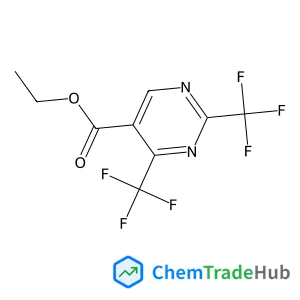
Ethyl 2,4-bis(trifluoromethyl)-5-pyrimidinecarboxylate
CAS Number:
188781-15-9
Molecular Formula:
C9H6F6N2O2
Haidy Metwally, Vincent Lemaur, Jérôme Cornil, Julien De Winter, Lars Konermann, Pascal Gerbaux
Recent advances in molecular dynamics (MD) simulations have made it possible to examine the behavior of large charged droplets that contain analytes such as proteins or polymers, thereby providing insights into electrospray ionization (ESI) mechanisms. In the present study, we use this approach to investigate the release of polylactide (PLA) ions from water/acetonitrile ESI droplets. We found that cationized gaseous PLA ions can be formed via various competing pathways. Some MD runs showed extrusion and subsequent separation of polymer chains from the droplet, as envisioned by the chain ejection model (CEM). On other occasions the PLA chains remained inside the droplets and were released after solvent evaporation to dryness, consistent with the charge residue model (CRM). Following their release from ESI droplets, the nascent gaseous PLA ions were subjected to structural relaxation for several μs in vacuo. The MD conformations generated in this way for various PLA charge states compared favorably to experimental results obtained by ion mobility spectrometry-mass spectrometry (IMS-MS). The structures of all PLA ions evolved during relaxation in the gas phase. However, some macroion species retained features that resembled their nascent structures. For this subset of ions, the IMS-MS response appears to be strongly correlated with the ESI release mechanism (CEM vs. CRM). The former favored extended structures, whereas the latter preferentially generated compact conformers.
M. Arunachalam, Pradyut Ghosh
DOI: 10.1039/B910014H
Qiong Wu, Yang-Guang Li, Yong-Hui Wang, Ying Lu, En-Bo Wang
DOI: 10.1039/B909246C
Peter D. Abram, David Ellis, Georgina M. Rosair, Alan J. Welch
DOI: 10.1039/B911350A
Akira Matsumoto, Takashi Endo
DOI: 10.1039/B911689C
Michael M. Madden, Claudia I. Rivera Vera, Wenjiao Song, Qing Lin
DOI: 10.1039/B912094G
Seunghee Hong, Minhak Oh, Mira Park, Ji Woong Yoon, Jong-San Chang, Myoung Soo Lah
DOI: 10.1039/B909250A
A. M. Coto-García, M. T. Fernández-Argüelles, J. M. Costa-Fernández, A. Sanz-Medel
DOI: 10.1039/B909469E
Stuart Kennedy, Scott J. Dalgarno
DOI: 10.1039/B909456C
Ruchi Shukla, Sergey V. Lindeman, Rajendra Rathore
DOI: 10.1039/B912796H
Boon Ping Ting, Jie Zhang, Majad Khan, Yi Yan Yang, Jackie Y. Ying
DOI: 10.1039/B910730D
When handling lithium chloride hydrate (1:1:1) (CAS: 16712-20-2), it is importan...
4-(4H-1,2,4-Triazol-4-yl)piperidine is generally considered safe for use in phar...
Waste containing 1,3-Thiazole-2-carboxamide (CAS: 16733-85-0) should be collecte...
5-(Difluoromethyl)-2-fluorobenzonitrile (CAS: 934175-58-3) is subject to regulat...
Methyl 3-acetamido-2-thiophenecarboxylate can be synthesized by the reaction of ...
4-Isoquinolinecarbonitrile is a chemical compound with the CAS number 34846-65-6...
Store Methyl 1H-1,2,3-triazole-4-carboxylate (CAS: 877309-59-6) in a cool, dry p...
6-Bromo[1,3]thiazolo[5,4-b]pyridin-2-amine (CAS: 1160791-13-8) is subject to the...
(2S,3S)-2-Ammonio-3-(3,4-dihydroxyphenyl)-3-hydroxypropanoate (CAS: 23651-95-8) ...
7-Bromo-3-methyl-3,4-dihydroquinazolin-4-one is a solid with a crystalline form....

Physical Chemistry Chemical Physics (PCCP) is an international journal co-owned by 19 physical chemistry and physics societies from around the world. This journal publishes original, cutting-edge research in physical chemistry, chemical physics and biophysical chemistry. To be suitable for publication in PCCP, articles must include significant innovation and/or insight into physical chemistry; this is the most important criterion that reviewers and Editors will judge against when evaluating submissions. The journal has a broad scope and welcomes contributions spanning experiment, theory, computation and data science. Topical coverage includes spectroscopy, dynamics, kinetics, statistical mechanics, thermodynamics, electrochemistry, catalysis, surface science, quantum mechanics, quantum computing and machine learning. Interdisciplinary research areas such as polymers and soft matter, materials, nanoscience, energy, surfaces/interfaces, and biophysical chemistry are welcomed if they demonstrate significant innovation and/or insight into physical chemistry. Joined experimental/theoretical studies are particularly appreciated when complementary and based on up-to-date approaches.