


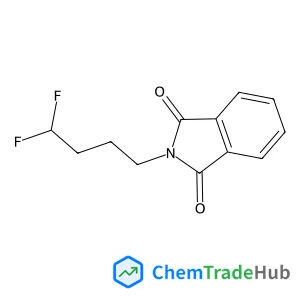
2-(4,4-Difluorobutyl)-1H-isoindole-1,3(2H)-dione
CAS Number:
1265341-14-7
Molecular Formula:
C12H11F2NO2
Yufeng Zhou, Yali Yu, Longlong Gao, Yifan Fei, Ting Ye, Qiusha Li, Xiaoshun Zhou, Ning Gan, Yong Shao
Efficient structuring of DNA by small molecules is very crucial in developing DNA-based novel switches with an ideal performance. In this work, we found that inverting only the polarity of the 3′ terminal guanine of the thrombin-binding aptamer (3iTBA) totally eradicates the original TBA G-quadruplex (G4) structure in K+. The unstructured 3iTBA can be further refolded upon specifically interacting with small molecules of natural isoquinoline alkaloids (IAs) due to their fruitful binding patterns with variant nucleic acid structures. We identified that 3iTBA can serve as a topology selector for planar IAs. Nitidine (NIT), owing to the planar aromatic ring and coplanar substituents, is the most efficient to restructure the 3iTBA random coil toward the anti-parallel G4 conformation. However, common metal ions can't realize this structuring. The topology selector competency of 3iTBA toward IAs’ planarity can be visualized using gold nanoparticles (AuNPs) as the chromogenic readout. Our work expands the G4 repertoire by exploring the polarity inversion regulation and provides a new approach to switch nucleic acid structures toward a small molecule structure-sensitive sensor.

Molecular Pharmacology

European Journal of Wood and Wood Products

Journal of Catalysis

Journal of Heterocyclic Chemistry

Organic Preparations and Procedures International

Planta Medica

Pharmacological Reviews

Proceedings of the National Academy of Sciences of the United States of America

Helvetica Chimica Acta

Israel Journal of Chemistry
Jonathan Keating, Gopinathan Sankar, Timothy I. Hyde, Shinji Kohara, Koji Ohara
DOI: 10.1039/C3CP50600B
Maxim F. Gelin, Dassia Egorova, Wolfgang Domcke
DOI: 10.1039/C3CP44454F
Ting Liao, Ziqi Sun, Aijun Du, Sean Smith
DOI: 10.1039/C3CP50654A
Małgorzata Wierzbowska, Adam Dominiak, Kamil Tokar
DOI: 10.1039/C3CP44378G
S. Günther, Hong Liu, T. O. Menteş, A. Locatelli, R. Imbihl
DOI: 10.1039/C3CP44478C
George Hasegawa, Mai Sannohe, Yuya Ishihara, Kazuyoshi Kanamori, Kazuki Nakanishi, Takeshi Abe
DOI: 10.1039/C3CP50352F
Gianluca Di Profio, Mika T. Reijonen, Rocco Caliandro, Antonietta Guagliardi, Efrem Curcio, Enrico Drioli
DOI: 10.1039/C3CP50664A
Chen-Wei Tsai, Yu-Chuan Su, Guan-De Li
DOI: 10.1039/C3CP50441G
Sergey Sirotin, Philippe Bazin, Françoise Maugé, Arnaud Travert
DOI: 10.1039/C3CP51146D
John L. Provis, Breaunnah Bloomer, Neil J. Henson, Katharine Page
DOI: 10.1039/C3CP44342F
N-(4-Methoxybenzyl)-2-pyridinamine (CAS: 52818-63-0) is increasingly being used ...
When handling Ethyl 4-(2-chlorophenyl)-1,3-thiazole-2-carboxylate, appropriate p...
Diethyldiselane (CAS: 628-39-7) is classified under the Globally Harmonized Syst...
The market for oxocopper (CAS: 12053-18-8) is primarily driven by its use in cat...
The market for 5-{[(2-Methyl-2-propanyl)oxy]carbonyl}-5-azaspiro[2.4]heptane-7-c...
2-(1-Pyrrolidinyl)-4-pyridinamine is a chemical compound with the CAS number 359...
2-(3-Pyridinyl)-1-azabicyclo[2.2.2]octane (CAS: 91556-75-1) is a crystalline sol...
(S)-Alpha-allyl-proline hydrochloride is usually synthesized via a Wittig reacti...
3-Methyl-1,2-oxazole-5-carboxylic acid (CAS: 4857-42-5) is an organic compound w...
Lys-SMCC-DM1 is synthesized via a multi-step process involving the coupling of S...

Analyst publishes analytical and bioanalytical research that reports premier fundamental discoveries and inventions, and the applications of those discoveries, unconfined by traditional discipline barriers.
![1-{3-[4-Amino-3-(4-phenoxyphenyl)-1H-pyrazolo[3,4-d]pyrimidin-1-yl]-1-piperidinyl}-2,3-dihydroxy-1-propanone structure](https://static.chemtradehub.com/structs/122/1226872-27-0-e037.webp "1-{3-[4-Amino-3-(4-phenoxyphenyl)-1H-pyrazolo[3,4-d]pyrimidin-1-yl]-1-piperidinyl}-2,3-dihydroxy-1-propanone structure")





