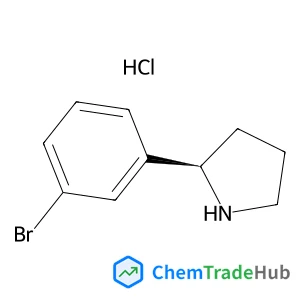
(2R)-2-(3-Bromophenyl)pyrrolidine hydrochloride (1:1)
CAS Number:
1391550-13-2
Molecular Formula:
C10H13BrClN
Ahmed Ali, Eun Young Hwang, Jaebum Choo, Dong Woo Lim
Surface-enhanced Raman scattering (SERS) is an optical spectroscopy technique that can detect a variety of analytes with high sensitivity and selectivity without any labels. Controlled clustering of metallic nanoparticles to prepare a new class of SERS nanotags is crucial for the ultra-sensitive detection of specific biological and chemical moieties because increased plasmonic hotspot junctions produce a greatly enhanced SERS signal. We report herein that controlled clustering of Au nanoparticles (AuNPs) was mediated by PEGylated nano-sized graphene (PNG) and that the PNG-induced AuNP clusters (PNG-AuNPCs) were highly sensitive SERS nanotags with colloidal stability for SERS-based biosensing. The AuNPs labeled with 4-mercaptopyridine as a Raman reporter were surface-modified with 1-aminomethylpyrene for the introduction of hydrophobic moieties, and were non-covalently complexed with PNG via π–π stacking and van der Waals forces. It resulted in the formation of PNG-AuNPCs that increased SERS intensity with an enhancement factor of 1.34 × 10¹¹. The PNG induced a high degree of AuNP clustering by enhancing the non-covalent interactions between them, resulting in increased hotspot junctions at highly localized plasmonic centers. Furthermore, to show that the PNG-AuNPCs would serve as stable, reproducible, and highly sensitive SERS nanotags for biosensing, we formed sandwich-type immunocomplexes composed of the PNG-AuNPCs, immunoglobulin G (IgG) as the antigen, and magnetic beads. We found a linear relationship between SERS intensity and IgG concentration, with a limit of detection lower than 31.0 fM for IgG detection. Thus, the PNG-AuNPCs could be useful as SERS nanotags for highly sensitive SERS-based biosensing applications.
K. Kondratenko, I. Carlescu, P.-E. Danjou, Y. Boussoualem, A. Simion, B. Duponchel, J. F. Blach, C. Legrand, N. Hurduc, A. Daoudi
DOI: 10.1039/D1CP01427G
Tam D. Vo, Amelia L. Schneider
DOI: 10.1039/D1CP01568K
Xuewei Dong, Ruxi Qi, Qin Qiao, Xuhua Li, Fangying Li, Jiaqian Wan, Qingwen Zhang, Guanghong Wei
DOI: 10.1039/D1CP02651H
Kuntal Chatterjee, Tarun Kumar Roy, Jai Khatri, Gerhard Schwaab, Martina Havenith
DOI: 10.1039/D1CP01789F
Feng-Yang Bai, Ming-Shuai Deng, Mei-Yan Chen, Lian Kong, Shuang Ni, Xiu-Mei Pan
DOI: 10.1039/D1CP01324F
Mojgan Kouhnavard, Yifan Diao, Pratim Biswas
DOI: 10.1039/D1CP00658D
Darius Abramavicius
DOI: 10.1039/D1CP00694K
Carolyn G. Farling, Mary C. Stackaruk, Cory C. Pye, Christa L. Brosseau
DOI: 10.1039/D1CP02416G
Ying Wang, Yupeng Zhang, Dong Wang, Zhaohu Luo, Fengjiao Zhang
DOI: 10.1039/D1CP02541D
N-(4-Methoxybenzyl)-2-pyridinamine (CAS: 52818-63-0) is increasingly being used ...
When handling Ethyl 4-(2-chlorophenyl)-1,3-thiazole-2-carboxylate, appropriate p...
Diethyldiselane (CAS: 628-39-7) is classified under the Globally Harmonized Syst...
The market for oxocopper (CAS: 12053-18-8) is primarily driven by its use in cat...
The market for 5-{[(2-Methyl-2-propanyl)oxy]carbonyl}-5-azaspiro[2.4]heptane-7-c...
2-(1-Pyrrolidinyl)-4-pyridinamine is a chemical compound with the CAS number 359...
2-(3-Pyridinyl)-1-azabicyclo[2.2.2]octane (CAS: 91556-75-1) is a crystalline sol...
(S)-Alpha-allyl-proline hydrochloride is usually synthesized via a Wittig reacti...
3-Methyl-1,2-oxazole-5-carboxylic acid (CAS: 4857-42-5) is an organic compound w...
Lys-SMCC-DM1 is synthesized via a multi-step process involving the coupling of S...

Analyst publishes analytical and bioanalytical research that reports premier fundamental discoveries and inventions, and the applications of those discoveries, unconfined by traditional discipline barriers.