












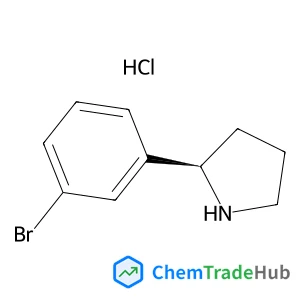
(2R)-2-(3-Bromophenyl)pyrrolidine hydrochloride (1:1)
CAS Number:
1391550-13-2
Molecular Formula:
C10H13BrClN
Tam D. Vo, Amelia L. Schneider
Electrostatic protein/DNA interactions arise from the neutralization of the DNA phosphodiester backbone as well as coupled exchanges by charged protein residues as salt bridges or with mobile ions. Much focus has been and continues to be paid to interfacial ion pairs with DNA. The role of extra-interfacial ionic interactions, particularly as dynamic drivers of DNA sequence selectivity, remain poorly known. The ETS family of transcription factors represents an attractive model for addressing this knowledge gap given their diverse ionic composition in primary structures that fold to a tightly conserved DNA-binding motif. To probe the importance of extra-interfacial salt bridges in DNA recognition, we compared the salt-dependent binding by Elk1 with ETV6, two ETS homologs differing markedly in ionic composition. While both proteins exhibit salt-dependent binding with cognate DNA that corresponds to interfacial phosphate contacts, their nonspecific binding diverges from cognate binding as well as each other. Molecular dynamics simulations in explicit solvent, which generated ionic interactions in agreement with the experimental binding data, revealed distinct salt-bridge dynamics in the nonspecific complexes formed by the two proteins. Impaired DNA contact by ETV6 resulted in fewer backbone contacts in the nonspecific complex, while Elk1 exhibited a redistribution of extra-interfacial salt bridges via residues that are non-conserved between the two ETS relatives. Thus, primary structure variation in ionic residues can encode highly differentiated specificity mechanisms in a highly conserved DNA-binding motif.
A. E. Boguslavskiy, J. P. Maier
DOI: 10.1039/B613109C
Vytautas Balevicius, Ruta Bariseviciute, Kestutis Aidas, Ingrid Svoboda, Helmut Ehrenberg, Hartmut Fuess
DOI: 10.1039/B701775H
Marianne Seijo, Serge Ulrich, Montserrat Filella, Jacques Buffle, Serge Stoll
DOI: 10.1039/B612118G
DOI: 10.1039/B618764A
Steven W. Rick
DOI: 10.1039/B614742A
Manuel J. Louwerse, Evert Jan Baerends
DOI: 10.1039/B613182D
Simon Penner, Bernhard Klötzer, Bernd Jenewein
DOI: 10.1039/B700650K
N-(4-Methoxybenzyl)-2-pyridinamine (CAS: 52818-63-0) is increasingly being used ...
When handling Ethyl 4-(2-chlorophenyl)-1,3-thiazole-2-carboxylate, appropriate p...
Diethyldiselane (CAS: 628-39-7) is classified under the Globally Harmonized Syst...
The market for oxocopper (CAS: 12053-18-8) is primarily driven by its use in cat...
The market for 5-{[(2-Methyl-2-propanyl)oxy]carbonyl}-5-azaspiro[2.4]heptane-7-c...
2-(1-Pyrrolidinyl)-4-pyridinamine is a chemical compound with the CAS number 359...
2-(3-Pyridinyl)-1-azabicyclo[2.2.2]octane (CAS: 91556-75-1) is a crystalline sol...
(S)-Alpha-allyl-proline hydrochloride is usually synthesized via a Wittig reacti...
3-Methyl-1,2-oxazole-5-carboxylic acid (CAS: 4857-42-5) is an organic compound w...
Lys-SMCC-DM1 is synthesized via a multi-step process involving the coupling of S...

Physical Chemistry Chemical Physics (PCCP) is an international journal co-owned by 19 physical chemistry and physics societies from around the world. This journal publishes original, cutting-edge research in physical chemistry, chemical physics and biophysical chemistry. To be suitable for publication in PCCP, articles must include significant innovation and/or insight into physical chemistry; this is the most important criterion that reviewers and Editors will judge against when evaluating submissions. The journal has a broad scope and welcomes contributions spanning experiment, theory, computation and data science. Topical coverage includes spectroscopy, dynamics, kinetics, statistical mechanics, thermodynamics, electrochemistry, catalysis, surface science, quantum mechanics, quantum computing and machine learning. Interdisciplinary research areas such as polymers and soft matter, materials, nanoscience, energy, surfaces/interfaces, and biophysical chemistry are welcomed if they demonstrate significant innovation and/or insight into physical chemistry. Joined experimental/theoretical studies are particularly appreciated when complementary and based on up-to-date approaches.

![1,10-bis(3,5-dimethylphenyl)-12-hydroxy-4,5,6,7-tetrahydroiindeno[7,1-de:1',7'-fg][1,3,2]dioxaphosphocine 12-oxide structure](https://static.chemtradehub.com/structs/141/1412439-82-7-b9a9.webp "1,10-bis(3,5-dimethylphenyl)-12-hydroxy-4,5,6,7-tetrahydroiindeno[7,1-de:1',7'-fg][1,3,2]dioxaphosphocine 12-oxide structure")





