












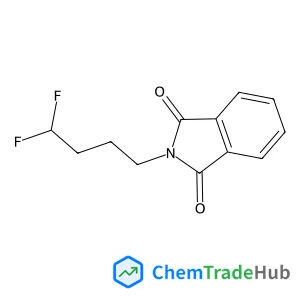
2-(4,4-Difluorobutyl)-1H-isoindole-1,3(2H)-dione
CAS Number:
1265341-14-7
Molecular Formula:
C12H11F2NO2
M. Gast, S. Kühner, H. Sobek, B. Mizaikoff
In the present study, virus imprinted particles have been synthesized for recognizing and specifically binding viruses. These materials may be used for biomimetic sensing schemes and for selective removal of virus particles. Virus imprinting procedures require careful optimization of the synthesis route for obtaining selective and efficiently binding imprinted materials. A remaining limitation has been a facile method for the quantification of the viral load during the imprinting process. Herein, human adenovirus (AdV) was selected as a model virus facilitating the development and application of a rapid virus quantification method based on a molecular biological approach. A real-time quantitative polymerase chain reaction, a.k.a., the qPCR method was developed for monitoring the AdV viral load during the synthesis of AdV imprinted particles, and subsequent rebinding studies. The developed analytical strategy allows the direct, rapid, and sensitive quantification of human adenovirus type 5 concentrations during synthesis and application of AdV imprinted polymers (AdV-MIPs) with a broad dynamic range suitable for both application scenarios. In addition, it was demonstrated by gel electrophoresis analysis that viruses indeed bind to the beads even after several washing steps.
Ping Zhao, Bo Jin, Qingchun Zhang, Rufang Peng
DOI: 10.1039/D1CP03466A
Zhendong Li
DOI: 10.1039/D1CP01075A
Sebastian Pios, Xiang Huang, Andrzej L. Sobolewski, Wolfgang Domcke
DOI: 10.1039/D1CP02026A
Anastasiia I. Fadeeva, Vitaly A. Gorbunov, Alexander V. Myshlyavtsev
DOI: 10.1039/D1CP03111B
Huimin Guo, Xiaolin Ma, Zhiwen Lei, Yang Qiu, Jianzhang Zhao, Bernhard Dick
DOI: 10.1039/D1CP01201K
Gustavo Cárdenas, Álvaro Pérez-Barcia, Marcos Mandado
DOI: 10.1039/D1CP03382D
Inseong Cho, Pawel Wagner, Peter C. Innis, Attila J. Mozer
DOI: 10.1039/D1CP01217G
Anne-Laure Barra, Johan van Tol, Sabine Hediger, Daniel Lee, Gaël De Paëpe
DOI: 10.1039/D1CP90117F
Emanuele Marsili, Antonio Prlj, Basile F. E. Curchod
DOI: 10.1039/D1CP02185K
N-(4-Methoxybenzyl)-2-pyridinamine (CAS: 52818-63-0) is increasingly being used ...
When handling Ethyl 4-(2-chlorophenyl)-1,3-thiazole-2-carboxylate, appropriate p...
Diethyldiselane (CAS: 628-39-7) is classified under the Globally Harmonized Syst...
The market for oxocopper (CAS: 12053-18-8) is primarily driven by its use in cat...
The market for 5-{[(2-Methyl-2-propanyl)oxy]carbonyl}-5-azaspiro[2.4]heptane-7-c...
2-(1-Pyrrolidinyl)-4-pyridinamine is a chemical compound with the CAS number 359...
2-(3-Pyridinyl)-1-azabicyclo[2.2.2]octane (CAS: 91556-75-1) is a crystalline sol...
(S)-Alpha-allyl-proline hydrochloride is usually synthesized via a Wittig reacti...
3-Methyl-1,2-oxazole-5-carboxylic acid (CAS: 4857-42-5) is an organic compound w...
Lys-SMCC-DM1 is synthesized via a multi-step process involving the coupling of S...

Analyst publishes analytical and bioanalytical research that reports premier fundamental discoveries and inventions, and the applications of those discoveries, unconfined by traditional discipline barriers.
![1-[6-(1H-Imidazol-1-yl)-3-pyridinyl]methanamine structure](https://static.chemtradehub.com/structs/914/914637-08-4-8825.webp "1-[6-(1H-Imidazol-1-yl)-3-pyridinyl]methanamine structure")
![N-{[(2-Methyl-2-propanyl)oxy]carbonyl}-L-methionylglycine structure](https://static.chemtradehub.com/structs/234/23446-03-9-e1e5.webp "N-{[(2-Methyl-2-propanyl)oxy]carbonyl}-L-methionylglycine structure")






