













The improved ion clustering and conductivity of a di-quaternized poly(arylene ether ketone sulfone)-based alkaline fuel cell membrane
Literature Information
Publication Date
2017-04-11
DOI
10.1039/C7SE00097A
Impact Factor
6.367
Authors
View Original
Abstract
Herein, we designed a hydrophobic–hydrophilic phase-separated poly(arylene ether ketone sulfone) (PAEKS) random copolymer-based di-quaternized stable and highly conductive alkaline membrane (AM). These membranes were prepared by bromination and mono- and di-quaternization using bi-functional 1,4-diazabicyclo[2,2,2]octane (DABCO) as the quaternization agent, which showed improved ion clusters. The reported method avoids the use of hazardous choloromethyl methyl ether (CMME), and the hydrophilic–hydrophobic blocks were responsible for the formation of OH− conductive channels. Furthermore, steric hindrance (due to methyl bonded second functional group) and the micro-phase separated structure were responsible for the improved alkaline resistance and formation of ion-clusters. The structure of PAEKS was confirmed by 1H NMR and FTIR spectroscopy, whereas the molecular weight was determined by gel permeation chromatography (GPC). Transmission electron microscopy (TEM) images showed well phase-separated ionic clusters. The well optimized di-quaternized alkaline membrane with a 68% degree of bromination (di-DQP-OH (DB: 68%)) exhibited a significantly improved ion-exchange capacity (2.45 meq g−1), hydroxide ion conductivity (4.68 × 10⁻² S cm−1), and activation energy (6.61 kJ mol−1) along with good thermal, mechanical, and dimensional stabilities. These properties of the AMs confirm their potential applications in alkaline fuel cells.
Recommended Journals
Related Literature
Radiation-induced transformations of matrix-isolated formic acid: evidence for the HCOOH → HOCO + H channel
Sergey V. Ryazantsev, Vladimir I. Feldman
2015-10-23
Paper
DOI: 10.1039/C5CP05446J
Fluorescence emissions of imide compounds and end-capped polyimides enhanced by intramolecular double hydrogen bonds
Kenta Kanosue, Shinji Ando
2015-10-26
Paper
DOI: 10.1039/C5CP05055C
Promoting and inhibiting tunneling via nuclear motions
Attila G. Császár, Tibor Furtenbacher
2015-12-11
Paper
DOI: 10.1039/C5CP04270D
Unveiling the peculiar hydrogen bonding behavior of solvated N-heterocyclic carbenes
2015-11-11
Paper
DOI: 10.1039/C5CP05369B
New insights into the photodissociation of methyl iodide at 193 nm: stereodynamics and product branching ratios
Sonia Marggi Poullain, Marta G. González, Peter C. Samartzis, Luis Rubio-Lago, Luis Bañares
2015-10-05
Paper
DOI: 10.1039/C5CP04850H
Edge reconstruction in armchair phosphorene nanoribbons revealed by discontinuous Galerkin density functional theory
Wei Hu, Chao Yang
2015-02-11
Paper
DOI: 10.1039/C5CP00333D
Real-space grids and the Octopus code as tools for the development of new simulation approaches for electronic systems
David Strubbe, Umberto De Giovannini, Ask Hjorth Larsen, Micael J. T. Oliveira, Alejandro Varas, Iris Theophilou, Nicole Helbig, Matthieu J. Verstraete, Lorenzo Stella, Fernando Nogueira, Alán Aspuru-Guzik, Miguel A. L. Marques
2015-02-20
Paper
DOI: 10.1039/C5CP00351B
Accurate and efficient linear scaling DFT calculations with universal applicability
Stephan Mohr, Luigi Genovese, Damien Caliste, Paul Boulanger, Stefan Goedecker, Thierry Deutsch
2015-04-27
Paper
DOI: 10.1039/C5CP00437C
Interfacial electronic structure and charge transfer of hybrid graphene quantum dot and graphitic carbon nitride nanocomposites: insights into high efficiency for photocatalytic solar water splitting
Zuju Ma, Rongjian Sa, Qiaohong Li, Kechen Wu
2015-11-26
Paper
DOI: 10.1039/C5CP05847C
Molecular dynamics simulations of the enhanced recovery of confined methane with carbon dioxide
Quanzi Yuan, Xueyan Zhu, Kui Lin, Ya-Pu Zhao
2015-11-05
Paper
DOI: 10.1039/C5CP06649B
You might also like
Compound Q&A
How should waste containing 6-Chloro-5-(2'-hydroxy-3'-methoxy-4-biphenylyl)-3-(3-methoxyphenyl)-1H-pyrrolo[3,2-d]pyrimidine-2,4(3H,5H)-dione (CAS: 1346607-05-3) be handled?
Waste containing 6-Chloro-5-(2'-hydroxy-3'-methoxy-4-biphenylyl)-3-(3-methoxyphe...
1346607-05-36-Chloro-5-(2'-hydro...
Compound Q&A
What are the main uses of (3alpha,5alpha)-3-Hydroxypregnane-11,20-dione (CAS: 23930-19-0)?
(3alpha,5alpha)-3-Hydroxypregnane-11,20-dione is primarily used in the pharmaceu...
23930-19-0(3alpha,5alpha)-3-Hy...
Compound Q&A
What is the market or research trend for 4-Amino-6-chloro-2-pyridinecarboxylic acid (CAS: 546141-56-4)?
The market for 4-Amino-6-chloro-2-pyridinecarboxylic acid (CAS: 546141-56-4) is ...
546141-56-44-Amino-6-chloro-2-p...
Compound Q&A
Are there alternatives to (2-Benzoylethyl)trimethylammonium chloride (CAS: 24472-88-6) in synthesis?
Alternatives to (2-Benzoylethyl)trimethylammonium chloride (CAS: 24472-88-6) in ...
24472-88-6(2-Benzoylethyl)trim...
Compound Q&A
Is N-[4-Nitro-3-(trifluoromethyl)phenyl]acetamide (CAS: 393-12-4) safe?
N-[4-Nitro-3-(trifluoromethyl)phenyl]acetamide (CAS: 393-12-4) is generally safe...
393-12-4N-[4-Nitro-3-(triflu...
Compound Q&A
Are there alternatives to [(4R,5R,6S)-5-hydroxy-10-imino-3,7-dioxa-1,9-diazatricyclo[6.4.0.02,6]dodeca-8,11-dien-4-yl]methyl dihydrogen phosphate (CAS: 39679-56-6) in synthesis?
Alternative reagents such as other phosphates or similar functional groups can b...
39679-56-6[(4R,5R,6S)-5-hydrox...
Compound Q&A
Are there alternatives to N,N'-Bis(3-aminopropyl)-1,3-propanediamine (CAS: 4605-14-5) in synthesis?
There are alternatives to N,N'-Bis(3-aminopropyl)-1,3-propanediamine (CAS: 4605-...
4605-14-5N,N'-Bis(3-aminoprop...
Compound Q&A
What precautions should be taken when handling Aluminium trihexadecanoate (CAS: 555-35-1)?
When handling Aluminium trihexadecanoate, it is important to use appropriate per...
555-35-1Aluminium trihexadec...
Compound Q&A
What is (1,1-Dioxido-3-oxo-1,2-benzothiazol-2(3H)-yl)acetic acid (CAS: 52188-11-1)?
(1,1-Dioxido-3-oxo-1,2-benzothiazol-2(3H)-yl)acetic acid is a chemical compound ...
52188-11-1(1,1-Dioxido-3-oxo-1...
Compound Q&A
Are there alternatives to 5,5-dimethyloxolan-2-one (CAS: 3123-97-5) in synthesis?
Several alternatives to 5,5-dimethyloxolan-2-one (CAS: 3123-97-5) can be used in...
3123-97-55,5-dimethyloxolan-2...
Source Journal
Recommended Compounds
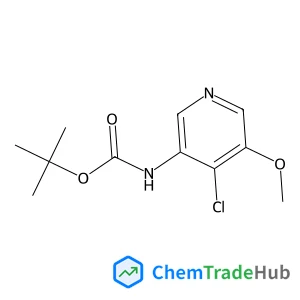
tert-Butyl 4-chloro-5-methoxypyridin-3-ylcarbamate
CAS Number:
1045858-17-0
Molecular Formula:
C11H15ClN2O3
![2-Methyl-2-propanyl [2-(2-oxa-6-azaspiro[3.3]hept-6-yl)ethyl]carbamate structure](https://static.chemtradehub.com/structs/141/1415562-38-7-c0a4.webp "2-Methyl-2-propanyl [2-(2-oxa-6-azaspiro[3.3]hept-6-yl)ethyl]carbamate structure")
2-Methyl-2-propanyl [2-(2-oxa-6-azaspiro[3.3]hept-6-yl)ethyl]carbamate
CAS Number:
1415562-38-7
Molecular Formula:
C12H22N2O3
Recommended Suppliers




Disclaimer
This page provides academic journal information for reference and research purposes only. We are not affiliated with any journal publishers and do not handle publication submissions. For publication-related inquiries, please contact the respective journal publishers directly.
If you notice any inaccuracies in the information displayed, please contact us at support@chemtradehub.com. We will promptly review and address your concerns.