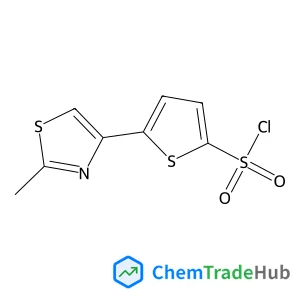
5-(2-Methyl-1,3-thiazol-4-yl)-2-thiophenesulfonyl chloride
CAS Number:
215434-25-6
Molecular Formula:
C8H6ClNO2S3
Sonia Marggi Poullain, Marta G. González, Peter C. Samartzis, Luis Rubio-Lago, Luis Bañares
The stereodynamics of methyl iodide photodissociation after excitation at 193 nm has been studied using a combination of slice imaging and resonance enhanced multiphoton ionization (REMPI) detection of the methyl and iodine products. A weak anisotropic ring appearing in the image corresponding to vibrationally excited CH3(ν1 = 1) confirms the production of ground state I(2P3/2) atoms at this excitation wavelength as a signature of the predissociation channel reported previously [M. G. González et al., J. Chem. Phys., 2011, 135, 021102] tentatively assigned to the coupling between the B-band 3R1 Rydberg state and the A-band 1Q1 repulsive state. Direct REMPI detection of ground state iodine atoms indicates that most of the I(2P3/2) species are produced in correlation with highly internally excited methyl radicals, in excellent agreement with the recent results of Xu and Pratt [Xu et al., J. Chem. Phys., 2013, 139, 214310; Xu et al., J. Phys. Chem. A, 2015, 119, 7548]. From the comparison between the CH3(ν) second order Dixon's bipolar moments β20(20), β00(22), β20(02) and β20(22) measured in this work and those reported previously for the B-band origin and the A-band, a general picture of the CH3I photodissociation stereodynamics in terms of different effects, such as the breakdown of the unique recoil direction (URD) approximation, the non-adiabatic curve crossings and the depolarization induced by the parent molecule rotation, is drawn.
Alexey A. Festa, Olga A. Storozhenko, Leonid G. Voskressensky
DOI: 10.1039/D3CS00366C
Quanpu Wang, Chao Fang
DOI: 10.1039/D3CS00489A
Hong Zhang, Lin Fu, Wenli Zhang, Yupeng Yuan
DOI: 10.1039/D3SC04853E
Yudong Xue
DOI: 10.1039/D3CS00706E
Ping Zhou, Maryam Nazari Haghighi Pashaki, Hans-Martin Frey, Andreas Hauser, Silvio Decurtins, Andrea Cannizzo, Thomas Feurer, Robert Häner, Shi-Xia Liu
DOI: 10.1039/D3SC03184E
Hao-Yang Liu, Xiao Li, Zhi-Gang Wang
DOI: 10.1039/D3CS00138E
Xinlu Zheng, Ziwei Ye, Zeeshan Akmal, Chun He, Jinlong Zhang, Lingzhi Wang
DOI: 10.1039/D3CS00462G
Ying Zhang, Jimin Yang, Yu-Long Ruan, Ling Liao, Chuang Ma
DOI: 10.1039/D3SC04474B
Xinke Kong, Lin Ru, Junjun Ge, Yalei Deng, Pan-ke Zhang, Yuanyuan Wang
DOI: 10.1039/D3SC04296K
Waste containing 6-Chloro-5-(2'-hydroxy-3'-methoxy-4-biphenylyl)-3-(3-methoxyphe...
(3alpha,5alpha)-3-Hydroxypregnane-11,20-dione is primarily used in the pharmaceu...
The market for 4-Amino-6-chloro-2-pyridinecarboxylic acid (CAS: 546141-56-4) is ...
Alternatives to (2-Benzoylethyl)trimethylammonium chloride (CAS: 24472-88-6) in ...
N-[4-Nitro-3-(trifluoromethyl)phenyl]acetamide (CAS: 393-12-4) is generally safe...
Alternative reagents such as other phosphates or similar functional groups can b...
There are alternatives to N,N'-Bis(3-aminopropyl)-1,3-propanediamine (CAS: 4605-...
When handling Aluminium trihexadecanoate, it is important to use appropriate per...
(1,1-Dioxido-3-oxo-1,2-benzothiazol-2(3H)-yl)acetic acid is a chemical compound ...
Several alternatives to 5,5-dimethyloxolan-2-one (CAS: 3123-97-5) can be used in...

Physical Chemistry Chemical Physics (PCCP) is an international journal co-owned by 19 physical chemistry and physics societies from around the world. This journal publishes original, cutting-edge research in physical chemistry, chemical physics and biophysical chemistry. To be suitable for publication in PCCP, articles must include significant innovation and/or insight into physical chemistry; this is the most important criterion that reviewers and Editors will judge against when evaluating submissions. The journal has a broad scope and welcomes contributions spanning experiment, theory, computation and data science. Topical coverage includes spectroscopy, dynamics, kinetics, statistical mechanics, thermodynamics, electrochemistry, catalysis, surface science, quantum mechanics, quantum computing and machine learning. Interdisciplinary research areas such as polymers and soft matter, materials, nanoscience, energy, surfaces/interfaces, and biophysical chemistry are welcomed if they demonstrate significant innovation and/or insight into physical chemistry. Joined experimental/theoretical studies are particularly appreciated when complementary and based on up-to-date approaches.