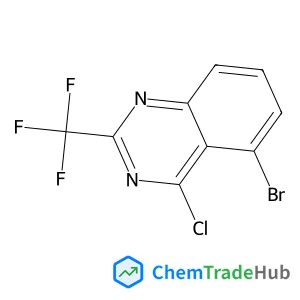
5-Bromo-4-chloro-2-(trifluoromethyl)quinazoline
CAS Number:
2089311-03-3
Molecular Formula:
C9H3BrClF3N2
Zuju Ma, Rongjian Sa, Qiaohong Li, Kechen Wu
New metal-free carbon nanodot/carbon nitride (C3N4) nanocomposites have shown to exhibit high efficiency for photocatalytic solar water splitting. (J. Liu, et al., Science, 2015, 347, 970) However, the mechanism underlying the ultrahigh performance of these nanocomposites and consequently the possibilities for further improvements are not at present clear. In this work, we performed hybrid functional calculations and included long-range dispersion corrections to accurately characterize the interfacial electron coupling of the graphene quantum dot–graphitic carbon nitride composites (Gdot/g-C3N4). The results revealed that the band gap of Gdot/g-C3N4 could be engineered by changing the lateral size of Gdots. In particular, the C24H12/g-C3N4 composites present an ideal band gap of 1.92 eV to harvest a large part of solar light. More interestingly, a type-II heterojunction is formed at the interface of the Gdot/g-C3N4 composites, a desirable feature for enhanced photocatalytic activity. The charge redistribution at the interface leads to strong electron depletion above the Gdot sheet and electron accumulation below the g-C3N4 monolayer, potentially facilitating the separation of H2O oxidation and reduction reactions. Furthermore, we suggested that the photocatalytic performance of the Gdot/g-C3N4 nanocomposites can be further improved by decreasing the thickness of Gdots and tuning the size of Gdots.
Hong Zhang, Lin Fu, Wenli Zhang, Yupeng Yuan
DOI: 10.1039/D3SC04853E
Marcus E. Graziotto, Clinton J. Kidman, Simon A. James, Hugh H. Harris
DOI: 10.1039/D3CS00509G
Khoa Chung
DOI: 10.1039/D3SC02761A
Andrew J. deMello, Maosheng Yao, Junji Cao
DOI: 10.1039/D3CS00417A
Xinke Kong, Lin Ru, Junjun Ge, Yalei Deng, Pan-ke Zhang, Yuanyuan Wang
DOI: 10.1039/D3SC04296K
Helena F. Piedra, Victoria Gebler, Carlos Valdés, Manuel Plaza
DOI: 10.1039/D3SC05263J
Julia Jökel, Esma Birsen Boydas, Joël Wellauer, Oliver S. Wenger, Michael Römelt
DOI: 10.1039/D3SC02679E
Tyler J. Hannah, Saurabh S. Chitnis
DOI: 10.1039/D3CS00765K
Yikuan Liu, Xiaona Liu, An Su, Chengtao Gong, Shenwei Chen, Liwei Xia, Chengwei Zhang, Xiaohuan Tao, Yue Li, Yonghe Li, Tulai Sun, Mengru Bu, Wei Shao, Jia Zhao, Xiaonian Li, Yongwu Peng, Yihan Zhu
DOI: 10.1039/D3CS00287J
Waste containing 6-Chloro-5-(2'-hydroxy-3'-methoxy-4-biphenylyl)-3-(3-methoxyphe...
(3alpha,5alpha)-3-Hydroxypregnane-11,20-dione is primarily used in the pharmaceu...
The market for 4-Amino-6-chloro-2-pyridinecarboxylic acid (CAS: 546141-56-4) is ...
Alternatives to (2-Benzoylethyl)trimethylammonium chloride (CAS: 24472-88-6) in ...
N-[4-Nitro-3-(trifluoromethyl)phenyl]acetamide (CAS: 393-12-4) is generally safe...
Alternative reagents such as other phosphates or similar functional groups can b...
There are alternatives to N,N'-Bis(3-aminopropyl)-1,3-propanediamine (CAS: 4605-...
When handling Aluminium trihexadecanoate, it is important to use appropriate per...
(1,1-Dioxido-3-oxo-1,2-benzothiazol-2(3H)-yl)acetic acid is a chemical compound ...
Several alternatives to 5,5-dimethyloxolan-2-one (CAS: 3123-97-5) can be used in...

Physical Chemistry Chemical Physics (PCCP) is an international journal co-owned by 19 physical chemistry and physics societies from around the world. This journal publishes original, cutting-edge research in physical chemistry, chemical physics and biophysical chemistry. To be suitable for publication in PCCP, articles must include significant innovation and/or insight into physical chemistry; this is the most important criterion that reviewers and Editors will judge against when evaluating submissions. The journal has a broad scope and welcomes contributions spanning experiment, theory, computation and data science. Topical coverage includes spectroscopy, dynamics, kinetics, statistical mechanics, thermodynamics, electrochemistry, catalysis, surface science, quantum mechanics, quantum computing and machine learning. Interdisciplinary research areas such as polymers and soft matter, materials, nanoscience, energy, surfaces/interfaces, and biophysical chemistry are welcomed if they demonstrate significant innovation and/or insight into physical chemistry. Joined experimental/theoretical studies are particularly appreciated when complementary and based on up-to-date approaches.
![2-Methyl-2-propanyl [2-(2-oxa-6-azaspiro[3.3]hept-6-yl)ethyl]carbamate structure](https://static.chemtradehub.com/structs/141/1415562-38-7-c0a4.webp "2-Methyl-2-propanyl [2-(2-oxa-6-azaspiro[3.3]hept-6-yl)ethyl]carbamate structure")