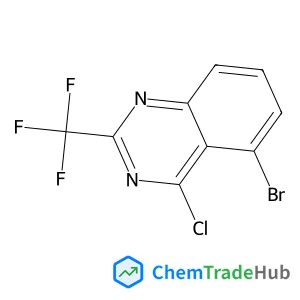
5-Bromo-4-chloro-2-(trifluoromethyl)quinazoline
CAS Number:
2089311-03-3
Molecular Formula:
C9H3BrClF3N2
To investigate the hydrogen bonding and its dynamics of N-heterocyclic carbenes (NHCs) in solution, a molecular mechanical force field was fitted for the homologous series of 1,3-dialkylimidazol-2-ylidenes. During the exploration of the potential energy surface of the water/1,3-dimethylimidazol-2-ylidene system, it was observed for the first time that the carbene is prone to interaction with hydrogen bond donor molecules also from the rather unusual “on top” orientation, where the direction of the interplay is perpendicular to the plane of the NHC's ring. The fitting of the force field parameters for imidazol-2-ylidenes was found to be the best in the case of a two-site model, which reproduces not only the strength, but also the direction dependency of hydrogen bonding. With the aid of this tool, curious, hitherto unknown types of hydrogen bonding could be unveiled for NHCs. In the case of non-hydrogen bonding solvents, carbenes tend to form short lived, but structurally influental hydrogen bonds between each other via ring hydrogen atoms and the divalent carbon atoms. The chemically highly important hydrogen bond dynamics of NHCs was found to be facilitated by three center hydrogen bonding, where two alcohol molecules bind to a carbene, which is allowed only by the aforementioned relatively strong interaction between the NHC and the hydrogen bond donor in the “on top” orientation. The latter finding has significant effects on processes that involve this kind of replacement, such as the selective transesterification reactions, and the mechanism of proton exchange on azolium rings.
Xinke Kong, Lin Ru, Junjun Ge, Yalei Deng, Pan-ke Zhang, Yuanyuan Wang
DOI: 10.1039/D3SC04296K
Jun-Jie Fang, Zheng Liu, Yang-Lin Shen, Yun-Peng Xie, Xing Lu
DOI: 10.1039/D3SC04682F
Divita Mathur, Sebastián A. Díaz, Ryan D. Pensack, Bernard Yurke, Austin Biaggne, Joseph S. Melinger, William B. Knowlton, Igor L. Medintz
DOI: 10.1039/D0CS00936A
Sean K. Sandstrom, Qiuyao Li, Yiming Sui, Mason Lyons, Chun-Wai Chang, Rui Zhang, Heng Jiang, Mingliang Yu, David Hoang, William F. Stickle, Huolin L. Xin, Zhenxing Feng, Xiulei Ji
DOI: 10.1039/D3SC04545E
Hao Lan, Jiawei Wang, Liwei Cheng, Dandan Yu, Hua Wang, Lin Guo
DOI: 10.1039/D3CS00860F
Yifeng Tang, Jeremiah Y. Kim, Carman K. M. IP, Azadeh Bahmani, Qing Chen, Matthew G. Rosenberger, Aaron P. Esser-Kahn, Andrew L. Ferguson
DOI: 10.1039/D3SC03613H
Ping Zhou, Maryam Nazari Haghighi Pashaki, Hans-Martin Frey, Andreas Hauser, Silvio Decurtins, Andrea Cannizzo, Thomas Feurer, Robert Häner, Shi-Xia Liu
DOI: 10.1039/D3SC03184E
DOI: 10.1039/D3CS00753G
Rémy Rajapaksha, Partha Samanta, Elsje Alessandra Quadrelli, Jérôme Canivet
DOI: 10.1039/D3CS00188A
Waste containing 6-Chloro-5-(2'-hydroxy-3'-methoxy-4-biphenylyl)-3-(3-methoxyphe...
(3alpha,5alpha)-3-Hydroxypregnane-11,20-dione is primarily used in the pharmaceu...
The market for 4-Amino-6-chloro-2-pyridinecarboxylic acid (CAS: 546141-56-4) is ...
Alternatives to (2-Benzoylethyl)trimethylammonium chloride (CAS: 24472-88-6) in ...
N-[4-Nitro-3-(trifluoromethyl)phenyl]acetamide (CAS: 393-12-4) is generally safe...
Alternative reagents such as other phosphates or similar functional groups can b...
There are alternatives to N,N'-Bis(3-aminopropyl)-1,3-propanediamine (CAS: 4605-...
When handling Aluminium trihexadecanoate, it is important to use appropriate per...
(1,1-Dioxido-3-oxo-1,2-benzothiazol-2(3H)-yl)acetic acid is a chemical compound ...
Several alternatives to 5,5-dimethyloxolan-2-one (CAS: 3123-97-5) can be used in...

Physical Chemistry Chemical Physics (PCCP) is an international journal co-owned by 19 physical chemistry and physics societies from around the world. This journal publishes original, cutting-edge research in physical chemistry, chemical physics and biophysical chemistry. To be suitable for publication in PCCP, articles must include significant innovation and/or insight into physical chemistry; this is the most important criterion that reviewers and Editors will judge against when evaluating submissions. The journal has a broad scope and welcomes contributions spanning experiment, theory, computation and data science. Topical coverage includes spectroscopy, dynamics, kinetics, statistical mechanics, thermodynamics, electrochemistry, catalysis, surface science, quantum mechanics, quantum computing and machine learning. Interdisciplinary research areas such as polymers and soft matter, materials, nanoscience, energy, surfaces/interfaces, and biophysical chemistry are welcomed if they demonstrate significant innovation and/or insight into physical chemistry. Joined experimental/theoretical studies are particularly appreciated when complementary and based on up-to-date approaches.
![4-{[4-(Trifluoromethoxy)benzyl]oxy}benzonitrile structure](https://static.chemtradehub.com/structs/103/1036629-63-6-2172.webp "4-{[4-(Trifluoromethoxy)benzyl]oxy}benzonitrile structure")