












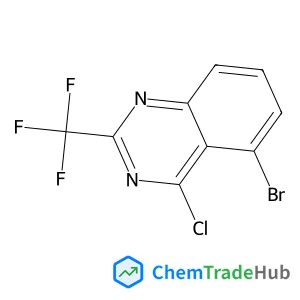
5-Bromo-4-chloro-2-(trifluoromethyl)quinazoline
CAS Number:
2089311-03-3
Molecular Formula:
C9H3BrClF3N2
Attila G. Császár, Tibor Furtenbacher
Accurate, experimental rotational–vibrational energy levels determined via the MARVEL (Measured Active Rotational–Vibrational Energy Levels) algorithm and published recently for the symmetric-top 14NH3 molecule in J. Quant. Spectrosc. Radiat. Transfer, 2015, 116, 117–130 are analyzed to unravel the promoting and inhibiting effects of vibrations and rotations on the tunneling splittings of the corresponding symmetric (s) and antisymmetric (a) rovibrational energy level pairs. The experimental transition data useful from the point of view of the present analysis cover the range 0.7–7000 cm−1, sufficiently detailed rovibrational energy sets worth analyzing are available for 20 vibrational bands. The highest J value, where J stands for the rotational quantum number, within the experimental dataset employed is 30. Coupling of the “umbrella” motion of 14NH3 with other vibrational degrees of freedom has only a minor effect on the a–s tunneling splitting characterizing the ground vibrational state, 0.79436(70) cm−1. In the majority of the cases rotation around the C3 axis increases, while rotation around the two perpendicular axes decreases the tunneling splittings. For example, for the pair of vibrational ground states, 0+ and 0−, the tunneling splitting basically disappears at around J = 25 for the (J,K) = (J,1) states, where K = |k| is the usual quantum number characterizing the projection of the rotational angular momentum on the principal axis. The tunneling splittings, defined as energy differences E(a) − E(s) of corresponding energy level pairs, as a function of J and K show a very regular behavior for the ground state (GS) and the nν2 bands. For the other bands investigated exceptions from a regular behavior do occur, especially for bands characterized by degenerate vibrations, and occasionally the data available are not sufficient to arrive at definitive conclusions. The most irregular behavior is observed for rotational states characterized by the k − l = 3n rule (l is the vibrational angular momentum quantum number), with n = 0, 1, 2,… High-quality, variationally computed rovibrational data support all the conclusions of this study based on experimental energy levels.
Yiping Zhao, Amit Kumar, Yanjun Yang
DOI: 10.1039/D3CS00540B
Helena F. Piedra, Victoria Gebler, Carlos Valdés, Manuel Plaza
DOI: 10.1039/D3SC05263J
Ping Zhou, Maryam Nazari Haghighi Pashaki, Hans-Martin Frey, Andreas Hauser, Silvio Decurtins, Andrea Cannizzo, Thomas Feurer, Robert Häner, Shi-Xia Liu
DOI: 10.1039/D3SC03184E
Jun-Jie Fang, Zheng Liu, Yang-Lin Shen, Yun-Peng Xie, Xing Lu
DOI: 10.1039/D3SC04682F
Conor J. Crawford
DOI: 10.1039/D3CS00321C
Hanqing Fan, Xinglin Lu, Menachem Elimelech
DOI: 10.1039/D3CS00395G
Jiang Li, Dan Li, Yunke Ma, Shucun Zhou, Yu Wang, Daohong Zhang
DOI: 10.1039/D3CS00713H
Yingying Fan, Jinguang Hu, Hyeon Suk Shin, Damien Voiry, Qingye Lu, Jimmy C. Yu
DOI: 10.1039/D2CS00205A
Waste containing 6-Chloro-5-(2'-hydroxy-3'-methoxy-4-biphenylyl)-3-(3-methoxyphe...
(3alpha,5alpha)-3-Hydroxypregnane-11,20-dione is primarily used in the pharmaceu...
The market for 4-Amino-6-chloro-2-pyridinecarboxylic acid (CAS: 546141-56-4) is ...
Alternatives to (2-Benzoylethyl)trimethylammonium chloride (CAS: 24472-88-6) in ...
N-[4-Nitro-3-(trifluoromethyl)phenyl]acetamide (CAS: 393-12-4) is generally safe...
Alternative reagents such as other phosphates or similar functional groups can b...
There are alternatives to N,N'-Bis(3-aminopropyl)-1,3-propanediamine (CAS: 4605-...
When handling Aluminium trihexadecanoate, it is important to use appropriate per...
(1,1-Dioxido-3-oxo-1,2-benzothiazol-2(3H)-yl)acetic acid is a chemical compound ...
Several alternatives to 5,5-dimethyloxolan-2-one (CAS: 3123-97-5) can be used in...

Physical Chemistry Chemical Physics (PCCP) is an international journal co-owned by 19 physical chemistry and physics societies from around the world. This journal publishes original, cutting-edge research in physical chemistry, chemical physics and biophysical chemistry. To be suitable for publication in PCCP, articles must include significant innovation and/or insight into physical chemistry; this is the most important criterion that reviewers and Editors will judge against when evaluating submissions. The journal has a broad scope and welcomes contributions spanning experiment, theory, computation and data science. Topical coverage includes spectroscopy, dynamics, kinetics, statistical mechanics, thermodynamics, electrochemistry, catalysis, surface science, quantum mechanics, quantum computing and machine learning. Interdisciplinary research areas such as polymers and soft matter, materials, nanoscience, energy, surfaces/interfaces, and biophysical chemistry are welcomed if they demonstrate significant innovation and/or insight into physical chemistry. Joined experimental/theoretical studies are particularly appreciated when complementary and based on up-to-date approaches.
![2-Methyl-2-propanyl [2-(2-oxa-6-azaspiro[3.3]hept-6-yl)ethyl]carbamate structure](https://static.chemtradehub.com/structs/141/1415562-38-7-c0a4.webp "2-Methyl-2-propanyl [2-(2-oxa-6-azaspiro[3.3]hept-6-yl)ethyl]carbamate structure")
![(3-{[4-(Aminomethyl)-6-(trifluoromethyl)-2-pyridinyl]oxy}phenyl)[(3R,4R)-3-fluoro-4-hydroxy-1-pyrrolidinyl]methanone structure](https://static.chemtradehub.com/structs/200/2007885-39-2-affc.webp "(3-{[4-(Aminomethyl)-6-(trifluoromethyl)-2-pyridinyl]oxy}phenyl)[(3R,4R)-3-fluoro-4-hydroxy-1-pyrrolidinyl]methanone structure")




