












Temperature-sensitive poly(phenyleneethynylene) nanomedicines for intracellular tracking via fluorescence resonance energy transfer
Literature Information
Publication Date
2018-01-16
DOI
10.1039/C7PY02081C
Impact Factor
5.582
Authors
Shinan Geng, Qianwen Fu, Hao Zhao, Xiaole Peng, Chun Zhang, Yanbing Zhao, Jiangling Wan, Xiangliang Yang
View Original
Abstract
pNIPAM-grafted poly(phenyleneethynylene) nanoparticles (pNE NPs) were synthesized by the atom transfer radical polymerization and Sonogashira coupling reaction and were developed as novel self-indicating drug nano-carriers for monitoring the intracellular drug release in the present work. Owing to the strong π–π stacking and hydrophobic interaction between pNE NPs and Dox, the drug loading amount (DL) and encapsulation efficiency (EE) reached up to 19.9% and 99.2%, respectively. The resultant doxorubicin-loaded pNE NPs (Dox-pNE NPs) achieved fluorescence resonance energy transfer (FRET) from the green fluorescence of PPEs (λem = 485 nm) to the red fluorescence of Dox (λem = 556 nm), which was used to monitor the intracellular release of Dox. The intracellular behavior of Dox-pNE NPs indicated that the green fluorescence of PPEs was gradually enhanced and the red fluorescence of Dox was correspondingly reduced after Dox-pNE NPs were taken up into the cells. It meant that the FRET effect could be characterized by the relative ratio of the green and red fluorescence intensities, which was significantly reduced with the increase in cell culture time. In addition, a long-term sustained release of Dox from Dox-pNE NPs was also studied in vitro at various pHs by monitoring the FRET effect. In conclusion, pNE NPs could be promising novel self-indicating nano-carriers for monitoring drug intracellular release.
Recommended Journals
Related Literature
Redox-robust pentamethylamidoferrocenyl metallodendrimers that cleanly and selectively recognize the H2PO4− anion
Jaime Ruiz, Maria Jesus Ruiz Medel, Marie-Christine Daniel, Jean-Claude Blais, Didier Astruc
2003-01-27
Communication
DOI: 10.1039/B211772J
A bilayer to monolayer phase transition in liquid crystal glycolipids
Valérie Molinier, Paul H. J. Kouwer, Yves Queneau, Juliette Fitremann, Grahame Mackenzie, John W. Goodby
2003-10-23
Communication
DOI: 10.1039/B308880D
Potassium–zinc induced synergic enhancement of the basicity of hexamethyldisilazide (HMDS) towards methylbenzene molecules
William Clegg, Glenn C. Forbes, Alan R. Kennedy, Robert E. Mulvey, Stephen T. Liddle
2003-01-14
Communication
DOI: 10.1039/B211392A
Lanthanide complexes derived from (R)-1,1′-binaphthyl-2,2′-bis(neopentylamine) – {Li(THF)4}{Ln[(R)-C20H12N2(C10H22)]2} (Ln = Sm, Yb) – novel catalysts for enantioselective intramolecular hydroamination
Jacqueline Collin, Jean-Claude Daran, Emmanuelle Schulz, Alexander Trifonov
2003-11-07
Communication
DOI: 10.1039/B310954B
First observation of highly efficient dehydrogenation of methanol to anhydrous formaldehyde over novel Ag–SiO2–MgO–Al2O3 catalyst
Li-Ping Ren, Wei-Lin Dai, Yong Cao, Hexing Li, Kangnian Fan
2003-11-11
Communication
DOI: 10.1039/B310316A
Novel isomenthone-derived 1,3-diol ligands identified through parallel synthesis and screening catalyse an asymmetric aldol reaction
John M. Gardiner, Philip D. Crewe, Gillian E. Smith, Kenneth T. Veal
2003-02-06
Communication
DOI: 10.1039/B212769P
Enzymatic hydrogen atom abstraction from polyunsaturated fatty acids
Chris M. McGinley, Wilfred A. van der Donk
2003-11-03
Focus
DOI: 10.1039/B311008G
Crown-ether functionalised second coordination sphere palladiumcatalysts by molecular imprinting
Florian Viton, Peter S. White, Michel R. Gagné
2003-10-20
Communication
DOI: 10.1039/B309072H
Pd-catalysed cross coupling of terminal alkynes to diynes in the absence of a stoichiometric additive
Ian J. S. Fairlamb, Patrick S. Bäuerlein, Lester R. Marrison, Julia M. Dickinson
2003-02-07
Communication
DOI: 10.1039/B212430K
Self-assembly of a unique hexadecanuclear [4 × (2 × 2)]-Pb16 ‘grid of grids’ type structure
Stuart T. Onions, Anthony M. Frankin, Peter N. Horton, Michael B. Hursthouse, Craig J. Matthews
2003-10-28
Communication
DOI: 10.1039/B308512K
You might also like
Compound Q&A
What precautions should be taken when handling lithium chloride hydrate (1:1:1) (CAS: 16712-20-2)?
When handling lithium chloride hydrate (1:1:1) (CAS: 16712-20-2), it is importan...
16712-20-2Lithium chloride hyd...
Compound Q&A
Is 4-(4H-1,2,4-Triazol-4-yl)piperidine (CAS: 690261-92-8) safe?
4-(4H-1,2,4-Triazol-4-yl)piperidine is generally considered safe for use in phar...
690261-92-84-(4H-1,2,4-Triazol-...
Compound Q&A
How should waste containing 1,3-Thiazole-2-carboxamide (CAS: 16733-85-0) be handled?
Waste containing 1,3-Thiazole-2-carboxamide (CAS: 16733-85-0) should be collecte...
16733-85-01,3-Thiazole-2-carbo...
Compound Q&A
What regulatory guidelines apply to 5-(Difluoromethyl)-2-fluorobenzonitrile (CAS: 934175-58-3)?
5-(Difluoromethyl)-2-fluorobenzonitrile (CAS: 934175-58-3) is subject to regulat...
934175-58-35-(Difluoromethyl)-2...
Compound Q&A
How is Methyl 3-acetamido-2-thiophenecarboxylate (CAS: 22288-79-5) typically synthesized?
Methyl 3-acetamido-2-thiophenecarboxylate can be synthesized by the reaction of ...
22288-79-5Methyl 3-acetamido-2...
Compound Q&A
What is 4-Isoquinolinecarbonitrile (CAS: 34846-65-6)?
4-Isoquinolinecarbonitrile is a chemical compound with the CAS number 34846-65-6...
34846-65-64-Isoquinolinecarbon...
Compound Q&A
How should Methyl 1H-1,2,3-triazole-4-carboxylate (CAS: 877309-59-6) be stored?
Store Methyl 1H-1,2,3-triazole-4-carboxylate (CAS: 877309-59-6) in a cool, dry p...
877309-59-6Methyl 1H-1,2,3-tria...
Compound Q&A
What regulatory guidelines apply to 6-Bromo[1,3]thiazolo[5,4-b]pyridin-2-amine (CAS: 1160791-13-8)?
6-Bromo[1,3]thiazolo[5,4-b]pyridin-2-amine (CAS: 1160791-13-8) is subject to the...
1160791-13-86-Bromo[1,3]thiazolo...
Compound Q&A
Is (2S,3S)-2-Ammonio-3-(3,4-dihydroxyphenyl)-3-hydroxypropanoate (CAS: 23651-95-8) safe?
(2S,3S)-2-Ammonio-3-(3,4-dihydroxyphenyl)-3-hydroxypropanoate (CAS: 23651-95-8) ...
23651-95-8(2S,3S)-2-Ammonio-3-...
Compound Q&A
What are the physical and chemical properties of 7-bromo-3-methyl-3,4-dihydroquinazolin-4-one (CAS: 1293987-84-4)?
7-Bromo-3-methyl-3,4-dihydroquinazolin-4-one is a solid with a crystalline form....
1293987-84-47-bromo-3-methyl-3,4...
Source Journal
Polymer Chemistry

CiteScore:
8.6
Self-citation Rate:
7.3%
Articles per Year:
457
Polymer Chemistry welcomes submissions in all areas of polymer science that have a strong focus on macromolecular chemistry. Manuscripts may cover a broad range of fields, yet no direct application focus is required.
Recommended Compounds
![Ethyl 4-[8-chloro(5,5,6,6,7-~2~H_5_)-5,6-dihydro-11H-benzo[5,6]cyclohepta[1,2-b]pyridin-11-ylidene]-1-piperidinecarboxylate structure](https://static.chemtradehub.com/structs/102/1020719-57-6-37e2.webp "Ethyl 4-[8-chloro(5,5,6,6,7-~2~H_5_)-5,6-dihydro-11H-benzo[5,6]cyclohepta[1,2-b]pyridin-11-ylidene]-1-piperidinecarboxylate structure")
Ethyl 4-[8-chloro(5,5,6,6,7-~2~H_5_)-5,6-dihydro-11H-benzo[5,6]cyclohepta[1,2-b]pyridin-11-ylidene]-1-piperidinecarboxylate
CAS Number:
1020719-57-6
Molecular Formula:
C22H18D5ClN2O2
![[(2R)-6,6-Dimethyl-2-morpholinyl]methanol hydrochloride (1:1) structure](https://static.chemtradehub.com/structs/141/1416444-88-6-e06a.webp "[(2R)-6,6-Dimethyl-2-morpholinyl]methanol hydrochloride (1:1) structure")
[(2R)-6,6-Dimethyl-2-morpholinyl]methanol hydrochloride (1:1)
CAS Number:
1416444-88-6
Molecular Formula:
C7H16ClNO2
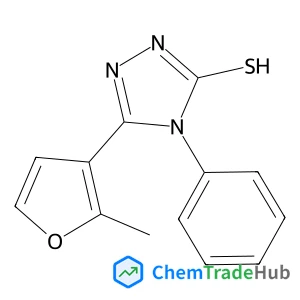
5-(2-Methyl-3-furyl)-4-phenyl-2,4-dihydro-3H-1,2,4-triazole-3-thione
CAS Number:
346464-59-3
Molecular Formula:
C13H11N3OS
Recommended Suppliers





Disclaimer
This page provides academic journal information for reference and research purposes only. We are not affiliated with any journal publishers and do not handle publication submissions. For publication-related inquiries, please contact the respective journal publishers directly.
If you notice any inaccuracies in the information displayed, please contact us at support@chemtradehub.com. We will promptly review and address your concerns.