












Co-delivery of doxorubicin and methotrexate by dendritic chitosan-g-mPEG as a magnetic nanocarrier for multi-drug delivery in combination chemotherapy
Literature Information
Publication Date
2017-11-03
DOI
10.1039/C7PY01701D
Impact Factor
5.582
Authors
Mahdi Rahimi, Kazem D. Safa, Roya Salehi
View Original
Abstract
Nanoparticulate drug delivery systems have the potential to improve the therapeutic efficacy of anticancer agents, and combination therapy is a promising strategy for clinical cancer treatment with synergistic effects. The purpose of this report is to evaluate a smart, biocompatible, magnetic nanocarrier for the intracellular co-delivery of doxorubicin (DOX) and methotrexate (MTX) to the MCF7 cell line. Since dendritic architecture based nanoparticles can load high doses of drugs with various properties, we evaluated dendritic chitosan grafted mPEG coated magnetic nanoparticles (DPC@MNPs) as a magnetic nanocarrier that has potential in multi-drug delivery. DPC@MNPs with high encapsulation efficiencies of 95.96% for DOX and 67.91% for MTX, has shown controlled and pH-dependent behaviour with tumor target release. After confirmation of the nanocarrier biocompatibility with human red blood cells by hemolysis assay, SDS-PAGE assay was performed to simulate how the nanocarrier interacts with proteins that exist in the blood circulation systems. The results show that several proteins in human blood plasma could attach to the nanocarrier surface and provide the nanocarrier with stealth properties that are suitable for drug delivery systems. An in vitro study of cell viability showed that combination drug delivery has synergistic effects and reduces toxic side effects. Furthermore, the cytotoxicity assay of the nanocarrier to the MCF7 cell line indicated that DPC@MNPs is suitable as an anticancer drug nanocarrier. Dual-drug delivery with efficient anticancer performance was also confirmed by DAPI staining, cellular uptake, cell cycle, and apoptosis analysis, compared to free dual anticancer drugs. To assess the healthy, apoptotic, and necrotic cells, DAPI staining and apoptosis analysis by flow-cytometry were conducted and all data showed that the apoptotic effects of the drug-loaded nanocarrier are higher in comparison to the corresponding free drugs. Cellular uptake was also examined to validate the internalization of the nanocarrier in the cells and the results have shown that a high uptake percentage was observed within 3 h. Finally, the side effects of the drug-loaded nanocarrier and free drugs were assessed using the mouse model and it was concluded that this combination therapy offers a promising approach to cancer treatment and can be used for further in vivo applications.
Related Literature
A new organic superconductor, (DODHT)2BF4·H2O
Hiroyuki Nishikawa, Asami Machida, Takanobu Morimoto, Koichi Kikuchi, Takeshi Kodama, Isao Ikemoto, Jun-ichi Yamada, Harukazu Yoshino, Keizo Murata
2003-01-27
Communication
DOI: 10.1039/B211275B
Synthesis, spectral and electrochemical investigations of bichromophoric pentads possessing tetraazaporphyrin and (bipy)2RuII/(phen)2RuII moieties
Rajendra Prasad, Elisa Murguly, Neil R. Branda
2003-01-27
Communication
DOI: 10.1039/B209812A
TEM stereo-imaging of mesoporous zeolite single crystals
Iver Schmidt, Anna Carlsson, Søren Dahl, Michael Brorson, Claus J. H. Jacobsen
2003-03-14
Communication
DOI: 10.1039/B212646J
Anion-directed assembly: the first fluoride-directed double helix
Simon J. Coles, Jeremy G. Frey, Philip A. Gale, Michael B. Hursthouse, Mark E. Light, Korakot Navakhun, Gemma L. Thomas
2003-02-04
Communication
DOI: 10.1039/B210847J
Homolytic 1,5-transfer of chiral organosilicon groups from an enoxy oxygen to an alkoxy oxygen—implications for mechanism
Sonia M. Horvat, Sunggak Kim, Carl H. Schiesser
2003-04-16
Communication
DOI: 10.1039/B302307A
Novel and efficient chiral sulfideoxathiane ligands for palladium-catalyzed asymmetric allylic alkylation
Yuko Okuyama, Hiroto Nakano, Kouichi Takahashi, Hiroshi Hongo, Chizuko Kabuto
2003-01-17
Communication
DOI: 10.1039/B211031H
A quasi-covalent metal–metal bond in an early–late heterobimetallic Ti–Pt complex stabilized by phosphinoenolate ligands‡
Pierre Braunstein, Xavier Morise, Marc Bénard, Marie-Madeleine Rohmer, Richard Welter
2003-02-03
Communication
DOI: 10.1039/B211289M
Enhancement of facilitated olefin transport by amino acid in silver–polymer complex membranes
Sang Wook Kang, Jong Hak Kim, Jongok Won, Kookheon Char, Yong Soo Kang
2003-02-25
Communication
DOI: 10.1039/B211933A
Reductive cleavage of the C–O bond of acetals and orthoesters: reduction by silane in the presence of a Rh–PPh3 complex
Tetsuo Ohta, Tsugumi Michibata, Kazuyuki Yamada, Ryohei Omori, Isao Furukawa
2003-04-17
Communication
DOI: 10.1039/B302124F
Non-covalent switch for intramolecular energy transfer
Joe Otsuki, Akane Yasuda, Toshio Takido
2003-02-05
Communication
DOI: 10.1039/B212912D
You might also like
Compound Q&A
What precautions should be taken when handling 4-(2-Furylmethyl)thiomorpholine 1,1-dioxide (CAS: 79206-94-3)?
When handling 4-(2-Furylmethyl)thiomorpholine 1,1-dioxide (CAS: 79206-94-3), it ...
79206-94-34-(2-Furylmethyl)thi...
Compound Q&A
What precautions should be taken when handling 4-Chloro-N-[2-(4-morpholinyl)ethyl]benzamide (CAS: 71320-77-9)?
When handling 4-Chloro-N-[2-(4-morpholinyl)ethyl]benzamide (CAS: 71320-77-9), it...
71320-77-94-Chloro-N-[2-(4-mor...
Compound Q&A
How should waste containing 2-[2-(2-Methoxyethoxy)ethoxy]ethyl 4-methylbenzenesulfonate (CAS: 62921-74-8) be handled?
Waste containing this compound (CAS: 62921-74-8) should be handled according to ...
62921-74-82-[2-(2-Methoxyethox...
Compound Q&A
How should waste containing (S)-Methyl 2-amino-3-cyclohexylpropanoate be handled?
Waste containing (S)-Methyl 2-amino-3-cyclohexylpropanoate should be collected i...
40056-18-6(S)-Methyl 2-amino-3...
Compound Q&A
How is 5-({4-[(2S,4R)-4-Hydroxy-2-methyltetrahydro-2H-pyran-4-yl]-2-thienyl}sulfanyl)-1-methyl-1,3-dihydro-2H-indol-2-one (CAS: 166882-70-8) typically synthesized?
This compound can be synthesized using a multi-step process involving the conjug...
166882-70-85-({4-[(2S,4R)-4-Hyd...
Compound Q&A
Are there alternatives to (2E)-3-(3,4-Dichlorophenyl)acrylic acid (CAS: 7312-27-8) in synthesis?
There are several alternatives to (2E)-3-(3,4-Dichlorophenyl)acrylic acid in syn...
7312-27-8(2E)-3-(3,4-Dichloro...
Compound Q&A
How should Ethyl 6-(2-nitrophenyl)imidazo[2,1-b][1,3]thiazole-3-carboxylate (CAS: 925437-84-9) be stored?
Ethyl 6-(2-nitrophenyl)imidazo[2,1-b][1,3]thiazole-3-carboxylate (CAS: 925437-84...
925437-84-9Ethyl 6-(2-nitrophen...
Compound Q&A
How should waste containing 2-(1,3-Thiazol-2-yl)ethanamine (CAS: 18453-07-1) be handled?
Waste containing 2-(1,3-Thiazol-2-yl)ethanamine (CAS: 18453-07-1) should be coll...
18453-07-12-(1,3-Thiazol-2-yl)...
Compound Q&A
How is Methyl 5-iodo-2-methylbenzoate (CAS: 103440-54-6) typically synthesized?
Methyl 5-iodo-2-methylbenzoate can be synthesized through the iodination of meth...
103440-54-6Methyl 5-iodo-2-meth...
Compound Q&A
How is 5-Chloro[1,2,4]triazolo[1,5-a]pyridine (CAS: 1427399-34-5) typically synthesized?
5-Chloro[1,2,4]triazolo[1,5-a]pyridine is commonly synthesized via the condensat...
1427399-34-55-Chloro[1,2,4]triaz...
Source Journal
Polymer Chemistry

CiteScore:
8.6
Self-citation Rate:
7.3%
Articles per Year:
457
Polymer Chemistry welcomes submissions in all areas of polymer science that have a strong focus on macromolecular chemistry. Manuscripts may cover a broad range of fields, yet no direct application focus is required.
Recommended Compounds
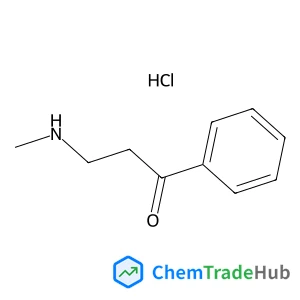
3-(Methylamino)-1-phenyl-1-propanone hydrochloride (1:1)
CAS Number:
2538-50-3
Molecular Formula:
C10H14ClNO

Recommended Suppliers




Disclaimer
This page provides academic journal information for reference and research purposes only. We are not affiliated with any journal publishers and do not handle publication submissions. For publication-related inquiries, please contact the respective journal publishers directly.
If you notice any inaccuracies in the information displayed, please contact us at support@chemtradehub.com. We will promptly review and address your concerns.