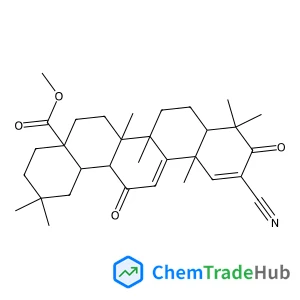
Methyl 2-cyano-3,12-dioxooleana-1,9(11)-dien-28-oate
CAS Number:
218600-53-4
Molecular Formula:
C32H43NO4
Tetsuo Ohta, Tsugumi Michibata, Kazuyuki Yamada, Ryohei Omori, Isao Furukawa
Reductions of acetals to ethers and of orthoester to acetal by hydrosilane using rhodium catalyst are described.
Susanna L. Stephens, David P. Tew, Nicholas R. Walker, Anthony C. Legon
DOI: 10.1039/C6CP03512D
Shivnetra Saha, Shashank Deep
DOI: 10.1039/C6CP02906J
Matthew Becton, Xianqiao Wang
DOI: 10.1039/C5CP03460D
M. Rauhalahti, A. Muñoz-Castro, D. Sundholm
DOI: 10.1039/C6CP03808E
Jeng-Lung Chen, Chi-Liang Chen, Jyh-Fu Lee, Jin-Ming Chen, Yu-Chen Tsai, Ping-Hung Yeh, Wu Ching Chou, Chung-Li Dong
DOI: 10.1039/C6CP01192F
Xiang Li, Aiwen Qin, Xinzhen Zhao, Dapeng Liu, Haiye Wang, Chunju He
DOI: 10.1039/C5CP02498F
M. H. Yang, Y. Li, J. H. Li, B. X. Liu
DOI: 10.1039/C6CP90176J
Chunya Wu, Mingjun Chen, Yu Zhang, Peter T. Cummings
DOI: 10.1039/C6CP03046G
Tamara Husch, Martin Korth
DOI: 10.1039/C5CP02937F
Judy Gopal, Manikandan Muthu, Sechul Chun
DOI: 10.1039/C6CP03478K
When handling 4-(2-Furylmethyl)thiomorpholine 1,1-dioxide (CAS: 79206-94-3), it ...
When handling 4-Chloro-N-[2-(4-morpholinyl)ethyl]benzamide (CAS: 71320-77-9), it...
Waste containing this compound (CAS: 62921-74-8) should be handled according to ...
Waste containing (S)-Methyl 2-amino-3-cyclohexylpropanoate should be collected i...
This compound can be synthesized using a multi-step process involving the conjug...
There are several alternatives to (2E)-3-(3,4-Dichlorophenyl)acrylic acid in syn...
Ethyl 6-(2-nitrophenyl)imidazo[2,1-b][1,3]thiazole-3-carboxylate (CAS: 925437-84...
Waste containing 2-(1,3-Thiazol-2-yl)ethanamine (CAS: 18453-07-1) should be coll...
Methyl 5-iodo-2-methylbenzoate can be synthesized through the iodination of meth...
5-Chloro[1,2,4]triazolo[1,5-a]pyridine is commonly synthesized via the condensat...

ChemComm publishes urgent research which is of outstanding significance and interest to experts in the field, while also appealing to the journal’s broad chemistry readership. Our communication format is ideally suited to short, urgent studies that are of such importance that they require accelerated publication. Our scope covers all topics in chemistry, and research at the interface of chemistry and other disciplines (such as materials science, nanoscience, physics, engineering and biology) where there is a significant novelty in the chemistry aspects. Major topic areas covered include: Analytical Chemistry Catalysis Chemical Biology and medicinal chemistry Computational Chemistry and Machine Learning Energy and sustainable chemistry Environmental Chemistry Green Chemistry Inorganic Chemistry Materials Chemistry Nanoscience Organic Chemistry Physical Chemistry Polymer Chemistry Supramolecular Chemistry
![N-[(Benzyloxy)carbonyl]serine structure](https://static.chemtradehub.com/structs/276/2768-56-1-77f7.webp "N-[(Benzyloxy)carbonyl]serine structure")