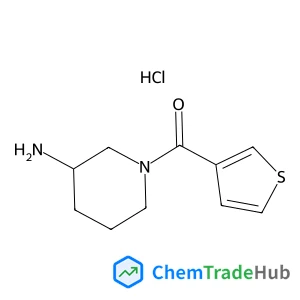
(3-Amino-piperidin-1-yl)-thiophen-3-yl-methanone hydrochloride
CAS Number:
1185316-70-4
Molecular Formula:
C10H15ClN2OS
Xiao-hui Liu, Qiu-yan Zhang, Wen-li Di, Yan-guang Zhang, Chen Ding
Reverse atom transfer radical polymerization (R-ATRP) and ring-opening polymerization (ROP) are the two representative processes of the most promising living/controlled polymerization techniques. Herein, a facile and stable metal catalyst, Cu(S(SC)(N–CH3)CH2CH2OH)2, containing a hydroxyl group was first designed with an aim to prepare block copolymers of vinyl monomer and cyclic ester monomer via a combination of R-ATRP and ROP. The vinyl polymer chain end attached with a hydroxyl functionality obtained from R-ATRP was directly used as a macroinitiator to prepare the block copolymers via ROP of ε-caprolactone. 1H NMR and GPC analyses as well as ROP chain-extension reaction confirmed that the vinyl polymers possessed very high chain end functionality, and the block copolymers of the vinyl monomer and cyclic ester monomer were successfully synthesized.

Physical Chemistry Chemical Physics

Mini-Reviews in Medicinal Chemistry

Journal of Medical Biochemistry

Molecules

Journal of Enzyme inhibition and Medicinal Chemistry

European Journal of Organic Chemistry

Lab on a Chip

Angewandte Chemie International Edition

Current Pharmaceutical Biotechnology

Foundations of Chemistry
M. Jotkar, L. Rongy, A. De Wit
DOI: 10.1039/C9CP03044A
Paulo R. Bueno, Robert Hein, Adriano Santos, Jason J. Davis
DOI: 10.1039/C9CP05543F
M. P. Dvores, P. Çarçabal, P. Maître, J. P. Simons
DOI: 10.1039/C9CP06572E
Earl Matthew Davis, Giulia Berti, Helmut Kuhlenbeck, Vedran Vonk, Hans-Joachim Freund
DOI: 10.1039/C9CP04157E
Shuaihua Lu, Chuanfu Li, Chonggui Zhong, Zhiyun Zhao, Lihua Qu, Yi Min, Na Zhang, Jun-Ming Liu
DOI: 10.1039/C9CP03675J
Xiaolu Xiong, Guangshi Li, Hongwei Cheng, Qian Xu
DOI: 10.1039/D0CP00197J
Alireza Mashaghi
DOI: 10.1039/C9CP03175H
Artur Nowak, Paweł Tecmer, Katharina Boguslawski
DOI: 10.1039/C9CP03678D
Hongxia Zhu, Xiaolei Zhao, Huanhuan Li
DOI: 10.1039/C9CP06425G
When handling 2-Methyl-2-propanyl 5-amino-2-thiophenecarboxylate (CAS: 1498311-5...
5-Bromo-1,2-dichloro-3-fluorobenzene (CAS: 1000572-93-9) is a crystalline solid ...
(2R)-2-Amino-2-(4-bromophenyl)ethanol (CAS: 354153-64-3) should be stored in a c...
Methyl 4-(aminomethyl)tetrahydro-2H-pyran-4-carboxylate hydrochloride (CAS: 3627...
1,4-Dimethyl-1H-pyrazole-5-sulfonyl chloride is primarily used as an intermediat...
Dinaphtho[1,2-b:2',1'-d]furan is generally safe when handled with appropriate pe...
The market for 7-Methyl-7,9-dihydro-1H-purine-2,6,8(3H)-trione (CAS: 612-37-3) i...
2-(4-Chlorophenyl)malonaldehyde (CAS: 205676-17-1) is a colorless or light yello...
2-Methylchrysene (CAS: 3351-32-4) is typically synthesized via the reaction of c...
N-(6-aminopyrimidin-4-yl)acetamide (CAS: 89533-23-3) is generally considered saf...

Polymer Chemistry welcomes submissions in all areas of polymer science that have a strong focus on macromolecular chemistry. Manuscripts may cover a broad range of fields, yet no direct application focus is required.
![N-[(1-Ethyl-2-pyrrolidinyl)methyl]-2-hydroxy-5-sulfamoylbenzamide structure](https://static.chemtradehub.com/structs/673/67381-52-6-877f.webp "N-[(1-Ethyl-2-pyrrolidinyl)methyl]-2-hydroxy-5-sulfamoylbenzamide structure")