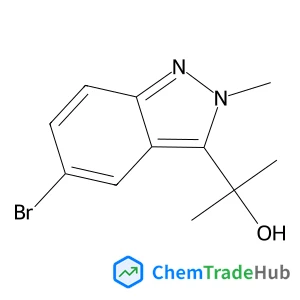
2-(5-Bromo-2-methyl-2H-indazol-3-yl)-2-propanol
CAS Number:
1823787-20-7
Molecular Formula:
C11H13BrN2O
M. P. Dvores, P. Çarçabal, P. Maître, J. P. Simons
Protonated intermediates are postulated to be involved in the rate determining step of many sugar reactions. This paper presents a study of protonated sugar species, isolated in the gas phase, using a combination of infrared multiple photon dissociation (IRMPD) spectroscopy, classical ab initio molecular dynamics (AIMD) and quantum mechanical vibrational self-consistent field (VSCF) calculations. It provides a likely identification of the reactive intermediate oxocarbenium ion structure in a D-galactosyl system as well as the saccharide pyrolysis product anhydrogalactose (that suggests oxocarbenium ion stabilization), along with the spectrum of the protonated parent species: methyl D-galactopyranoside-H+. Its vibrational fingerprint indicates intramolecular proton sharing. Classical AIMD simulations for galactosyl oxocarbenium ions, conducted in the temperature range ∼300–350 K (using B3LYP potentials on-the-fly) reveal efficient transitions on the picosecond timescale. Multiple conformers are likely to exist under the experimental conditions and along with static VSCF calculations, they have facilitated the identification of the individual structural motifs of the galactosyl oxocarbenium ion and protonated anhydrogalactose ion conformers that contribute to the observed experimental spectra. These results demonstrate the power of experimental IRMPD spectroscopy combined with dynamics simulations and with computational spectroscopy at the anharmonic level to unravel conformer structures of protonated saccharides, and to provide information on their lifetimes.
Christophe Barnier Quer, Hana Robson Marsden, Stefan Romeijn, Harshal Zope, Alexander Kros, Wim Jiskoot
DOI: 10.1039/C1PY00010A
Alexander W. Jackson, Christopher Stakes, David A. Fulton
DOI: 10.1039/C1PY00261A
Marc A. Hillmyer
DOI: 10.1039/C1PY00147G
Nicolas Blanchard
DOI: 10.1039/C1PY00231G
Ken Okamoto, Christine K. Luscombe
DOI: 10.1039/C1PY00171J
Mohammed Hashem, C. Grazia Bezzu, Benson M. Kariuki, Neil B. McKeown
DOI: 10.1039/C1PY00288K
Didier Gigmes, Pierre-Emmanuel Dufils, David Glé, Denis Bertin, Catherine Lefay, Yohann Guillaneuf
DOI: 10.1039/C1PY00057H
When handling 2-Methyl-2-propanyl 5-amino-2-thiophenecarboxylate (CAS: 1498311-5...
5-Bromo-1,2-dichloro-3-fluorobenzene (CAS: 1000572-93-9) is a crystalline solid ...
(2R)-2-Amino-2-(4-bromophenyl)ethanol (CAS: 354153-64-3) should be stored in a c...
Methyl 4-(aminomethyl)tetrahydro-2H-pyran-4-carboxylate hydrochloride (CAS: 3627...
1,4-Dimethyl-1H-pyrazole-5-sulfonyl chloride is primarily used as an intermediat...
Dinaphtho[1,2-b:2',1'-d]furan is generally safe when handled with appropriate pe...
The market for 7-Methyl-7,9-dihydro-1H-purine-2,6,8(3H)-trione (CAS: 612-37-3) i...
2-(4-Chlorophenyl)malonaldehyde (CAS: 205676-17-1) is a colorless or light yello...
2-Methylchrysene (CAS: 3351-32-4) is typically synthesized via the reaction of c...
N-(6-aminopyrimidin-4-yl)acetamide (CAS: 89533-23-3) is generally considered saf...

Physical Chemistry Chemical Physics (PCCP) is an international journal co-owned by 19 physical chemistry and physics societies from around the world. This journal publishes original, cutting-edge research in physical chemistry, chemical physics and biophysical chemistry. To be suitable for publication in PCCP, articles must include significant innovation and/or insight into physical chemistry; this is the most important criterion that reviewers and Editors will judge against when evaluating submissions. The journal has a broad scope and welcomes contributions spanning experiment, theory, computation and data science. Topical coverage includes spectroscopy, dynamics, kinetics, statistical mechanics, thermodynamics, electrochemistry, catalysis, surface science, quantum mechanics, quantum computing and machine learning. Interdisciplinary research areas such as polymers and soft matter, materials, nanoscience, energy, surfaces/interfaces, and biophysical chemistry are welcomed if they demonstrate significant innovation and/or insight into physical chemistry. Joined experimental/theoretical studies are particularly appreciated when complementary and based on up-to-date approaches.