


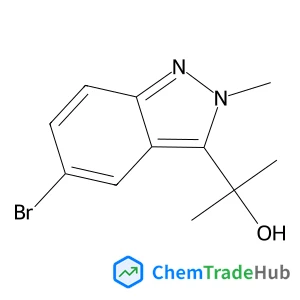
2-(5-Bromo-2-methyl-2H-indazol-3-yl)-2-propanol
CAS Number:
1823787-20-7
Molecular Formula:
C11H13BrN2O
Hongxia Zhu, Xiaolei Zhao, Huanhuan Li
To improve the quality of chemical vapor deposition (CVD)-prepared hexagonal boron nitride (h-BN), it is essential to understand the growth mechanism, particularly to learn the structures as well as their stabilities and kinetic evolutions of the formed clusters in the initial growth stage. Herein, we performed systematic studies on the stabilities of various geometries of different-/identical-sized BN clusters on (111) surfaces of Ni and Cu by density functional theory simulations. The results show that the stable configurations of different-sized clusters are those containing the most normal hexagons composed with alternate B and N atoms. There exist ultra-stable magic clusters on the (111) surfaces of both the metals. On Ni(111), the geometries of the magic clusters are composed of hexagons arranged in the core–shell structure, while they contain tetragons on the Cu(111) surface. The ultra-high stabilities of the magic clusters can be attributed to the comprehensive effect from the core–shell structure, high symmetry, edged atoms, and adsorption sites. The stable geometries of different-sized clusters as well as magic clusters present the vital roles of metal substrates in CVD-synthesis of h-BN and provide instructive information in improving the quality of h-BN by selecting appropriate metal substrates.

Applied Composite Materials

Advances in Cement Research

Construction and Building Materials

Journal of Physical Organic Chemistry

Computational Materials Science

Heterocyclic Communications

Journal of Computer-Aided Molecular Design

Bio-Medical Materials and Engineering

Cement and Concrete Composites

Chemistry of Materials
Weiping Gao, Donghua Xu, Dong Woo Lim, Stephen L. Craig, Ashutosh Chilkoti
DOI: 10.1039/C1PY00074H
Andreas S. Lang, Mukundan Thelakkat
DOI: 10.1039/C1PY00191D
Mathieu Arseneault, Philippe Dufour, Isabelle Levesque, Jean-François Morin
DOI: 10.1039/C1PY00146A
Feiyao Qing, Xiaochen Wang, Na Li, Yongfang Li, Xiaoyu Li, Haiqiao Wang
DOI: 10.1039/C1PY00192B
Martin Helgesen, Morten V. Madsen, Birgitta Andreasen, Thomas Tromholt, Jens W. Andreasen, Frederik C. Krebs
DOI: 10.1039/C1PY00323B
Markus Döbbelin, Irantzu Llarena, Luis J. Claros Marfil, Germán Cabañero, Javier Rodriguez, David Mecerreyes
DOI: 10.1039/C1PY00044F
Shi-Min Shau, Tzong-Yuan Juang, Wei-He Ting, Min-Yu Wu, Shenghong A. Dai
DOI: 10.1039/C1PY00238D
Katja Skrabania, Anna Miasnikova, Achille Mayelle Bivigou-Koumba, Daniel Zehm
DOI: 10.1039/C1PY00173F
When handling 2-Methyl-2-propanyl 5-amino-2-thiophenecarboxylate (CAS: 1498311-5...
5-Bromo-1,2-dichloro-3-fluorobenzene (CAS: 1000572-93-9) is a crystalline solid ...
(2R)-2-Amino-2-(4-bromophenyl)ethanol (CAS: 354153-64-3) should be stored in a c...
Methyl 4-(aminomethyl)tetrahydro-2H-pyran-4-carboxylate hydrochloride (CAS: 3627...
1,4-Dimethyl-1H-pyrazole-5-sulfonyl chloride is primarily used as an intermediat...
Dinaphtho[1,2-b:2',1'-d]furan is generally safe when handled with appropriate pe...
The market for 7-Methyl-7,9-dihydro-1H-purine-2,6,8(3H)-trione (CAS: 612-37-3) i...
2-(4-Chlorophenyl)malonaldehyde (CAS: 205676-17-1) is a colorless or light yello...
2-Methylchrysene (CAS: 3351-32-4) is typically synthesized via the reaction of c...
N-(6-aminopyrimidin-4-yl)acetamide (CAS: 89533-23-3) is generally considered saf...

Physical Chemistry Chemical Physics (PCCP) is an international journal co-owned by 19 physical chemistry and physics societies from around the world. This journal publishes original, cutting-edge research in physical chemistry, chemical physics and biophysical chemistry. To be suitable for publication in PCCP, articles must include significant innovation and/or insight into physical chemistry; this is the most important criterion that reviewers and Editors will judge against when evaluating submissions. The journal has a broad scope and welcomes contributions spanning experiment, theory, computation and data science. Topical coverage includes spectroscopy, dynamics, kinetics, statistical mechanics, thermodynamics, electrochemistry, catalysis, surface science, quantum mechanics, quantum computing and machine learning. Interdisciplinary research areas such as polymers and soft matter, materials, nanoscience, energy, surfaces/interfaces, and biophysical chemistry are welcomed if they demonstrate significant innovation and/or insight into physical chemistry. Joined experimental/theoretical studies are particularly appreciated when complementary and based on up-to-date approaches.
![3-(benzotriazol-1-yl)-N-[[2-[(3-bromophenyl)methoxy]phenyl]methylideneamino]propanamide structure](https://static.chemtradehub.com/structs/559/5595-78-8-0a32.webp "3-(benzotriazol-1-yl)-N-[[2-[(3-bromophenyl)methoxy]phenyl]methylideneamino]propanamide structure")

![2-Bromo-7-chloro-4H-pyrrolo[2,3-b]pyrazine structure](https://static.chemtradehub.com/structs/115/1150617-58-5-0b0a.webp "2-Bromo-7-chloro-4H-pyrrolo[2,3-b]pyrazine structure")





