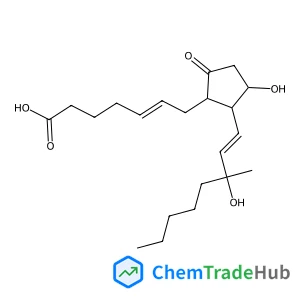
(5Z,11alpha,13E,15R)-11,15-Dihydroxy-15-methyl-9-oxoprosta-5,13-dien-1-oic acid
CAS Number:
55028-70-1
Molecular Formula:
C21H34O5
Artur Nowak, Paweł Tecmer, Katharina Boguslawski
We scrutinize the performance of different variants of equation of motion coupled cluster (EOM-CC) methods to predict electronic excitation energies and excited state potential energy surfaces in closed-shell actinide species. We focus our analysis on various recently presented pair coupled cluster doubles (pCCD) models [J. Chem. Phys., 2016, 23, 234105 and J. Chem. Theory Comput., 2019, 15, 18–24] and compare their performance to the conventional EOM-CCSD approach and to the completely renormalized EOM-CCSD with perturbative triples ansatz. Since the single-reference pCCD model allows us to efficiently describe static/nondynamic electron correlation, while dynamical electron correlation is accounted for a posteriori, the investigated pCCD-based methods represent a good compromise between accuracy and computational cost. Such a feature is particularly advantageous when modelling electronic structures of actinide-containing compounds with stretched bonds. Our work demonstrates that EOM-pCCD-based methods reliably predict electronic spectra of small actinide building blocks containing thorium, uranium, and protactinium atoms. Specifically, the standard errors in adiabatic and vertical excitation energies obtained by the conventional EOM-CCSD approach are reduced by a factor of 2 when employing the EOM-pCCD-LCCSD variant resulting in a mean error of 0.05 eV and a standard deviation of 0.25 eV.
Maša Hren, Mojca Božič, Darinka Fakin
DOI: 10.1039/D0SE01373K
Ridwanur Chowdhury, Yan Zhao, Xinhua Liu, Nigel Brandon
DOI: 10.1039/D0SE01611J
Feiyun Li, Feiyang Qin, Cheng Cai, Yuxia Pang, Weifeng Liu, Qiong Li, Xueqing Qiu
DOI: 10.1039/D0SE01158D
Haifang Mao, Hongzhao Wang, Ting Tang, Qixuan Shi, Haiyan Yu, Xiaojun Hu, Zuobing Xiao, Pingyi Zhang, Jibo Liu
DOI: 10.1039/D1SE00011J
Ganesh Sunil More, Rajendra Srivastava
DOI: 10.1039/D0SE01912G
Yukesh Kannah R., Kavitha S., Sivashanmugam P., Gopalakrishnan Kumar, Rajesh Banu J.
DOI: 10.1039/D0SE01814G
Chaokun Yang, Yanglin Chen, Ye Qu, Jiaxu Zhang, Jianmin Sun
DOI: 10.1039/D0SE01293A
Ramón Arcas, Eduardo Peris, Elena Mas-Marzá, Francisco Fabregat-Santiago
DOI: 10.1039/D0SE01322F
When handling 2-Methyl-2-propanyl 5-amino-2-thiophenecarboxylate (CAS: 1498311-5...
5-Bromo-1,2-dichloro-3-fluorobenzene (CAS: 1000572-93-9) is a crystalline solid ...
(2R)-2-Amino-2-(4-bromophenyl)ethanol (CAS: 354153-64-3) should be stored in a c...
Methyl 4-(aminomethyl)tetrahydro-2H-pyran-4-carboxylate hydrochloride (CAS: 3627...
1,4-Dimethyl-1H-pyrazole-5-sulfonyl chloride is primarily used as an intermediat...
Dinaphtho[1,2-b:2',1'-d]furan is generally safe when handled with appropriate pe...
The market for 7-Methyl-7,9-dihydro-1H-purine-2,6,8(3H)-trione (CAS: 612-37-3) i...
2-(4-Chlorophenyl)malonaldehyde (CAS: 205676-17-1) is a colorless or light yello...
2-Methylchrysene (CAS: 3351-32-4) is typically synthesized via the reaction of c...
N-(6-aminopyrimidin-4-yl)acetamide (CAS: 89533-23-3) is generally considered saf...

Physical Chemistry Chemical Physics (PCCP) is an international journal co-owned by 19 physical chemistry and physics societies from around the world. This journal publishes original, cutting-edge research in physical chemistry, chemical physics and biophysical chemistry. To be suitable for publication in PCCP, articles must include significant innovation and/or insight into physical chemistry; this is the most important criterion that reviewers and Editors will judge against when evaluating submissions. The journal has a broad scope and welcomes contributions spanning experiment, theory, computation and data science. Topical coverage includes spectroscopy, dynamics, kinetics, statistical mechanics, thermodynamics, electrochemistry, catalysis, surface science, quantum mechanics, quantum computing and machine learning. Interdisciplinary research areas such as polymers and soft matter, materials, nanoscience, energy, surfaces/interfaces, and biophysical chemistry are welcomed if they demonstrate significant innovation and/or insight into physical chemistry. Joined experimental/theoretical studies are particularly appreciated when complementary and based on up-to-date approaches.
![2-Bromo-7-chloro-4H-pyrrolo[2,3-b]pyrazine structure](https://static.chemtradehub.com/structs/115/1150617-58-5-0b0a.webp "2-Bromo-7-chloro-4H-pyrrolo[2,3-b]pyrazine structure")