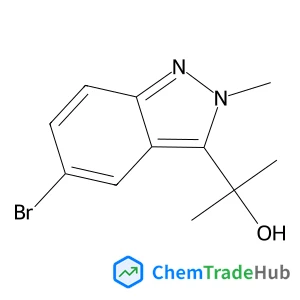
2-(5-Bromo-2-methyl-2H-indazol-3-yl)-2-propanol
CAS Number:
1823787-20-7
Molecular Formula:
C11H13BrN2O
Shuaihua Lu, Chuanfu Li, Chonggui Zhong, Zhiyun Zhao, Lihua Qu, Yi Min, Na Zhang, Jun-Ming Liu
Using first-principles calculations, we investigate the structural, electronic, and magnetic properties of perovskite LaMO3/YMO3 superlattices (M = Cr, Mn, Co and Ni). It is found that ferroelectricity can emerge in LaMO3/YMO3 superlattices (M = Cr, Mn, Co), allowing them to be promising multiferroic candidates, while no ferroelectricity is found in the LaNiO3/YNiO3 superlattice. The electronic structure calculations indicate that the LaCrO3/YCrO3, LaMnO3/YMnO3, and LaCoO3/YCoO3 superlattices are insulators, and their magnetic ground states exhibit G-type antiferromagnetic (AFM), A-type AFM, and G-type AFM order, respectively, while the LaNiO3/YNiO3 superlattice is however a half-metallic ferromagnet. The electronic structure and magnetic ground state are discussed, based on the projected density of states data and Heisenberg model, respectively, and the magnetic phase transition temperature is evaluated based on mean-field theory. In the meantime, the spontaneous ferroelectric polarization of the LaMO3/YMO3 superlattices (M = Cr, Mn, Co) is determined respectively using the Born effective charge model and Berry phase method, and their hybrid improper ferroelectric character is predicted, with the net polarization mainly from the different displacements of the LaO layers and YO layers along the b-axis. It is suggested that alternative multiferroic materials can be obtained by properly designing superlattices that consist of two non-polar magnetic materials but exhibit tunable magnetic ground states and transition temperature and hybrid improper ferroelectricity.
Ramón Arcas, Eduardo Peris, Elena Mas-Marzá, Francisco Fabregat-Santiago
DOI: 10.1039/D0SE01322F
Muye Liu, Yue Wen, Luhua Lu, Ying Chen, Xiaocong Tian, Hongyun Jin, Jinghai Liu, Kai Dai
DOI: 10.1039/D0SE01828G
Chaokun Yang, Yanglin Chen, Ye Qu, Jiaxu Zhang, Jianmin Sun
DOI: 10.1039/D0SE01293A
Alessio Zuliani, Manuel Cano, Federica Calsolaro, Alain R. Puente Santiago, Juan J. Giner-Casares, Enrique Rodríguez-Castellón, Gloria Berlier, Giancarlo Cravotto, Katia Martina
DOI: 10.1039/D0SE01505A
Kalliopi Ladomenou, Georgios Landrou, Georgios Charalambidis, Emmanouil Nikoloudakis, Athanassios G. Coutsolelos
DOI: 10.1039/D0SE01630F
Guoqiang Ding, Xianqing Li
DOI: 10.1039/D0SE01776K
Santosh K. Singh, Kotaro Takeyasu, Bappi Paul, Sachin K. Sharma, Junji Nakamura
DOI: 10.1039/D0SE01285H
Isabelle Heath-Apostolopoulos, Diego Vargas-Ortiz, Liam Wilbraham, Kim E. Jelfs, Martijn A. Zwijnenburg
DOI: 10.1039/D0SE00985G
Guiyun Lin, Long Sun, Guocheng Huang, Qiaoshan Chen, Shengqiong Fang, Ling Wu
DOI: 10.1039/D0SE01504K
Peyman Z. Moghadam
DOI: 10.1039/D0SE01824D
When handling 2-Methyl-2-propanyl 5-amino-2-thiophenecarboxylate (CAS: 1498311-5...
5-Bromo-1,2-dichloro-3-fluorobenzene (CAS: 1000572-93-9) is a crystalline solid ...
(2R)-2-Amino-2-(4-bromophenyl)ethanol (CAS: 354153-64-3) should be stored in a c...
Methyl 4-(aminomethyl)tetrahydro-2H-pyran-4-carboxylate hydrochloride (CAS: 3627...
1,4-Dimethyl-1H-pyrazole-5-sulfonyl chloride is primarily used as an intermediat...
Dinaphtho[1,2-b:2',1'-d]furan is generally safe when handled with appropriate pe...
The market for 7-Methyl-7,9-dihydro-1H-purine-2,6,8(3H)-trione (CAS: 612-37-3) i...
2-(4-Chlorophenyl)malonaldehyde (CAS: 205676-17-1) is a colorless or light yello...
2-Methylchrysene (CAS: 3351-32-4) is typically synthesized via the reaction of c...
N-(6-aminopyrimidin-4-yl)acetamide (CAS: 89533-23-3) is generally considered saf...

Physical Chemistry Chemical Physics (PCCP) is an international journal co-owned by 19 physical chemistry and physics societies from around the world. This journal publishes original, cutting-edge research in physical chemistry, chemical physics and biophysical chemistry. To be suitable for publication in PCCP, articles must include significant innovation and/or insight into physical chemistry; this is the most important criterion that reviewers and Editors will judge against when evaluating submissions. The journal has a broad scope and welcomes contributions spanning experiment, theory, computation and data science. Topical coverage includes spectroscopy, dynamics, kinetics, statistical mechanics, thermodynamics, electrochemistry, catalysis, surface science, quantum mechanics, quantum computing and machine learning. Interdisciplinary research areas such as polymers and soft matter, materials, nanoscience, energy, surfaces/interfaces, and biophysical chemistry are welcomed if they demonstrate significant innovation and/or insight into physical chemistry. Joined experimental/theoretical studies are particularly appreciated when complementary and based on up-to-date approaches.
![2,5-Dichloro-1H-pyrrolo[3,2-b]pyridine structure](https://static.chemtradehub.com/structs/100/1000342-87-9-f632.webp "2,5-Dichloro-1H-pyrrolo[3,2-b]pyridine structure")