


Facile construction of crosslinked anion exchange membranes based on fluorenyl-containing polysulfone via click chemistry
Literature Information
Publication Date
2017-06-27
DOI
10.1039/C7PY00789B
Impact Factor
5.582
Authors
Bo Hu, Luyang Miao, Yang Bai, Changli Lü
View Original
Abstract
A series of fluorenyl-containing polysulfone-based crosslinked anion exchange membranes with high conductivity and excellent stability were fabricated via click chemistry. Azide groups were firstly introduced into the side chains of fluorenyl-containing polysulfone via the quaternization reaction, and then the designed bifunctional crosslinking agents containing alkyne groups with different lengths and polarities (hydrophilicity) were used to construct the crosslinked structure via the click reaction between azides and alkynes. The degree of crosslinking of membranes can be adjusted by controlling the content of the crosslinking agent. The proper crosslinking of AEMs in this work can tighten the internal packing structure of membranes, which could not only enhance the mechanical strength of AEMs but also improve the fuel permeability, alkaline resistance and oxidative stability of membranes. The water uptake and swelling ratio of the crosslinked AEMs were also improved with the increase of polarity and length of crosslinking agents. The hydroxide conductivity of d-CPFSU-1 was not decreased by crosslinking rather it increased to 193.95 mS cm−1 at 80 °C due to the formation of a uniform nano-micro phase separation structure. Our study showed that AEMs with enhanced performance can be achieved by the design of crosslinking within the control of the micro-phase structure.
Recommended Journals

Organic Preparations and Procedures International

European Journal of Wood and Wood Products

Israel Journal of Chemistry

Journal of Organometallic Chemistry

Pure and Applied Chemistry

Fibre Chemistry

Kinetics and Catalysis

Molecular Pharmacology

Proceedings of the National Academy of Sciences of the United States of America

Nature
Related Literature
Design of novel nonlinear optical chromophores with multiple substitutions
Paper
DOI: 10.1039/A903535D
Interactions of photosynthetic reaction center with 2,3-dimethoxy-5-methyl-1,4-benzoquinone in reverse micelles
Gerardo Palazzo, Antonia Mallardi, Mauro Giustini, Mario Della Monica, Giovanni Venturoli
2000-08-15
Paper
DOI: 10.1039/B003905P
The interaction of nitrobenzene with the hydrate basal surface of montmorillonite: an ab initio study
Danuta Leszczynska
2000-10-04
Paper
DOI: 10.1039/B004698L
Ferritin adsorption to multicomponent monolayers: Influence of lipid charge density, miscibility and fluidity
David W. Britt, Dietmar Möbius, Vladimir Hlady
2000-09-19
Paper
DOI: 10.1039/B003608K
Trapped hydrogen atoms radiolytically formed in natural and synthetic kaolinites: an electron paramagnetic resonance study
Kazumi Toriyama, Anders Lund, Masaharu Okazaki
2000-09-20
Paper
DOI: 10.1039/B005413P
Spectroscopic evidence for adsorption-induced polymerisation of terthiophene at silver surfaces
Giuseppe Compagnini, Angela De Bonis, Rosario S. Cataliotti, Giovanni Marletta
2000-10-26
Paper
DOI: 10.1039/B005892K
Inhibition by gaseous impurities of hydrogen absorption by Pd and by internally oxidized Pd–Al alloys
Kurt L. Shanahan
2000-10-06
Paper
DOI: 10.1039/B004353M
You might also like
Compound Q&A
What precautions should be taken when handling 4-(2-Furylmethyl)thiomorpholine 1,1-dioxide (CAS: 79206-94-3)?
When handling 4-(2-Furylmethyl)thiomorpholine 1,1-dioxide (CAS: 79206-94-3), it ...
79206-94-34-(2-Furylmethyl)thi...
Compound Q&A
What precautions should be taken when handling 4-Chloro-N-[2-(4-morpholinyl)ethyl]benzamide (CAS: 71320-77-9)?
When handling 4-Chloro-N-[2-(4-morpholinyl)ethyl]benzamide (CAS: 71320-77-9), it...
71320-77-94-Chloro-N-[2-(4-mor...
Compound Q&A
How should waste containing 2-[2-(2-Methoxyethoxy)ethoxy]ethyl 4-methylbenzenesulfonate (CAS: 62921-74-8) be handled?
Waste containing this compound (CAS: 62921-74-8) should be handled according to ...
62921-74-82-[2-(2-Methoxyethox...
Compound Q&A
How should waste containing (S)-Methyl 2-amino-3-cyclohexylpropanoate be handled?
Waste containing (S)-Methyl 2-amino-3-cyclohexylpropanoate should be collected i...
40056-18-6(S)-Methyl 2-amino-3...
Compound Q&A
How is 5-({4-[(2S,4R)-4-Hydroxy-2-methyltetrahydro-2H-pyran-4-yl]-2-thienyl}sulfanyl)-1-methyl-1,3-dihydro-2H-indol-2-one (CAS: 166882-70-8) typically synthesized?
This compound can be synthesized using a multi-step process involving the conjug...
166882-70-85-({4-[(2S,4R)-4-Hyd...
Compound Q&A
Are there alternatives to (2E)-3-(3,4-Dichlorophenyl)acrylic acid (CAS: 7312-27-8) in synthesis?
There are several alternatives to (2E)-3-(3,4-Dichlorophenyl)acrylic acid in syn...
7312-27-8(2E)-3-(3,4-Dichloro...
Compound Q&A
How should Ethyl 6-(2-nitrophenyl)imidazo[2,1-b][1,3]thiazole-3-carboxylate (CAS: 925437-84-9) be stored?
Ethyl 6-(2-nitrophenyl)imidazo[2,1-b][1,3]thiazole-3-carboxylate (CAS: 925437-84...
925437-84-9Ethyl 6-(2-nitrophen...
Compound Q&A
How should waste containing 2-(1,3-Thiazol-2-yl)ethanamine (CAS: 18453-07-1) be handled?
Waste containing 2-(1,3-Thiazol-2-yl)ethanamine (CAS: 18453-07-1) should be coll...
18453-07-12-(1,3-Thiazol-2-yl)...
Compound Q&A
How is Methyl 5-iodo-2-methylbenzoate (CAS: 103440-54-6) typically synthesized?
Methyl 5-iodo-2-methylbenzoate can be synthesized through the iodination of meth...
103440-54-6Methyl 5-iodo-2-meth...
Compound Q&A
How is 5-Chloro[1,2,4]triazolo[1,5-a]pyridine (CAS: 1427399-34-5) typically synthesized?
5-Chloro[1,2,4]triazolo[1,5-a]pyridine is commonly synthesized via the condensat...
1427399-34-55-Chloro[1,2,4]triaz...
Source Journal
Polymer Chemistry

CiteScore:
8.6
Self-citation Rate:
7.3%
Articles per Year:
457
Polymer Chemistry welcomes submissions in all areas of polymer science that have a strong focus on macromolecular chemistry. Manuscripts may cover a broad range of fields, yet no direct application focus is required.
Recommended Compounds
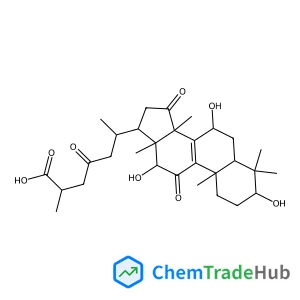
(3beta,7beta,12beta)-3,7,12-Trihydroxy-11,15,23-trioxolanost-8-en-26-oic acid
CAS Number:
98665-22-6
Molecular Formula:
C30H44O8

Recommended Suppliers





Disclaimer
This page provides academic journal information for reference and research purposes only. We are not affiliated with any journal publishers and do not handle publication submissions. For publication-related inquiries, please contact the respective journal publishers directly.
If you notice any inaccuracies in the information displayed, please contact us at support@chemtradehub.com. We will promptly review and address your concerns.