












Thin film properties and surface morphology of metal free phthalocyanine films grown by organic molecular beam deposition
Literature Information
Publication Date
DOI
10.1039/A904089G
Impact Factor
3.676
Authors
View Original
Abstract
The structure, optical properties and surface morphology of thin films of metal free phthalocyanine (H2Pc) deposited in an ultra-high vacuum environment by organic molecular beam deposition have been studied using a variety of ex-situ techniques. The growth conditions have a strong influence on the properties of the films. H2Pc undergoes a phase transition (α→β) at a deposition temperature of ∽330°C, or upon post annealing a film grown at room temperature. Both the structure and optical properties of the films change and powder X-ray diffraction, electronic absorption spectroscopy, Raman and photoluminescence spectroscopies are used to characterise the differences between the two phases. Atomic force microscopy and Nomarski interference microscopy show that the lower temperature α-phase is characterised by a smooth morphology with spherical islands that show no apparent long-range order. By contrast, the β-phase has a much greater root mean square roughness and long thin needle-like crystals are observed on the surface of the films. The morphology of the β-phase depends on the method of preparation and there are two distinct types, β1 and β2. The crystallites show a preferential orientation and alignment with respect to each other for growth at room temperature followed by annealing (β1), but are randomly oriented for films grown at elevated substrate temperatures (β2).
Related Literature
Structure and magnetism of the first strictly dinuclear compound containing paramagnetic 3d and 5f metal ions. Major influence of the CuII ion coordination on the exchange CuII–UIV interaction
Lionel Salmon, Pierre Thuéry, Eric Rivière, Jean-Jacques Girerd, Michel Ephritikhine
2003-02-25
Communication
DOI: 10.1039/B212635D
Stereoselective fluorescence quenching by photoinduced electron transfer in naphthalene-amine dyads
Sergio Abad, Miguel A. Miranda
2003-04-02
Communication
DOI: 10.1039/B301414B
Kumada–Corriu coupling of Grignard reagents, probed with a chiral Grignard reagent
Bettina Hölzer, Reinhard W. Hoffmann
2003-02-19
Communication
DOI: 10.1039/B300033H
Decorating catalytic palladium nanoparticles on carbon nanotubes in supercritical carbon dioxide
Yuehe Lin, Chien M. Wai
2003-02-10
Communication
DOI: 10.1039/B211350C
Site-selective RNA scission at two sites for precise genotyping of SNPs by mass spectrometry‡
Akinori Kuzuya, Ryo Mizoguchi, Fumi Morisawa, Makoto Komiyama
2003-02-25
Communication
DOI: 10.1039/B300368J
A new strategy towards ultra stable mesoporous titania with nanosized anatase walls
K. Cassiers, T. Linssen, V. Meynen, P. Van Der Voort, P. Cool, E. F. Vansant
2003-04-16
Communication
DOI: 10.1039/B302116E
Formation and destruction of the guanine quartet in solution observed by cold-spray ionization mass spectrometry
Shigeru Sakamoto, Isao Saito
2003-02-17
Communication
DOI: 10.1039/B212432G
Electrochemically tuneable hydrogen bonding interactions between a phenyl-urea terminated dendrimer and phenanthrenequinone
Graeme Cooke, Vladimir Sindelar, Vincent M. Rotello
2003-02-20
Communication
DOI: 10.1039/B211370H
Photoluminescent supramolecular networks from metal-mediated assembly of polythia conjugated dieneyne
Yuan-Te Fu, Vincent M. Lynch, Richard J. Lagow
2003-03-31
Communication
DOI: 10.1039/B212789J
Ion-exchange synthesis and magneto-optical spectra of colored magnetic thin films composed of metal(ii) hexacyanochromate(iii)
Masanori Tozawa, Norimichi Kojima, Kazuhito Hashimoto
2003-04-22
Communication
DOI: 10.1039/B212861F
You might also like
Compound Q&A
What precautions should be taken when handling 4-(2-Furylmethyl)thiomorpholine 1,1-dioxide (CAS: 79206-94-3)?
When handling 4-(2-Furylmethyl)thiomorpholine 1,1-dioxide (CAS: 79206-94-3), it ...
79206-94-34-(2-Furylmethyl)thi...
Compound Q&A
What precautions should be taken when handling 4-Chloro-N-[2-(4-morpholinyl)ethyl]benzamide (CAS: 71320-77-9)?
When handling 4-Chloro-N-[2-(4-morpholinyl)ethyl]benzamide (CAS: 71320-77-9), it...
71320-77-94-Chloro-N-[2-(4-mor...
Compound Q&A
How should waste containing 2-[2-(2-Methoxyethoxy)ethoxy]ethyl 4-methylbenzenesulfonate (CAS: 62921-74-8) be handled?
Waste containing this compound (CAS: 62921-74-8) should be handled according to ...
62921-74-82-[2-(2-Methoxyethox...
Compound Q&A
How should waste containing (S)-Methyl 2-amino-3-cyclohexylpropanoate be handled?
Waste containing (S)-Methyl 2-amino-3-cyclohexylpropanoate should be collected i...
40056-18-6(S)-Methyl 2-amino-3...
Compound Q&A
How is 5-({4-[(2S,4R)-4-Hydroxy-2-methyltetrahydro-2H-pyran-4-yl]-2-thienyl}sulfanyl)-1-methyl-1,3-dihydro-2H-indol-2-one (CAS: 166882-70-8) typically synthesized?
This compound can be synthesized using a multi-step process involving the conjug...
166882-70-85-({4-[(2S,4R)-4-Hyd...
Compound Q&A
Are there alternatives to (2E)-3-(3,4-Dichlorophenyl)acrylic acid (CAS: 7312-27-8) in synthesis?
There are several alternatives to (2E)-3-(3,4-Dichlorophenyl)acrylic acid in syn...
7312-27-8(2E)-3-(3,4-Dichloro...
Compound Q&A
How should Ethyl 6-(2-nitrophenyl)imidazo[2,1-b][1,3]thiazole-3-carboxylate (CAS: 925437-84-9) be stored?
Ethyl 6-(2-nitrophenyl)imidazo[2,1-b][1,3]thiazole-3-carboxylate (CAS: 925437-84...
925437-84-9Ethyl 6-(2-nitrophen...
Compound Q&A
How should waste containing 2-(1,3-Thiazol-2-yl)ethanamine (CAS: 18453-07-1) be handled?
Waste containing 2-(1,3-Thiazol-2-yl)ethanamine (CAS: 18453-07-1) should be coll...
18453-07-12-(1,3-Thiazol-2-yl)...
Compound Q&A
How is Methyl 5-iodo-2-methylbenzoate (CAS: 103440-54-6) typically synthesized?
Methyl 5-iodo-2-methylbenzoate can be synthesized through the iodination of meth...
103440-54-6Methyl 5-iodo-2-meth...
Compound Q&A
How is 5-Chloro[1,2,4]triazolo[1,5-a]pyridine (CAS: 1427399-34-5) typically synthesized?
5-Chloro[1,2,4]triazolo[1,5-a]pyridine is commonly synthesized via the condensat...
1427399-34-55-Chloro[1,2,4]triaz...
Source Journal
Physical Chemistry Chemical Physics

CiteScore:
5.5
Self-citation Rate:
10.3%
Articles per Year:
3036
Physical Chemistry Chemical Physics (PCCP) is an international journal co-owned by 19 physical chemistry and physics societies from around the world. This journal publishes original, cutting-edge research in physical chemistry, chemical physics and biophysical chemistry. To be suitable for publication in PCCP, articles must include significant innovation and/or insight into physical chemistry; this is the most important criterion that reviewers and Editors will judge against when evaluating submissions. The journal has a broad scope and welcomes contributions spanning experiment, theory, computation and data science. Topical coverage includes spectroscopy, dynamics, kinetics, statistical mechanics, thermodynamics, electrochemistry, catalysis, surface science, quantum mechanics, quantum computing and machine learning. Interdisciplinary research areas such as polymers and soft matter, materials, nanoscience, energy, surfaces/interfaces, and biophysical chemistry are welcomed if they demonstrate significant innovation and/or insight into physical chemistry. Joined experimental/theoretical studies are particularly appreciated when complementary and based on up-to-date approaches.
Recommended Compounds
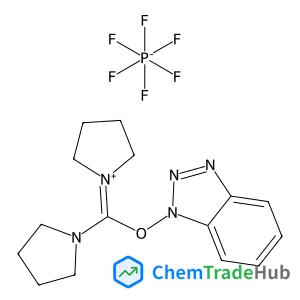
(1H-Benzotriazol-1-yloxy)(di-1-pyrrolidinyl)methylium hexafluorophosphate
CAS Number:
105379-24-6
Molecular Formula:
C15H21F6N5OP

![[4-(Heptyloxy)phenyl]boronic acid structure](https://static.chemtradehub.com/structs/136/136370-19-9-ad33.webp "[4-(Heptyloxy)phenyl]boronic acid structure")

Recommended Suppliers



Disclaimer
This page provides academic journal information for reference and research purposes only. We are not affiliated with any journal publishers and do not handle publication submissions. For publication-related inquiries, please contact the respective journal publishers directly.
If you notice any inaccuracies in the information displayed, please contact us at support@chemtradehub.com. We will promptly review and address your concerns.