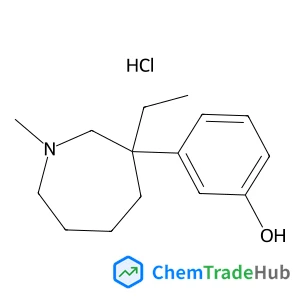
3-(3-Ethyl-1-methyl-3-azepanyl)phenol hydrochloride (1:1)
CAS Number:
59263-76-2
Molecular Formula:
C15H24ClNO
The problem of the uniqueness of parameters obtained during fitting of experimental spectra containing closely overlapping bands has been evaluated, since conventional methods of fitting do not produce reliable results. It is here shown that, despite the difficulties inherent in both the formal mathematical problem and its numerical solutions, typical and representative spectra can be resolved unambiguously within a reasonably chosen theoretical model. Reliable values of the parameters of the model, including parameters of band shape, can also be obtained. A random search method of global minimisation of a function with a significant number of arguments is derived. A program and algorithm to implement this method for spectra decomposition have been developed. The program allows the microdynamics of liquids to be obtained directly upon performing numerical Fourier transformations on a model (theoretical) time correlation function together with using model spectra obtained thereby in each fitting step. A model spectrum for any desired accuracy and frequency range can hence be generated without the unavoidable errors inherent in conventional methods. The apparatus function of the spectrophotometer is also now readily incorporated. Using the algorithm, the parameters of the microdynamics of acetonitrile molecules are obtainable for the first time upon decomposition of its ν2 Raman vibration, and a value of 0.069 was obtained for the dimensionless modulation speed in liquid acetonitrile. This method has also enabled for the first time the detection of molecules in the second solvation shell around Li+ in acetonitrile, from within its Raman spectrum.
Jung-Mo Ahn, Paul Wentworth Jr., Kim D. Janda
DOI: 10.1039/B210696E
Rémi Métivier, Isabelle Leray, Bernard Valeur
DOI: 10.1039/B301323E
Debasis Samanta, Nicolas Faure, Francis Rondelez, Amitabha Sarkar
DOI: 10.1039/B300833A
Kun-Chan Wu, Moawia O. Ahmed, Chun-Yan Chen, Guo-Wei Huang, Yung-Son Hon, Pi-Tai Chou
DOI: 10.1039/B300941F
Yuan-Te Fu, Vincent M. Lynch, Richard J. Lagow
DOI: 10.1039/B212789J
Amitava Choudhury
DOI: 10.1039/B210037C
Artur Krężel, Jacek Wójcik, Maciej Maciejczyk, Wojciech Bal
DOI: 10.1039/B300632H
K. Cassiers, T. Linssen, V. Meynen, P. Van Der Voort, P. Cool, E. F. Vansant
DOI: 10.1039/B302116E
DOI: 10.1039/B301634J
Jin-Quan Yu, Hai-Chen Wu, Chandrashekar Ramarao, Jonathan B. Spencer, Steven V. Ley
DOI: 10.1039/B300074P
When handling 4-(2-Furylmethyl)thiomorpholine 1,1-dioxide (CAS: 79206-94-3), it ...
When handling 4-Chloro-N-[2-(4-morpholinyl)ethyl]benzamide (CAS: 71320-77-9), it...
Waste containing this compound (CAS: 62921-74-8) should be handled according to ...
Waste containing (S)-Methyl 2-amino-3-cyclohexylpropanoate should be collected i...
This compound can be synthesized using a multi-step process involving the conjug...
There are several alternatives to (2E)-3-(3,4-Dichlorophenyl)acrylic acid in syn...
Ethyl 6-(2-nitrophenyl)imidazo[2,1-b][1,3]thiazole-3-carboxylate (CAS: 925437-84...
Waste containing 2-(1,3-Thiazol-2-yl)ethanamine (CAS: 18453-07-1) should be coll...
Methyl 5-iodo-2-methylbenzoate can be synthesized through the iodination of meth...
5-Chloro[1,2,4]triazolo[1,5-a]pyridine is commonly synthesized via the condensat...

Physical Chemistry Chemical Physics (PCCP) is an international journal co-owned by 19 physical chemistry and physics societies from around the world. This journal publishes original, cutting-edge research in physical chemistry, chemical physics and biophysical chemistry. To be suitable for publication in PCCP, articles must include significant innovation and/or insight into physical chemistry; this is the most important criterion that reviewers and Editors will judge against when evaluating submissions. The journal has a broad scope and welcomes contributions spanning experiment, theory, computation and data science. Topical coverage includes spectroscopy, dynamics, kinetics, statistical mechanics, thermodynamics, electrochemistry, catalysis, surface science, quantum mechanics, quantum computing and machine learning. Interdisciplinary research areas such as polymers and soft matter, materials, nanoscience, energy, surfaces/interfaces, and biophysical chemistry are welcomed if they demonstrate significant innovation and/or insight into physical chemistry. Joined experimental/theoretical studies are particularly appreciated when complementary and based on up-to-date approaches.

![[4-Amino-2-(methylsulfanyl)-5-pyrimidinyl]methanol structure](https://static.chemtradehub.com/structs/588/588-36-3-fc73.webp "[4-Amino-2-(methylsulfanyl)-5-pyrimidinyl]methanol structure")