












Ferritin adsorption to multicomponent monolayers: Influence of lipid charge density, miscibility and fluidity
Literature Information
Publication Date
2000-09-19
DOI
10.1039/B003608K
Impact Factor
3.676
Authors
David W. Britt, Dietmar Möbius, Vladimir Hlady
View Original
Abstract
The binding of ferritin to Langmuir monolayers was monitored through enhancement in light reflection normal to the air/water interface. Single component monolayers of eicosylamine, and binary mixtures of dioctadecyldimethylammonium bromide (DOMA) and methyl stearate (SME) were used to test the influence of monolayer charge type and density on ferritin adsorption. The absence of ferritin binding to the neutral SME films and a diminished binding to the positively charged DOMA and eicosylamine films from high ionic strength subphases suggested an electrostatic based adsorption mechanism. Surprisingly, eicosylamine films bound more ferritin than DOMA films, even though DOMA films demonstrated a more positive surface potential. However, as DOMA was progressively diluted in SME, ferritin binding increased, reaching a maximum value, similar to that of eicosylamine, for an SME–DOMA=6:1 molar ratio. Although employed as a charge diluent, miscibility analysis indicated that SME actually increased the net surface potential in the mixed films. The latter effect is attributed to altered lipid dipole orientations and changes in the local dielectric in the mixed films. In contrast to the results at the air/water interface, ferritin adsorption to transferred monolayers, studied using total internal reflection fluorescence, demonstrated decreased ferritin binding on all SME–DOMA mixed films compared to pure DOMA films. These opposite protein adsorption trends on a solid support s. at the air/water interface are considered in terms of differences in monolayer packing, fluidity and phase behavior.
Related Literature
Facile fabrication of polypyrrolenanotubes using reverse microemulsion polymerization
Jyongsik Jang, Hyeonseok Yoon
2003-02-12
Communication
DOI: 10.1039/B211716A
A simple and efficient method for synthesis of 5-substituted 2′-deoxyuridine nucleosides using metal–halogen exchange reaction of 5-iodo-2′-deoxyuridine sodium salt
Mariko Aso, Toshiyuki Kaneko, Morihide Nakamura, Noboru Koga, Hiroshi Suemune
2003-04-02
Communication
DOI: 10.1039/B301425H
May GSH and l-His contribute to intracellular binding of zinc? Thermodynamic and solution structural study of a ternary complex
Artur Krężel, Jacek Wójcik, Maciej Maciejczyk, Wojciech Bal
2003-02-21
Communication
DOI: 10.1039/B300632H
A novel dry route to ortho-functionalized triarylbismuthanes that are difficult to access by conventional wet routes
Mika Urano, Shinobu Wada, Hitomi Suzuki
2003-04-22
Communication
DOI: 10.1039/B301983G
A novel bioassay for screening and quantification of taxanes
Sergi Morais, P. C. Pandey, Wilfred Chen, Ashok Mulchandani
2003-04-17
Communication
DOI: 10.1039/B302112B
Electrochemically tuneable hydrogen bonding interactions between a phenyl-urea terminated dendrimer and phenanthrenequinone
Graeme Cooke, Vladimir Sindelar, Vincent M. Rotello
2003-02-20
Communication
DOI: 10.1039/B211370H
The diatropic σ ring currents of [π2s + π2s + π2s] pericyclic transition states
Leonardus W. Jenneskens, Patrick W. Fowler, Erich Steiner
2003-02-20
Communication
DOI: 10.1039/B212251K
Structure and magnetism of the first strictly dinuclear compound containing paramagnetic 3d and 5f metal ions. Major influence of the CuII ion coordination on the exchange CuII–UIV interaction
Lionel Salmon, Pierre Thuéry, Eric Rivière, Jean-Jacques Girerd, Michel Ephritikhine
2003-02-25
Communication
DOI: 10.1039/B212635D
Photoluminescent supramolecular networks from metal-mediated assembly of polythia conjugated dieneyne
Yuan-Te Fu, Vincent M. Lynch, Richard J. Lagow
2003-03-31
Communication
DOI: 10.1039/B212789J
Synthesis and characterization of hyperbranched mesoporous silica SBA-15
Ji Zhu, Agnes Szegedi, Imre Kiricsi, Paul Alivisatos, Gabor A. Somorjai
2003-01-06
Communication
DOI: 10.1039/B210053C
You might also like
Compound Q&A
What precautions should be taken when handling 4-(2-Furylmethyl)thiomorpholine 1,1-dioxide (CAS: 79206-94-3)?
When handling 4-(2-Furylmethyl)thiomorpholine 1,1-dioxide (CAS: 79206-94-3), it ...
79206-94-34-(2-Furylmethyl)thi...
Compound Q&A
What precautions should be taken when handling 4-Chloro-N-[2-(4-morpholinyl)ethyl]benzamide (CAS: 71320-77-9)?
When handling 4-Chloro-N-[2-(4-morpholinyl)ethyl]benzamide (CAS: 71320-77-9), it...
71320-77-94-Chloro-N-[2-(4-mor...
Compound Q&A
How should waste containing 2-[2-(2-Methoxyethoxy)ethoxy]ethyl 4-methylbenzenesulfonate (CAS: 62921-74-8) be handled?
Waste containing this compound (CAS: 62921-74-8) should be handled according to ...
62921-74-82-[2-(2-Methoxyethox...
Compound Q&A
How should waste containing (S)-Methyl 2-amino-3-cyclohexylpropanoate be handled?
Waste containing (S)-Methyl 2-amino-3-cyclohexylpropanoate should be collected i...
40056-18-6(S)-Methyl 2-amino-3...
Compound Q&A
How is 5-({4-[(2S,4R)-4-Hydroxy-2-methyltetrahydro-2H-pyran-4-yl]-2-thienyl}sulfanyl)-1-methyl-1,3-dihydro-2H-indol-2-one (CAS: 166882-70-8) typically synthesized?
This compound can be synthesized using a multi-step process involving the conjug...
166882-70-85-({4-[(2S,4R)-4-Hyd...
Compound Q&A
Are there alternatives to (2E)-3-(3,4-Dichlorophenyl)acrylic acid (CAS: 7312-27-8) in synthesis?
There are several alternatives to (2E)-3-(3,4-Dichlorophenyl)acrylic acid in syn...
7312-27-8(2E)-3-(3,4-Dichloro...
Compound Q&A
How should Ethyl 6-(2-nitrophenyl)imidazo[2,1-b][1,3]thiazole-3-carboxylate (CAS: 925437-84-9) be stored?
Ethyl 6-(2-nitrophenyl)imidazo[2,1-b][1,3]thiazole-3-carboxylate (CAS: 925437-84...
925437-84-9Ethyl 6-(2-nitrophen...
Compound Q&A
How should waste containing 2-(1,3-Thiazol-2-yl)ethanamine (CAS: 18453-07-1) be handled?
Waste containing 2-(1,3-Thiazol-2-yl)ethanamine (CAS: 18453-07-1) should be coll...
18453-07-12-(1,3-Thiazol-2-yl)...
Compound Q&A
How is Methyl 5-iodo-2-methylbenzoate (CAS: 103440-54-6) typically synthesized?
Methyl 5-iodo-2-methylbenzoate can be synthesized through the iodination of meth...
103440-54-6Methyl 5-iodo-2-meth...
Compound Q&A
How is 5-Chloro[1,2,4]triazolo[1,5-a]pyridine (CAS: 1427399-34-5) typically synthesized?
5-Chloro[1,2,4]triazolo[1,5-a]pyridine is commonly synthesized via the condensat...
1427399-34-55-Chloro[1,2,4]triaz...
Source Journal
Physical Chemistry Chemical Physics

CiteScore:
5.5
Self-citation Rate:
10.3%
Articles per Year:
3036
Physical Chemistry Chemical Physics (PCCP) is an international journal co-owned by 19 physical chemistry and physics societies from around the world. This journal publishes original, cutting-edge research in physical chemistry, chemical physics and biophysical chemistry. To be suitable for publication in PCCP, articles must include significant innovation and/or insight into physical chemistry; this is the most important criterion that reviewers and Editors will judge against when evaluating submissions. The journal has a broad scope and welcomes contributions spanning experiment, theory, computation and data science. Topical coverage includes spectroscopy, dynamics, kinetics, statistical mechanics, thermodynamics, electrochemistry, catalysis, surface science, quantum mechanics, quantum computing and machine learning. Interdisciplinary research areas such as polymers and soft matter, materials, nanoscience, energy, surfaces/interfaces, and biophysical chemistry are welcomed if they demonstrate significant innovation and/or insight into physical chemistry. Joined experimental/theoretical studies are particularly appreciated when complementary and based on up-to-date approaches.
Recommended Compounds
![5-Acetyl-2,3-dihydrobenzo[b]furan structure](https://static.chemtradehub.com/structs/908/90843-31-5-eea4.webp "5-Acetyl-2,3-dihydrobenzo[b]furan structure")
![[4-Amino-2-(methylsulfanyl)-5-pyrimidinyl]methanol structure](https://static.chemtradehub.com/structs/588/588-36-3-fc73.webp "[4-Amino-2-(methylsulfanyl)-5-pyrimidinyl]methanol structure")

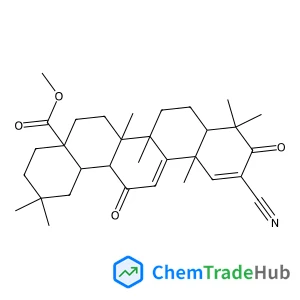
Methyl 2-cyano-3,12-dioxooleana-1,9(11)-dien-28-oate
CAS Number:
218600-53-4
Molecular Formula:
C32H43NO4
Recommended Suppliers






Disclaimer
This page provides academic journal information for reference and research purposes only. We are not affiliated with any journal publishers and do not handle publication submissions. For publication-related inquiries, please contact the respective journal publishers directly.
If you notice any inaccuracies in the information displayed, please contact us at support@chemtradehub.com. We will promptly review and address your concerns.