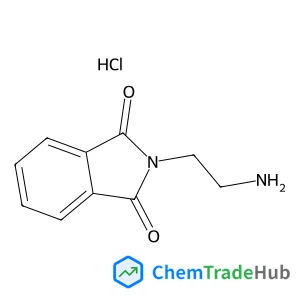
2-(2-Aminoethyl)-1H-isoindole-1,3(2H)-dione hydrochloride (1:1)
CAS Number:
30250-67-0
Molecular Formula:
C10H11ClN2O2
A graphical abstract is available for this content
C. J. Cobos, G. Knight, L. Sölter, E. Tellbach
DOI: 10.1039/C7CP07098E
Shuming Bai, Mario Barbatti
DOI: 10.1039/C8CP02306A
Nanjie Deng, Di Cui, Bin W. Zhang, Junchao Xia, Jeffrey Cruz, Ronald Levy
DOI: 10.1039/C8CP01524D
Mohit Chawla, Ida Autiero, Romina Oliva, Luigi Cavallo
DOI: 10.1039/C7CP07400J
J. Matthias Kahk, Beng Hau Tan, Claus-Dieter Ohl
DOI: 10.1039/C8CP02697A
Maria Dimitrova, Dage Sundholm
DOI: 10.1039/C7CP07212K
Titouan Jaunet-Lahary, Fabrice Fleury, Adèle D. Laurent
DOI: 10.1039/C8CP00704G
Mikhail Vagin, Ivan G. Ivanov, Tihomir Iakimov, G. Reza Yazdi, Rositsa Yakimova
DOI: 10.1039/C8CP01814F
Tumcan Sen, Murat Barisik
DOI: 10.1039/C8CP01906A
Alexandra Baumann, Hammad Cheema, Md Abdus Sabuj, Louis E. McNamara, Yanbing Zhang, Adithya Peddapuram, Suong T. Nguyen, Davita L. Watkins, Nathan I. Hammer, Neeraj Rai, Jared H. Delcamp
DOI: 10.1039/C8CP03065K
(1R,3S)-1,3-Cyclopentanediol finds applications in various industries. In the ph...
When handling N'-[4-(Dimethylamino)phenyl]-N,N-dimethyl-1,4-benzenediamine, it i...
There are several alternatives to 5-(2,4-Difluorophenyl)-2-methoxypyrimidine in ...
1-(3-Methoxyphenoxy)propan-2-ol (CAS: 382141-68-6) must comply with the Globally...
Tetrodotoxin Citrate is extremely dangerous and should be handled with extreme c...
2-Methyl-2-propanyl [(1R,3S)-3-hydroxycyclopentyl]carbamate (CAS: 225641-84-9) i...
Waste containing 4-(2-Hydroxyhexafluoroisopropyl)Benzoic Acid (CAS: 16261-80-6) ...
2-Methyl-2-proanyl {(2S)-1-[(benzyloxy)amino]-3-hydroxy-3-methyl-1-oxo-2-butanyl...
Benzeneethanamine, α-ethyl-, hydrochloride (1:1) is an organic compound with the...
In the synthesis of compounds similar to 3-{(E)-[4-(Dimethylamino)phenyl]diazeny...

Physical Chemistry Chemical Physics (PCCP) is an international journal co-owned by 19 physical chemistry and physics societies from around the world. This journal publishes original, cutting-edge research in physical chemistry, chemical physics and biophysical chemistry. To be suitable for publication in PCCP, articles must include significant innovation and/or insight into physical chemistry; this is the most important criterion that reviewers and Editors will judge against when evaluating submissions. The journal has a broad scope and welcomes contributions spanning experiment, theory, computation and data science. Topical coverage includes spectroscopy, dynamics, kinetics, statistical mechanics, thermodynamics, electrochemistry, catalysis, surface science, quantum mechanics, quantum computing and machine learning. Interdisciplinary research areas such as polymers and soft matter, materials, nanoscience, energy, surfaces/interfaces, and biophysical chemistry are welcomed if they demonstrate significant innovation and/or insight into physical chemistry. Joined experimental/theoretical studies are particularly appreciated when complementary and based on up-to-date approaches.