


Computational simulations determining disulfonic stilbene derivative bioavailability within human serum albumin
Literature Information
Publication Date
2018-06-04
DOI
10.1039/C8CP00704G
Impact Factor
3.676
Authors
Titouan Jaunet-Lahary, Fabrice Fleury, Adèle D. Laurent
View Original
Abstract
Disulfonic stilbene (DS) derivatives are a member of the large family of compounds widely employed in medicine and biology as modulators for membrane transporters or inhibitors of a protein involved in DNA repair. They constitute interesting compounds that have not yet been investigated within the bioavailability framework. No crystallographic structures exist involving such compounds embedded in the most common drug carrier, human serum albumin (HSA). The present work studies, for the first time, the physico-chemical features driving the inclusion of three DS derivatives (amino, nitro and acetamido, named DADS, DNDS and DATDS, respectively) within the four common HSA binding sites using combined molecular docking and molecular dynamics simulations. A careful analysis of each ligand within each of the studied binding sites is carried out, highlighting specific interactions and key residues playing a role in stabilizing the ligand within each pocket. The comparison between DADS, DNDS and DATDS reveals that depending on the binding site, the conclusions are rather different. For instance, the IB binding site shows a specificity to DADS compounds while IIIA is the most favorable site for DNDS and DATDS.
Recommended Journals

Journal of Peptide Science

Nature Medicine

Russian Journal of Bioorganic Chemistry

Organic Process Research & Development

Russian Journal of Coordination Chemistry

Saudi Pharmaceutical Journal

Current Opinion in Colloid & Interface Science

Journal of Saudi Chemical Society

Acta Materialia

Crystallography Reports
Related Literature
Unusual chromic and doping behavior of ether substituted polythiophenes
Yu Wang, William B. Euler, Brett L. Lucht
2004-02-11
Communication
DOI: 10.1039/B312537H
Gold and silver nanoparticles functionalized with known numbers of oligonucleotides per particle for DNA detection
Yang Chen, Jenny Aveyard, Robert Wilson
2004-11-18
Communication
DOI: 10.1039/B411181H
Palladium catalysed cyclisation–carbonylation of enynes to give cyclic γ,δ-unsaturated acids
Varinder K. Aggarwal, Mike Butters, Paul W. Davies
2003-04-02
Communication
DOI: 10.1039/B300719G
Chiral self-dimerization of vanadium complexes on a SiO2 surface: the first heterogeneous catalyst for asymmetric 2-naphthol coupling
Mizuki Tada, Toshiaki Taniike, Lakshmi M. Kantam, Yasuhiro Iwasawa
2004-10-04
Communication
DOI: 10.1039/B410307F
Crystalline oligopyrene nanowires with multicolored emission
Liangti Qu, Gaoquan Shi
2004-11-03
Communication
DOI: 10.1039/B412638F
Thermosensitive PNIPAAm cryogel with superfast and stable oscillatory properties
Xian-Zheng Zhang, Chih-Chang Chu
2003-05-19
Communication
DOI: 10.1039/B301423A
A novel catalyst with high activity for polyhydric alcohol oxidation: nanosilver/zeolite film
Jiang Shen, Wei Shan, Yahong Zhang, Junming Du, Hualong Xu, Kangnian Fan, Wei Shen, Yi Tang
2004-11-15
Communication
DOI: 10.1039/B412986E
Bioinspired synthesis of new silica structures
Siddharth V. Patwardhan, Niloy Mukherjee, Miriam Steinitz-Kannan, Stephen J. Clarson
2003-04-23
Communication
DOI: 10.1039/B302056H
Supramolecular control of complexation-induced fluorescence change of water-soluble, β-cyclodextrin-modified CdS quantum dots
Kumaranand Palaniappan, Stephen A. Hackney, Jian Liu
2004-10-11
Communication
DOI: 10.1039/B409075F
Synthesis and structure of [{Sn(μ–PCy)}3(Na·PMDETA)2], containing an electron-deficient [{Sn(μ–PCy)}3]2− dianion
Paula Alvarez-Bercedo, Andrew D. Bond, Robert Haigh, Alexander D. Hopkins, Gavin T. Lawson, Mary McPartlin, David Moncrieff, Marta E. Gonzalez Mosquera, Jeremy M. Rawson, Anthony D. Woods, Dominic S. Wright
2003-05-06
Communication
DOI: 10.1039/B300522D
You might also like
Compound Q&A
What industries use (1R,3S)-1,3-Cyclopentanediol (CAS: 16326-97-9)?
(1R,3S)-1,3-Cyclopentanediol finds applications in various industries. In the ph...
16326-97-9(1R,3S)-1,3-Cyclopen...
Compound Q&A
What precautions should be taken when handling N'-[4-(Dimethylamino)phenyl]-N,N-dimethyl-1,4-benzenediamine (CAS: 637-31-0)?
When handling N'-[4-(Dimethylamino)phenyl]-N,N-dimethyl-1,4-benzenediamine, it i...
637-31-0N'-[4-(Dimethylamino...
Compound Q&A
Are there alternatives to 5-(2,4-Difluorophenyl)-2-methoxypyrimidine (CAS: 1352318-16-1) in synthesis?
There are several alternatives to 5-(2,4-Difluorophenyl)-2-methoxypyrimidine in ...
1352318-16-15-(2,4-Difluoropheny...
Compound Q&A
What regulatory guidelines apply to 1-(3-Methoxyphenoxy)propan-2-ol (CAS: 382141-68-6)?
1-(3-Methoxyphenoxy)propan-2-ol (CAS: 382141-68-6) must comply with the Globally...
382141-68-61-(3-Methoxyphenoxy)...
Compound Q&A
Is Tetrodotoxin Citrate (CAS: 18660-81-6) safe?
Tetrodotoxin Citrate is extremely dangerous and should be handled with extreme c...
18660-81-6Tetrodotoxin Citrate
Compound Q&A
What are the main uses of 2-Methyl-2-propanyl [(1R,3S)-3-hydroxycyclopentyl]carbamate (CAS: 225641-84-9)?
2-Methyl-2-propanyl [(1R,3S)-3-hydroxycyclopentyl]carbamate (CAS: 225641-84-9) i...
225641-84-92-Methyl-2-propanyl ...
Compound Q&A
How should waste containing 4-(2-Hydroxyhexafluoroisopropyl)Benzoic Acid (CAS: 16261-80-6) be handled?
Waste containing 4-(2-Hydroxyhexafluoroisopropyl)Benzoic Acid (CAS: 16261-80-6) ...
16261-80-64-(2-Hydroxyhexafluo...
Compound Q&A
How is 2-Methyl-2-proanyl {(2S)-1-[(benzyloxy)amino]-3-hydroxy-3-methyl-1-oxo-2-butanyl}carbamate (CAS: 102507-19-7) typically synthesized?
2-Methyl-2-proanyl {(2S)-1-[(benzyloxy)amino]-3-hydroxy-3-methyl-1-oxo-2-butanyl...
102507-19-72-Methyl-2-propanyl ...
Compound Q&A
What is Benzeneethanamine, α-ethyl-, hydrochloride (1:1) (CAS: 20735-15-3)?
Benzeneethanamine, α-ethyl-, hydrochloride (1:1) is an organic compound with the...
20735-15-3Benzeneethanamine, α...
Compound Q&A
Are there alternatives to 3-{(E)-[4-(Dimethylamino)phenyl]diazenyl}benzoic acid (CAS: 20691-84-3) in synthesis?
In the synthesis of compounds similar to 3-{(E)-[4-(Dimethylamino)phenyl]diazeny...
20691-84-33-{(E)-[4-(Dimethyla...
Source Journal
Physical Chemistry Chemical Physics

CiteScore:
5.5
Self-citation Rate:
10.3%
Articles per Year:
3036
Physical Chemistry Chemical Physics (PCCP) is an international journal co-owned by 19 physical chemistry and physics societies from around the world. This journal publishes original, cutting-edge research in physical chemistry, chemical physics and biophysical chemistry. To be suitable for publication in PCCP, articles must include significant innovation and/or insight into physical chemistry; this is the most important criterion that reviewers and Editors will judge against when evaluating submissions. The journal has a broad scope and welcomes contributions spanning experiment, theory, computation and data science. Topical coverage includes spectroscopy, dynamics, kinetics, statistical mechanics, thermodynamics, electrochemistry, catalysis, surface science, quantum mechanics, quantum computing and machine learning. Interdisciplinary research areas such as polymers and soft matter, materials, nanoscience, energy, surfaces/interfaces, and biophysical chemistry are welcomed if they demonstrate significant innovation and/or insight into physical chemistry. Joined experimental/theoretical studies are particularly appreciated when complementary and based on up-to-date approaches.
Recommended Compounds
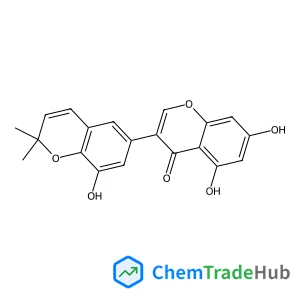
5,7,8'-Trihydroxy-2',2'-dimethyl-2'H,4H-3,6'-bichromen-4-one
CAS Number:
129280-33-7
Molecular Formula:
C20H16O6
Recommended Suppliers





Disclaimer
This page provides academic journal information for reference and research purposes only. We are not affiliated with any journal publishers and do not handle publication submissions. For publication-related inquiries, please contact the respective journal publishers directly.
If you notice any inaccuracies in the information displayed, please contact us at support@chemtradehub.com. We will promptly review and address your concerns.