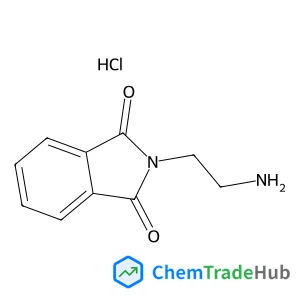
2-(2-Aminoethyl)-1H-isoindole-1,3(2H)-dione hydrochloride (1:1)
CAS Number:
30250-67-0
Molecular Formula:
C10H11ClN2O2
Mikhail Vagin, Ivan G. Ivanov, Tihomir Iakimov, G. Reza Yazdi, Rositsa Yakimova
Here, we report the electrochemical deposition of lead (Pb) as a model metal on epitaxial graphene fabricated on silicon carbide (Gr/SiC). The kinetics of electrodeposition and morphological characteristics of the deposits were evaluated by complementary electrochemical, physical and computational methods. The use of Gr/SiC as an electrode allowed the tracking of lead-associated redox conversions. The analysis of current transients passed during the deposition revealed an instantaneous nucleation mechanism controlled by convergent mass transport on the nuclei locally randomly distributed on epitaxial graphene. This key observation of the deposit topology was confirmed by low values of the experimentally-estimated apparent diffusion coefficient, Raman spectroscopy and scanning electron microscopy (SEM) studies. First principles calculations showed that the nucleation of Pb clusters on the graphene surface leads to weakening of the interaction strength of the metal–graphene complex, and only spatially separated Pb adatoms adsorbed on bridge and/or edge-plane sites can affect the vibrational properties of graphene. We expect that the lead adatoms can merge in large metallic clusters only at defect sites that reinforce the metal–graphene interactions. Our findings provide valuable insights into both heavy metal ion electrochemical analysis and metal electroplating on graphene interfaces that are important for designing effective detectors of toxic heavy metals.

Current Opinion in Colloid & Interface Science

Russian Journal of Applied Chemistry

Russian Journal of General Chemistry

Journal of Peptide Science

Russian Journal of Organic Chemistry

New Journal of Chemistry

Journal of Natural Medicines

Chemistry Education Research and Practice

Current Opinion in Solid State & Materials Science

Drug Discovery Today
Patrick Taylor, Paul M. Lahti
DOI: 10.1039/B411574K
Max J. Cryle, Julia M. U. Stuthe, Paul R. Ortiz de Montellano, James J. De Voss
DOI: 10.1039/B315911F
François Stoffelbach, Rinaldo Poli
DOI: 10.1039/B409992C
Muhammad Nawaz Tahir, Patrick Théato, Werner E. G. Müller, Heinz C. Schröder, Andreas Janshoff, Jian Zhang, Joachim Huth, Wolfgang Tremel
DOI: 10.1039/B410283E
Serge Vilminot, Mireille Richard-Plouet, Gilles André, Tahar Mhiri, Mohamedally Kurmoo
DOI: 10.1039/B411304G
Jianzhong Yang, Andrew R. Barron
DOI: 10.1039/B411118D
Paula Alvarez-Bercedo, Andrew D. Bond, Robert Haigh, Alexander D. Hopkins, Gavin T. Lawson, Mary McPartlin, David Moncrieff, Marta E. Gonzalez Mosquera, Jeremy M. Rawson, Anthony D. Woods, Dominic S. Wright
DOI: 10.1039/B300522D
Moonhyun Oh, Charlotte L. Stern, Chad A. Mirkin
DOI: 10.1039/B408084J
Mizuki Tada, Toshiaki Taniike, Lakshmi M. Kantam, Yasuhiro Iwasawa
DOI: 10.1039/B410307F
Hiroshi Shiigi, Yojiro Yamamoto, Hidetaka Yakabe, Shiho Tokonami, Tsutomu Nagaoka
DOI: 10.1039/B212226J
(1R,3S)-1,3-Cyclopentanediol finds applications in various industries. In the ph...
When handling N'-[4-(Dimethylamino)phenyl]-N,N-dimethyl-1,4-benzenediamine, it i...
There are several alternatives to 5-(2,4-Difluorophenyl)-2-methoxypyrimidine in ...
1-(3-Methoxyphenoxy)propan-2-ol (CAS: 382141-68-6) must comply with the Globally...
Tetrodotoxin Citrate is extremely dangerous and should be handled with extreme c...
2-Methyl-2-propanyl [(1R,3S)-3-hydroxycyclopentyl]carbamate (CAS: 225641-84-9) i...
Waste containing 4-(2-Hydroxyhexafluoroisopropyl)Benzoic Acid (CAS: 16261-80-6) ...
2-Methyl-2-proanyl {(2S)-1-[(benzyloxy)amino]-3-hydroxy-3-methyl-1-oxo-2-butanyl...
Benzeneethanamine, α-ethyl-, hydrochloride (1:1) is an organic compound with the...
In the synthesis of compounds similar to 3-{(E)-[4-(Dimethylamino)phenyl]diazeny...

Physical Chemistry Chemical Physics (PCCP) is an international journal co-owned by 19 physical chemistry and physics societies from around the world. This journal publishes original, cutting-edge research in physical chemistry, chemical physics and biophysical chemistry. To be suitable for publication in PCCP, articles must include significant innovation and/or insight into physical chemistry; this is the most important criterion that reviewers and Editors will judge against when evaluating submissions. The journal has a broad scope and welcomes contributions spanning experiment, theory, computation and data science. Topical coverage includes spectroscopy, dynamics, kinetics, statistical mechanics, thermodynamics, electrochemistry, catalysis, surface science, quantum mechanics, quantum computing and machine learning. Interdisciplinary research areas such as polymers and soft matter, materials, nanoscience, energy, surfaces/interfaces, and biophysical chemistry are welcomed if they demonstrate significant innovation and/or insight into physical chemistry. Joined experimental/theoretical studies are particularly appreciated when complementary and based on up-to-date approaches.