













Thermal stability of trihexyl(tetradecyl)phosphonium chloride
Literature Information
Publication Date
2018-01-05
DOI
10.1039/C7CP08556G
Impact Factor
3.676
Authors
Arne Van den Bossche, Jan Luyten, Harald Oosterhof, Jan Fransaer, Koen Binnemans
View Original
Abstract
Dynamic TGA studies of phosphonium ionic liquids have reported thermal stabilities of 300 °C or higher for these compounds. This is often an overestimation of the real thermal stability. The chosen technique as well as the experimental parameters can influence the thermal stability. In this paper, the thermal stability of commercially available Cyphos IL 101 is studied. The effect of the nature of the atmosphere (air or inert gas), the purity of the sample, the heating rate and presence of a metal on the short-term and long-term stability of commercial Cyphos IL 101 is investigated. The thermal decomposition products are characterized using thermogravimetric analysis coupled to mass spectrometry (TGA-MS). Impurities present and higher heating rates lead to an under- and overestimation of the thermal stability, respectively. The presence of oxygen leads to a lower thermal stability. In contrast, adding metal chlorides to the ionic liquid causes an increase in the thermal stability. The chloride anions are coordinated to the metal ion, so that the Lewis basicity of the anions is reduced. Also this paper gives insights in the behavior of Cyphos IL 101 at high temperatures, which is of relevance for possible application of this ionic liquid in high-temperature industrial processes.
Recommended Journals
Related Literature
A new entry to N-heterocyclic carbene chemistry: synthesis and characterisation of a triscarbene complex of thallium(i)
Hidetaka Nakai, Yongjun Tang, Peter Gantzel, Karsten Meyer
2002-11-26
Communication
DOI: 10.1039/B209071F
Switchable thiophene coordination in Ru(ii) bipyridyl phosphinoterthiophene complexes
Carolyn Moorlag, Olivier Clot, Michael O. Wolf, Brian O. Patrick
2002-11-19
Communication
DOI: 10.1039/B209035J
Catalytic asymmetric dihydroxylation of olefins using a recoverable and reusable OsO42− in ionic liquid [bmim][PF6]
Luís C. Branco, Carlos A. M. Afonso
2002-11-15
Communication
DOI: 10.1039/B208631J
Reactions of phenyldimethylsilyllithium with β-N,N-dimethylaminoenones
Ian Fleming, Elena Marangon, Chiara Roni, Matthew G. Russell, Sandra Taliansky Chamudis
2002-12-17
Communication
DOI: 10.1039/B210444J
The anionic thia-Fries rearrangement of aryl triflates
Jonathan P. H. Charmant, Alan M. Dyke, Guy C. Lloyd-Jones
2003-01-14
Communication
DOI: 10.1039/B210648E
Electrochemically controlled interactions between TTF-based dendrimers and an electron-rich oligomer
Andrew Beeby, Martin R. Bryce, Christian A. Christensen, Graeme Cooke, Florence M. A. Duclairoir, Vincent M. Rotello
2002-11-20
Communication
DOI: 10.1039/B209765F
Synthesis and structure of a novel supramolecular Zn3Co8assembly containing a linear Zn3 core
Lilu Zhang, Richard A. Jones, Vincent M. Lynch
2002-11-18
Communication
DOI: 10.1039/B209785K
Novel Cr-PNP complexes as catalysts for the trimerisation of ethylene
David S. McGuinness, Peter Wasserscheid, Wilhelm Keim, Chunhua Hu, Ulli Englert, John T. Dixon, Cronje Grove
2003-01-02
Communication
DOI: 10.1039/B210878J
Mechanistic studies on ethylene silylation with chlorosilanes catalysed by ruthenium complexes
Sébastien Lachaize, Sylviane Sabo-Etienne, Bruno Donnadieu, Bruno Chaudret
2002-12-11
Communication
DOI: 10.1039/B210552G
Pure silica BETA colloidal zeolite assembled in thin films
S. Mintova, M. Reinelt, T. H. Metzger, J. Senker, T. Bein
2002-12-20
Communication
DOI: 10.1039/B210767H
You might also like
Compound Q&A
What industries use (1R,3S)-1,3-Cyclopentanediol (CAS: 16326-97-9)?
(1R,3S)-1,3-Cyclopentanediol finds applications in various industries. In the ph...
16326-97-9(1R,3S)-1,3-Cyclopen...
Compound Q&A
What precautions should be taken when handling N'-[4-(Dimethylamino)phenyl]-N,N-dimethyl-1,4-benzenediamine (CAS: 637-31-0)?
When handling N'-[4-(Dimethylamino)phenyl]-N,N-dimethyl-1,4-benzenediamine, it i...
637-31-0N'-[4-(Dimethylamino...
Compound Q&A
Are there alternatives to 5-(2,4-Difluorophenyl)-2-methoxypyrimidine (CAS: 1352318-16-1) in synthesis?
There are several alternatives to 5-(2,4-Difluorophenyl)-2-methoxypyrimidine in ...
1352318-16-15-(2,4-Difluoropheny...
Compound Q&A
What regulatory guidelines apply to 1-(3-Methoxyphenoxy)propan-2-ol (CAS: 382141-68-6)?
1-(3-Methoxyphenoxy)propan-2-ol (CAS: 382141-68-6) must comply with the Globally...
382141-68-61-(3-Methoxyphenoxy)...
Compound Q&A
Is Tetrodotoxin Citrate (CAS: 18660-81-6) safe?
Tetrodotoxin Citrate is extremely dangerous and should be handled with extreme c...
18660-81-6Tetrodotoxin Citrate
Compound Q&A
What are the main uses of 2-Methyl-2-propanyl [(1R,3S)-3-hydroxycyclopentyl]carbamate (CAS: 225641-84-9)?
2-Methyl-2-propanyl [(1R,3S)-3-hydroxycyclopentyl]carbamate (CAS: 225641-84-9) i...
225641-84-92-Methyl-2-propanyl ...
Compound Q&A
How should waste containing 4-(2-Hydroxyhexafluoroisopropyl)Benzoic Acid (CAS: 16261-80-6) be handled?
Waste containing 4-(2-Hydroxyhexafluoroisopropyl)Benzoic Acid (CAS: 16261-80-6) ...
16261-80-64-(2-Hydroxyhexafluo...
Compound Q&A
How is 2-Methyl-2-proanyl {(2S)-1-[(benzyloxy)amino]-3-hydroxy-3-methyl-1-oxo-2-butanyl}carbamate (CAS: 102507-19-7) typically synthesized?
2-Methyl-2-proanyl {(2S)-1-[(benzyloxy)amino]-3-hydroxy-3-methyl-1-oxo-2-butanyl...
102507-19-72-Methyl-2-propanyl ...
Compound Q&A
What is Benzeneethanamine, α-ethyl-, hydrochloride (1:1) (CAS: 20735-15-3)?
Benzeneethanamine, α-ethyl-, hydrochloride (1:1) is an organic compound with the...
20735-15-3Benzeneethanamine, α...
Compound Q&A
Are there alternatives to 3-{(E)-[4-(Dimethylamino)phenyl]diazenyl}benzoic acid (CAS: 20691-84-3) in synthesis?
In the synthesis of compounds similar to 3-{(E)-[4-(Dimethylamino)phenyl]diazeny...
20691-84-33-{(E)-[4-(Dimethyla...
Source Journal
Physical Chemistry Chemical Physics

CiteScore:
5.5
Self-citation Rate:
10.3%
Articles per Year:
3036
Physical Chemistry Chemical Physics (PCCP) is an international journal co-owned by 19 physical chemistry and physics societies from around the world. This journal publishes original, cutting-edge research in physical chemistry, chemical physics and biophysical chemistry. To be suitable for publication in PCCP, articles must include significant innovation and/or insight into physical chemistry; this is the most important criterion that reviewers and Editors will judge against when evaluating submissions. The journal has a broad scope and welcomes contributions spanning experiment, theory, computation and data science. Topical coverage includes spectroscopy, dynamics, kinetics, statistical mechanics, thermodynamics, electrochemistry, catalysis, surface science, quantum mechanics, quantum computing and machine learning. Interdisciplinary research areas such as polymers and soft matter, materials, nanoscience, energy, surfaces/interfaces, and biophysical chemistry are welcomed if they demonstrate significant innovation and/or insight into physical chemistry. Joined experimental/theoretical studies are particularly appreciated when complementary and based on up-to-date approaches.
Recommended Compounds
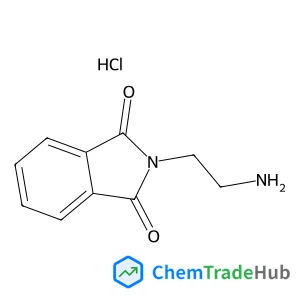
2-(2-Aminoethyl)-1H-isoindole-1,3(2H)-dione hydrochloride (1:1)
CAS Number:
30250-67-0
Molecular Formula:
C10H11ClN2O2
Recommended Suppliers






Disclaimer
This page provides academic journal information for reference and research purposes only. We are not affiliated with any journal publishers and do not handle publication submissions. For publication-related inquiries, please contact the respective journal publishers directly.
If you notice any inaccuracies in the information displayed, please contact us at support@chemtradehub.com. We will promptly review and address your concerns.