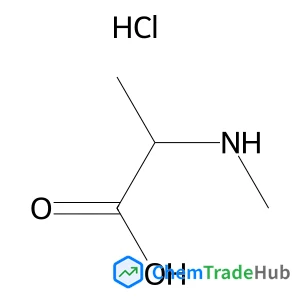
(R)-2-(Methylamino)propanoic acid hydrochloride
CAS Number:
1155878-14-0
Molecular Formula:
C4H10ClNO2
Daniella A. Ferluccio, Ronald I. Smith, Jim Buckman, Jan-Willem G. Bos
The half-Heuslers NbCoSn and NbCoSb have promising thermoelectric properties. Here, an investigation of the NbCo1+ySn1−zSbz (y = 0, 0.05; 0 ≤ z ≤ 1) solid-solution is presented. In addition, the p-type doping of NbCoSn using Ti and Zr substitution is investigated. Rietveld analysis reveals the gradual creation of Nb vacancies to compensate for the n-type doping caused by the substitution of Sb in NbCoSn. This leads to a similar valence electron count (∼18.25) for the NbCo1+ySn1−zSbz samples (z > 0). Mass fluctuation disorder due to the Nb vacancies strongly decreases the lattice thermal conductivity from 10 W m−1 K−1 (z = 0) to 4.5 W m−1 K−1 (z = 0.5, 1). This is accompanied by a transition to degenerate semiconducting behaviour leading to large power factors, S2/ρ = 2.5–3 mW m−1 K−2 and figures of merit, ZT = 0.25–0.33 at 773 K. Ti and Zr can be used to achieve positive Seebeck values, e.g. S = +150 μV K−1 for 20% Zr at 773 K. However, the electrical resistivity, ρ323K = 27–35 mΩ cm, remains too large for these materials to be considered useful p-type materials.
DOI: 10.1039/D0CP00241K
Chaocang Weng, Lei Gao, Guotao Duan
DOI: 10.1039/C9CP05930J
Lin-Yan Feng, Rui Li, Hua-Jin Zhai
DOI: 10.1039/C9CP03254A
Alfonso Alejo-Armijo, Nuno Basílio, Adilson A. Freitas, António L. Maçanita, João C. Lima, A. Jorge Parola, Fernando Pina
DOI: 10.1039/C9CP04917G
Shijie Zhou, Lei Tong, Yinjie Liao, Juxia Yi, Yao Qi
DOI: 10.1039/C9CP02703C
Fabian Düll, Manuel Meusel, Florian Späth, Simon Schötz, Udo Bauer, Philipp Bachmann, Johann Steinhauer, Hans-Peter Steinrück, Andreas Bayer, Christian Papp
DOI: 10.1039/C9CP04095A
P. S. Rukin, K. G. Komarova, B. Fresch, E. Collini, F. Remacle
DOI: 10.1039/D0CP00223B
Dinesh Mishra, Sisi Wang, Zhicheng Jin, Yan Xin, Eric Lochner, Hedi Mattoussi
DOI: 10.1039/C9CP03723C
Chenyi Li, Hichem Dammak, Guilhem Dezanneau
DOI: 10.1039/C9CP03048D
6-(3-Fluorophenyl)picolinic acid is generally considered safe for laboratory use...
(3R)-3-Pyrrolidinol is used in the pharmaceutical industry as a precursor for dr...
When handling (4R,5R)-4,5-Diethoxycarbonyl-2,2-dimethyldioxolane (CAS: 59779-75-...
1-(6-Chloroimidazo[1,2-b]pyridazin-3-yl)ethanone is often synthesized via a mult...
The market for N-Ethyl-3,4-dimethylbenzylamine (CAS: 39180-83-1) remains steady,...
Tert-butyl 3-(pyrrolidin-1-yl)azetidine-1-carboxylate is a chemical compound wit...
1-Bromo-3-chloro-2,4-dimethoxybenzene (CAS: 1228956-93-1) falls under the classi...
The safety of 8-Bromo-2-methyl-3,4-dihydroisoquinolin-1(2H)-one (CAS: 1368622-07...
Benzyl [(3S)-2,6-dioxo-3-piperidinyl]carbamate is generally safe when handled wi...
1-{[4-(4,4,5,5-Tetramethyl-1,3,2-dioxaborolan-2-yl)phenyl]sulfonyl}pyrrolidine s...

Physical Chemistry Chemical Physics (PCCP) is an international journal co-owned by 19 physical chemistry and physics societies from around the world. This journal publishes original, cutting-edge research in physical chemistry, chemical physics and biophysical chemistry. To be suitable for publication in PCCP, articles must include significant innovation and/or insight into physical chemistry; this is the most important criterion that reviewers and Editors will judge against when evaluating submissions. The journal has a broad scope and welcomes contributions spanning experiment, theory, computation and data science. Topical coverage includes spectroscopy, dynamics, kinetics, statistical mechanics, thermodynamics, electrochemistry, catalysis, surface science, quantum mechanics, quantum computing and machine learning. Interdisciplinary research areas such as polymers and soft matter, materials, nanoscience, energy, surfaces/interfaces, and biophysical chemistry are welcomed if they demonstrate significant innovation and/or insight into physical chemistry. Joined experimental/theoretical studies are particularly appreciated when complementary and based on up-to-date approaches.
![[4-Chloro-3-(diethylcarbamoyl)phenyl]boronic acid structure](https://static.chemtradehub.com/structs/871/871332-68-2-0e3b.webp "[4-Chloro-3-(diethylcarbamoyl)phenyl]boronic acid structure")