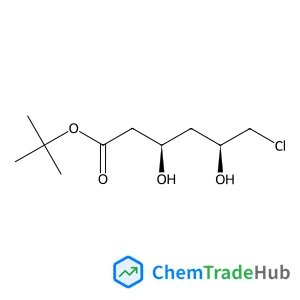
2-Methyl-2-propanyl (3R,5S)-6-chloro-3,5-dihydroxyhexanoate
CAS Number:
154026-93-4
Molecular Formula:
C10H19ClO4
Manh-Hiep Vu, Chinh-Chien Nguyen, M. Sakar, Trong-On Do
Nickel supported CdIn2S4 (Ni-CIS) spongy-like spheres have been developed using alcoholysis followed by a sulfidation process. The formation of nanocrystalline-single phase CdIn2S4 was confirmed using X-ray diffraction studies. Electron microscopy images showed that the spongy-like spheres are composed of CdIn2S4 nanoparticles with average sizes of around 25 nm. X-ray photoelectron spectra indicated the presence of elements with their respective stable oxidation states that led to the formation of single phase CdIn2S4 with enhanced structural integrity and chemical composition. The absorption spectra indicated the visible light activity of the material and the band gap energy is deduced to be 2.23 eV. The photocatalytic efficiency of the synthesized Ni-CIS in relation to its ability to produce hydrogen under solar light irradiation is estimated to be 1060 μmol g−1 h−1, which is around 5.5 and 3.6 fold higher than that of Pt-CIS (180 μmol g−1 h−1) and Pd-CIS (290 μmol g−1 h−1), respectively, as obtained in this study. Accordingly, the mechanism of the observed efficiency of the Ni-CIS nanoparticles is also proposed. The recyclability test showed consistent hydrogen evolution efficiency over 3 cycles (9 h), which essentially revealed the excellent photo- and chemical-stability of the photocatalyst. The strategy to utilize non-noble metals such as Ni, rather than noble-metals, as a co-catalyst opens up a new possibility to develop low cost and high-performance sunlight-driven photocatalysts as achieved in this study.
Mikhail Vagin, Ivan G. Ivanov, Tihomir Iakimov, G. Reza Yazdi, Rositsa Yakimova
DOI: 10.1039/C8CP01814F
Haochen Zhang, William A. Goddard, III, Qi Lu, Mu-Jeng Cheng
DOI: 10.1039/C7CP08153G
Debopreeti Mukherjee, Lilliana I. Ortiz Rodriguez, Mary Rose Hilaire
DOI: 10.1039/C7CP07160D
E. Barrez, G. Laurent, C. Pavageau, M. Sliwa, R. Métivier
DOI: 10.1039/C7CP06541H
Han-Ill Yoo
DOI: 10.1039/C7CP06009B
Nanjie Deng, Di Cui, Bin W. Zhang, Junchao Xia, Jeffrey Cruz, Ronald Levy
DOI: 10.1039/C8CP01524D
Junbo Ren, Wangqing Wang, Weibin Qiu, Pingping Qiu, Zeyu Wang, Zhili Lin, Jia-Xian Wang
DOI: 10.1039/C8CP01281D
H. S. Alagoz, I. Živković, K. H. Chow, J. Jung
DOI: 10.1039/C7CP02423A
Bin Liu, Meihua Gao, Haiping Li, Jianqiang Liu, Shiling Yuan, Na Du
DOI: 10.1039/C7CP06379B
(1R,3S)-1,3-Cyclopentanediol finds applications in various industries. In the ph...
When handling N'-[4-(Dimethylamino)phenyl]-N,N-dimethyl-1,4-benzenediamine, it i...
There are several alternatives to 5-(2,4-Difluorophenyl)-2-methoxypyrimidine in ...
1-(3-Methoxyphenoxy)propan-2-ol (CAS: 382141-68-6) must comply with the Globally...
Tetrodotoxin Citrate is extremely dangerous and should be handled with extreme c...
2-Methyl-2-propanyl [(1R,3S)-3-hydroxycyclopentyl]carbamate (CAS: 225641-84-9) i...
Waste containing 4-(2-Hydroxyhexafluoroisopropyl)Benzoic Acid (CAS: 16261-80-6) ...
2-Methyl-2-proanyl {(2S)-1-[(benzyloxy)amino]-3-hydroxy-3-methyl-1-oxo-2-butanyl...
Benzeneethanamine, α-ethyl-, hydrochloride (1:1) is an organic compound with the...
In the synthesis of compounds similar to 3-{(E)-[4-(Dimethylamino)phenyl]diazeny...

Physical Chemistry Chemical Physics (PCCP) is an international journal co-owned by 19 physical chemistry and physics societies from around the world. This journal publishes original, cutting-edge research in physical chemistry, chemical physics and biophysical chemistry. To be suitable for publication in PCCP, articles must include significant innovation and/or insight into physical chemistry; this is the most important criterion that reviewers and Editors will judge against when evaluating submissions. The journal has a broad scope and welcomes contributions spanning experiment, theory, computation and data science. Topical coverage includes spectroscopy, dynamics, kinetics, statistical mechanics, thermodynamics, electrochemistry, catalysis, surface science, quantum mechanics, quantum computing and machine learning. Interdisciplinary research areas such as polymers and soft matter, materials, nanoscience, energy, surfaces/interfaces, and biophysical chemistry are welcomed if they demonstrate significant innovation and/or insight into physical chemistry. Joined experimental/theoretical studies are particularly appreciated when complementary and based on up-to-date approaches.