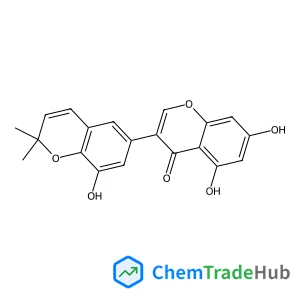
5,7,8'-Trihydroxy-2',2'-dimethyl-2'H,4H-3,6'-bichromen-4-one
CAS Number:
129280-33-7
Molecular Formula:
C20H16O6
H. S. Alagoz, I. Živković, K. H. Chow, J. Jung
The origin of the anomalous sharp phase transition from a ferromagnetic metal into a ferromagnetic insulator has been investigated in ruthenium (Ru)-doped RE0.55Sr0.45Mn1−xRuxO3 (0 ≤ x ≤ 0.25) manganites (RESRMO) with RE(A-site) = Sm, Eu and Gd. The transition is independent of RE and occurs at a Ru doping level x of around 0.16–0.18. The analysis of the temperature derivative of the resistivity and the magneto-resistance at high temperatures as a function of x suggests that the suppression of metallicity originates from the doping driven magnetic/spin disorder that coexist within the ferromagnetic metallic/insulating matrix in these compounds.

Crystallography Reports

Drug Discovery Today

Journal of Peptide Science

Saudi Pharmaceutical Journal

Russian Journal of Applied Chemistry

Russian Journal of Organic Chemistry

Journal of Saudi Chemical Society

Russian Journal of Bioorganic Chemistry

Chemistry Education Research and Practice

Current Opinion in Colloid & Interface Science
Cyril Poriel, Yann Ferrand, Paul le Maux, Joëlle Raul-Berthelot, Gerard Simonneaux
DOI: 10.1039/B301717F
Atsushi Shimojima
DOI: 10.1039/B411794H
Ulf Hanefeld, Isabel W. C. E. Arends, Adriaan J. Minnaard, Thomas Maschmeyer, Roger A. Sheldon
DOI: 10.1039/B411506F
Jianzhong Yang, Andrew R. Barron
DOI: 10.1039/B411118D
Kumaranand Palaniappan, Stephen A. Hackney, Jian Liu
DOI: 10.1039/B409075F
Varinder K. Aggarwal, Mike Butters, Paul W. Davies
DOI: 10.1039/B300719G
Robin B. Bedford, Duncan W. Bruce, Robert M. Frost, John W. Goodby, Michael Hird
DOI: 10.1039/B413790F
Cinzia Chiappe, Elsa Leandri, Daniela Pieraccini
DOI: 10.1039/B410796A
Max J. Cryle, Julia M. U. Stuthe, Paul R. Ortiz de Montellano, James J. De Voss
DOI: 10.1039/B315911F
Xianying Li, Hongzhi Wang, Kouzou Inoue, Masato Uehara, Hiroyuki Nakamura, Masaya Miyazaki, Eiichi Abe, Hideaki Maeda
DOI: 10.1039/B300765K
(1R,3S)-1,3-Cyclopentanediol finds applications in various industries. In the ph...
When handling N'-[4-(Dimethylamino)phenyl]-N,N-dimethyl-1,4-benzenediamine, it i...
There are several alternatives to 5-(2,4-Difluorophenyl)-2-methoxypyrimidine in ...
1-(3-Methoxyphenoxy)propan-2-ol (CAS: 382141-68-6) must comply with the Globally...
Tetrodotoxin Citrate is extremely dangerous and should be handled with extreme c...
2-Methyl-2-propanyl [(1R,3S)-3-hydroxycyclopentyl]carbamate (CAS: 225641-84-9) i...
Waste containing 4-(2-Hydroxyhexafluoroisopropyl)Benzoic Acid (CAS: 16261-80-6) ...
2-Methyl-2-proanyl {(2S)-1-[(benzyloxy)amino]-3-hydroxy-3-methyl-1-oxo-2-butanyl...
Benzeneethanamine, α-ethyl-, hydrochloride (1:1) is an organic compound with the...
In the synthesis of compounds similar to 3-{(E)-[4-(Dimethylamino)phenyl]diazeny...

Physical Chemistry Chemical Physics (PCCP) is an international journal co-owned by 19 physical chemistry and physics societies from around the world. This journal publishes original, cutting-edge research in physical chemistry, chemical physics and biophysical chemistry. To be suitable for publication in PCCP, articles must include significant innovation and/or insight into physical chemistry; this is the most important criterion that reviewers and Editors will judge against when evaluating submissions. The journal has a broad scope and welcomes contributions spanning experiment, theory, computation and data science. Topical coverage includes spectroscopy, dynamics, kinetics, statistical mechanics, thermodynamics, electrochemistry, catalysis, surface science, quantum mechanics, quantum computing and machine learning. Interdisciplinary research areas such as polymers and soft matter, materials, nanoscience, energy, surfaces/interfaces, and biophysical chemistry are welcomed if they demonstrate significant innovation and/or insight into physical chemistry. Joined experimental/theoretical studies are particularly appreciated when complementary and based on up-to-date approaches.