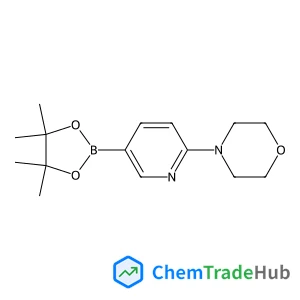
4-(5-(4,4,5,5-tetramethyl-1,3,2-dioxaborolan-2-yl)pyridin-2-yl)morpholine
CAS Number:
485799-04-0
Molecular Formula:
C15H23BN2O3
Kateřina Tomanová, Martin Precek, Viliam Múčka, Luděk Vyšín, Václav Čuba
Formation yields of ˙OH radicals were precisely determined in aqueous solutions of coumarin-3-carboxylic acid and ferrous sulfate (i.e., Fricke dosimeter) exposed to 253.7 nm radiation delivered from a continuous source. Quantum yield of ˙OH radicals was determined as ∼0.08, i.e., roughly one out of twelve photons, efficiently absorbed in UV-illuminated solutions, produced one ˙OH radical. Energetically, a water molecule should undergo a correlated action of at least two 4.9 eV photons delivering enough energy for direct H–OH dissociation (5.0–5.4 eV). We suggest a mechanism based on an interaction of two water molecules, both in long-living triplet states. An intermolecular transfer of excitation energy provided a sufficient amount of energy for the dissociation of one water molecule into ˙OH and H˙ radicals. In an aqueous solution of phospholipids, quantum yields of hydroperoxides formed under these irradiation conditions decreased with total effectively absorbed energy (i.e. a dose), similar to the radiation chemical yields obtained during an exposure to ionizing radiation, such as gamma rays from radionuclide sources. Under 253.7 nm irradiation, one ˙OH radical causes a peroxidation of 34 phospholipid molecules. This implicates chain mechanism of the reaction.
Jin Cai, Yuee Xie, Po-Yao Chang, Heung-Sik Kim, Yuanping Chen
DOI: 10.1039/C8CP02810A
L. J. Ding, Y. Zhong
DOI: 10.1039/C8CP03534B
Rafael T. da Silva, Alexandre Mesquita, Thalita Chiaramonte, Xavier Gratens, Valmir A. Chitta, Gul Rahman, Antonio C. Doriguetto, Maria I. B. Bernardi, Hugo B. de Carvalho
DOI: 10.1039/C8CP02870B
Shuming Bai, Mario Barbatti
DOI: 10.1039/C8CP02306A
J. Matthias Kahk, Beng Hau Tan, Claus-Dieter Ohl
DOI: 10.1039/C8CP02697A
Shumei Chen, Huabin Zhang, Jian Zhang
DOI: 10.1039/C8CP01986J
Stephen C. Chmely, Nicole Labbé
DOI: 10.1039/C7CP07195G
Mirtha A. O. Lourenço, Paula Ferreira, José R. B. Gomes
DOI: 10.1039/C8CP02589D
Debopreeti Mukherjee, Lilliana I. Ortiz Rodriguez, Mary Rose Hilaire
DOI: 10.1039/C7CP07160D
Reiner Zorn, Huajie Yin, Wiebke Lohstroh, Wayne Harrison, Peter M. Budd, Brian R. Pauw, Martin Böhning, Andreas Schönhals
DOI: 10.1039/C7CP07141H
(1R,3S)-1,3-Cyclopentanediol finds applications in various industries. In the ph...
When handling N'-[4-(Dimethylamino)phenyl]-N,N-dimethyl-1,4-benzenediamine, it i...
There are several alternatives to 5-(2,4-Difluorophenyl)-2-methoxypyrimidine in ...
1-(3-Methoxyphenoxy)propan-2-ol (CAS: 382141-68-6) must comply with the Globally...
Tetrodotoxin Citrate is extremely dangerous and should be handled with extreme c...
2-Methyl-2-propanyl [(1R,3S)-3-hydroxycyclopentyl]carbamate (CAS: 225641-84-9) i...
Waste containing 4-(2-Hydroxyhexafluoroisopropyl)Benzoic Acid (CAS: 16261-80-6) ...
2-Methyl-2-proanyl {(2S)-1-[(benzyloxy)amino]-3-hydroxy-3-methyl-1-oxo-2-butanyl...
Benzeneethanamine, α-ethyl-, hydrochloride (1:1) is an organic compound with the...
In the synthesis of compounds similar to 3-{(E)-[4-(Dimethylamino)phenyl]diazeny...

Physical Chemistry Chemical Physics (PCCP) is an international journal co-owned by 19 physical chemistry and physics societies from around the world. This journal publishes original, cutting-edge research in physical chemistry, chemical physics and biophysical chemistry. To be suitable for publication in PCCP, articles must include significant innovation and/or insight into physical chemistry; this is the most important criterion that reviewers and Editors will judge against when evaluating submissions. The journal has a broad scope and welcomes contributions spanning experiment, theory, computation and data science. Topical coverage includes spectroscopy, dynamics, kinetics, statistical mechanics, thermodynamics, electrochemistry, catalysis, surface science, quantum mechanics, quantum computing and machine learning. Interdisciplinary research areas such as polymers and soft matter, materials, nanoscience, energy, surfaces/interfaces, and biophysical chemistry are welcomed if they demonstrate significant innovation and/or insight into physical chemistry. Joined experimental/theoretical studies are particularly appreciated when complementary and based on up-to-date approaches.