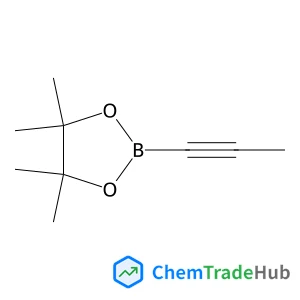
4,4,5,5-Tetramethyl-2-(1-propyn-1-YL)-1,3,2-dioxaborolane
CAS Number:
347389-75-7
Molecular Formula:
C9H15BO2
Mikko Karttunen
Understanding the atomic level interactions and the resulting structural characteristics is required for developing beta-cyclodextrin (βCD) derivatives for pharmaceutical and other applications. The effect of four different solvents on the structures of the native βCD and its hydrophilic (methylated βCD; MEβCD and hydroxypropyl βCD; HPβCD) and hydrophobic derivatives (ethylated βCD; ETβCD) was explored using molecular dynamics (MD) simulations and solvation free energy calculations. The native βCD, 2-MEβCD, 6-MEβCD, 2,6-DMβCD, 2,3,6-TMβCD, 6-HPβCD, 2,6-HPβCD and 2,6-ETβCD in non-polar solvents (cyclohexane; CHX and octane; OCT) were stably formed in a symmetric cyclic cavity shape through their intramolecular hydrogen bonds. In contrast, βCDs in polar solvents (methanol; MeOH and water; WAT) exhibited large structural changes and fluctuations leading to significant deformations of their cavities. Hydrogen bonding with polar solvents was found to be one of the major contributors to this behavior: solvent–βCD hydrogen bonding strongly competes with intramolecular bonding leading to significant changes in the structural stability of βCDs. An exception to this is the hydrophobic 2,6-ETβCD which retained its spherical cavity in all solvents. Based on this, it is proposed that the 2,6-ETβCD can act as a sustained release drug carrier.

Organic Preparations and Procedures International

Fibre Chemistry

Pharmacological Reviews

Pure and Applied Chemistry

Kinetics and Catalysis

Journal of Physics and Chemistry of Solids

Molecular Pharmacology

Journal of Organometallic Chemistry

Proceedings of the National Academy of Sciences of the United States of America

Science
Jia-Peng Wang, Yan Shu, Shi-Xi Liu, Jun-Tao Hu, Cheng-Tong Sun, Hao Zhou, Dong Gan, Xue-Yun Cai, Wei Pu, Le Cai, Zhong-Tao Ding
DOI: 10.1039/C9QO01076A
Mengmeng Lan, Guodong Cui, Hongwei Zhang
DOI: 10.1039/C9QO00685K
Yongqi Yu, Qianlong Wu, Da Liu, Lin Yu, Ze Tan, Gangguo Zhu
DOI: 10.1039/C9QO00994A
Paran J. Borpatra, Bhaskar Deka, Mohit L. Deb, Pranjal K. Baruah
DOI: 10.1039/C9QO00863B
Mei-Xin Zhao, Qiang Liu, Kun-Ming Yu, Xiao-Li Zhao
DOI: 10.1039/C9QO00939F
Yingying Guo, Zhoulu Wang, Ying Zhu, Qiaochu Zhang, Donghui Wei, Xiang Liu, Zhenqian Fu
DOI: 10.1039/C9QO01093A
Yisheng Zhao, Subo Wang, Guirong Wang, Hui Li, Zhongwu Guo, Guofeng Gu
DOI: 10.1039/C9QO00651F
6-(3-Fluorophenyl)picolinic acid is generally considered safe for laboratory use...
(3R)-3-Pyrrolidinol is used in the pharmaceutical industry as a precursor for dr...
When handling (4R,5R)-4,5-Diethoxycarbonyl-2,2-dimethyldioxolane (CAS: 59779-75-...
1-(6-Chloroimidazo[1,2-b]pyridazin-3-yl)ethanone is often synthesized via a mult...
The market for N-Ethyl-3,4-dimethylbenzylamine (CAS: 39180-83-1) remains steady,...
Tert-butyl 3-(pyrrolidin-1-yl)azetidine-1-carboxylate is a chemical compound wit...
1-Bromo-3-chloro-2,4-dimethoxybenzene (CAS: 1228956-93-1) falls under the classi...
The safety of 8-Bromo-2-methyl-3,4-dihydroisoquinolin-1(2H)-one (CAS: 1368622-07...
Benzyl [(3S)-2,6-dioxo-3-piperidinyl]carbamate is generally safe when handled wi...
1-{[4-(4,4,5,5-Tetramethyl-1,3,2-dioxaborolan-2-yl)phenyl]sulfonyl}pyrrolidine s...

Physical Chemistry Chemical Physics (PCCP) is an international journal co-owned by 19 physical chemistry and physics societies from around the world. This journal publishes original, cutting-edge research in physical chemistry, chemical physics and biophysical chemistry. To be suitable for publication in PCCP, articles must include significant innovation and/or insight into physical chemistry; this is the most important criterion that reviewers and Editors will judge against when evaluating submissions. The journal has a broad scope and welcomes contributions spanning experiment, theory, computation and data science. Topical coverage includes spectroscopy, dynamics, kinetics, statistical mechanics, thermodynamics, electrochemistry, catalysis, surface science, quantum mechanics, quantum computing and machine learning. Interdisciplinary research areas such as polymers and soft matter, materials, nanoscience, energy, surfaces/interfaces, and biophysical chemistry are welcomed if they demonstrate significant innovation and/or insight into physical chemistry. Joined experimental/theoretical studies are particularly appreciated when complementary and based on up-to-date approaches.
![1-Benzyl-1,7-diazaspiro[4.4]nonane dihydrochloride structure](https://static.chemtradehub.com/structs/115/1159822-71-5-0320.webp "1-Benzyl-1,7-diazaspiro[4.4]nonane dihydrochloride structure")