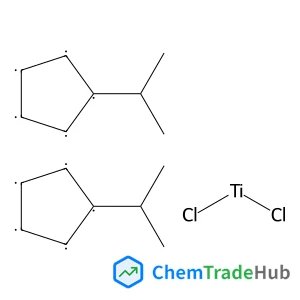
BIS(I-PROPYLCYCLOPENTADIENYL)TITANIUM DICHLORIDE
CAS Number:
12130-65-3
Molecular Formula:
C16H22Cl2Ti
Mengmeng Lan, Guodong Cui, Hongwei Zhang
Caerulomycins are a family of natural alkaloids featuring a 2,2′-bipyridine nucleus. Since the first example of caerulomycins, caerulomycin A from Streptomyces caeruleus, was reported in 1959, there have been 34 natural caerulomycins from microorganisms reported. The unique structure of caerulomycins and their potential bioactivity, including antifungal activity, cytotoxicity, and immunosuppression, have attracted the interest of both chemists and biologists. Herein, we report 8 new caerulomycins (19–22 and 39–42) as well as 14 known analogues (1–3, 6–9, 16, 18, 24, 25, 27, 29, and 31) from wild-type and mutant Actinoalloteichus cyanogriseus WH1-2216-6. The structures including the absolute configurations were unambiguously elucidated by spectroscopic analysis, X-ray single crystal diffraction, 1-phenyl-3-methyl-5-pyrazolone (PMP)-labeling HPLC analysis, Mosher's method and quantum electronic circular dichroism (ECD) calculation. The cytotoxicity of caerulomycins 1–42 and some previously reported analogues was assayed against six human tumor cell lines and a human normal liver cell line, L-02. Compounds 1, 2, 5, 13, 18, 27, and 39 exhibited moderate to strong cytotoxicity against the tumor cells with IC50 values ranging from 0.1 to 50 μM. The structure and activity relationships (SARs) are also discussed. In addition, the caerulomycin glycosides (29, 34, and 39) showed effective selectivity against HCT-116 cells with low toxicity toward the normal L-02 cell line, indicating their potential use as lead compounds for antitumor drugs.
Claudia E. Tait, Anjan Bedi, Ori Gidron, Jan Behrends
DOI: 10.1039/C9CP04135D
Ming-Hsiu Wu, Wan-Jou Chou, Jian-Syun Huang, Darwin Barayang Putungan, Shi-Hsin Lin
DOI: 10.1039/C9CP03893K
Michaela K. Jahn, Daniel A. Obenchain, K. P. Rajappan Nair, Jens-Uwe Grabow, Jean Demaison, Peter D. Godfrey, Don McNaughton
DOI: 10.1039/C9CP06775B
Dhananjay Bhattacharyya
DOI: 10.1039/C9CP03253C
Skandar Taj, Diane Baird, Alexander Rosu-Finsen, Martin R. S. McCoustra
DOI: 10.1039/C9CP90226K
Karl N. Blodgett, Dewei Sun, Joshua L. Fischer, Edwin L. Sibert, III, Timothy S. Zwier
DOI: 10.1039/C9CP04556B
Emmanuelle M. M. Weber, Dennis Kurzbach, Daniel Abergel
DOI: 10.1039/C9CP03334C
Debkumar Rana, Patrice Donfack, Vladislav Jovanov, Veit Wagner, Arnulf Materny
DOI: 10.1039/C9CP03736E
Susana Blanco, Alberto Macario, Juan Carlos López
DOI: 10.1039/C9CP04088A
6-(3-Fluorophenyl)picolinic acid is generally considered safe for laboratory use...
(3R)-3-Pyrrolidinol is used in the pharmaceutical industry as a precursor for dr...
When handling (4R,5R)-4,5-Diethoxycarbonyl-2,2-dimethyldioxolane (CAS: 59779-75-...
1-(6-Chloroimidazo[1,2-b]pyridazin-3-yl)ethanone is often synthesized via a mult...
The market for N-Ethyl-3,4-dimethylbenzylamine (CAS: 39180-83-1) remains steady,...
Tert-butyl 3-(pyrrolidin-1-yl)azetidine-1-carboxylate is a chemical compound wit...
1-Bromo-3-chloro-2,4-dimethoxybenzene (CAS: 1228956-93-1) falls under the classi...
The safety of 8-Bromo-2-methyl-3,4-dihydroisoquinolin-1(2H)-one (CAS: 1368622-07...
Benzyl [(3S)-2,6-dioxo-3-piperidinyl]carbamate is generally safe when handled wi...
1-{[4-(4,4,5,5-Tetramethyl-1,3,2-dioxaborolan-2-yl)phenyl]sulfonyl}pyrrolidine s...

Organic Chemistry Frontiers publishes high-quality research from across organic chemistry. Emphases are placed on studies that make significant contributions to the field of organic chemistry by reporting either new or significantly improved protocols or methodologies. Topics include, but are not limited to the following: Organic synthesis Development of synthetic methodologies Catalysis Natural products Functional organic materials Supramolecular and macromolecular chemistry Physical and computational organic chemistry
![trans-2-{[(Tert-butoxy)carbonyl]amino}cyclobutane-1-carboxylic acid structure](https://static.chemtradehub.com/structs/951/951173-25-4-27cd.webp "trans-2-{[(Tert-butoxy)carbonyl]amino}cyclobutane-1-carboxylic acid structure")