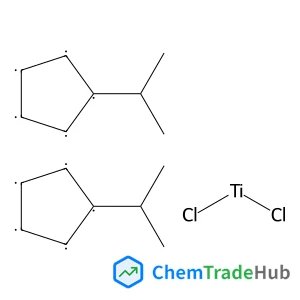
BIS(I-PROPYLCYCLOPENTADIENYL)TITANIUM DICHLORIDE
CAS Number:
12130-65-3
Molecular Formula:
C16H22Cl2Ti
Paran J. Borpatra, Bhaskar Deka, Mohit L. Deb, Pranjal K. Baruah
This review focuses on the intramolecular cyclization of molecules through C–O, C–N and C–S bonds forming C–H functionalizations with an emphasis on the literature after 2000. Intramolecular C–H functionalization reactions attract much interest because of the ease of reaction due to the proximity of reacting centers and favorable entropy over intermolecular reactions. Less by-product formation, high atom economy, ease of purification, and avoidance of prefunctionalization of substrates are the additional advantages. Hence, a number of research articles have been published in this field, but no review is available so far. This review includes the synthesis of various heterocycles involving C–O, C–N and C–S bond creation. This is the first review on the current topic which will motivate the readers to work in this area further.

Chemical Communications

Journal of Peptide Science

Crystallography Reports

Russian Journal of Coordination Chemistry

Acta Materialia

Journal of Saudi Chemical Society

Saudi Pharmaceutical Journal

Current Opinion in Solid State & Materials Science

Russian Journal of Bioorganic Chemistry

Chemistry Education Research and Practice
Juran Kim, Gee Yeong Kim, Trang Thi Thu Nguyen, Seokhyun Yoon, Yoon-Koo Kim, Seung-Yong Lee, Miyoung Kim, Dae-Hyung Cho, Yong-Duck Chung, Je-Ho Lee, Maeng-Je Seong, William Jo
DOI: 10.1039/C9CP06537G
Anthony M. S. Pembere, Chaonan Cui, Rajini Anumula, Haiming Wu, Pan An, Tongling Liang, Zhixun Luo
DOI: 10.1039/D0CP90052D
Artem B. Smolentsev, Ilya M. Magin, Vladimir V. Vyazovkin, Marina V. Parkhats, Anton V. Yadykov, Valerii Z. Shirinian
DOI: 10.1039/C9CP05744G
Marco Sauermoser, Signe Kjelstrup, Bruno G. Pollet, Eirik G. Flekkøy
DOI: 10.1039/C9CP05394H
Golda Mensa-Bonsu, Aude Lietard, Jan R. R. Verlet
DOI: 10.1039/D0CP90056G
Wenyi Shao, Yang Li, Xiang Wang, Xiao Ouyang, Jiafa Cai, Chen Li, Zhengyun Wu, Qiang Xu
DOI: 10.1039/C9CP06259A
Aritra Mandal
DOI: 10.1039/C9CP04101J
6-(3-Fluorophenyl)picolinic acid is generally considered safe for laboratory use...
(3R)-3-Pyrrolidinol is used in the pharmaceutical industry as a precursor for dr...
When handling (4R,5R)-4,5-Diethoxycarbonyl-2,2-dimethyldioxolane (CAS: 59779-75-...
1-(6-Chloroimidazo[1,2-b]pyridazin-3-yl)ethanone is often synthesized via a mult...
The market for N-Ethyl-3,4-dimethylbenzylamine (CAS: 39180-83-1) remains steady,...
Tert-butyl 3-(pyrrolidin-1-yl)azetidine-1-carboxylate is a chemical compound wit...
1-Bromo-3-chloro-2,4-dimethoxybenzene (CAS: 1228956-93-1) falls under the classi...
The safety of 8-Bromo-2-methyl-3,4-dihydroisoquinolin-1(2H)-one (CAS: 1368622-07...
Benzyl [(3S)-2,6-dioxo-3-piperidinyl]carbamate is generally safe when handled wi...
1-{[4-(4,4,5,5-Tetramethyl-1,3,2-dioxaborolan-2-yl)phenyl]sulfonyl}pyrrolidine s...

Organic Chemistry Frontiers publishes high-quality research from across organic chemistry. Emphases are placed on studies that make significant contributions to the field of organic chemistry by reporting either new or significantly improved protocols or methodologies. Topics include, but are not limited to the following: Organic synthesis Development of synthetic methodologies Catalysis Natural products Functional organic materials Supramolecular and macromolecular chemistry Physical and computational organic chemistry