


Catalytic mechanism of phenylacetone monooxygenases for non-native linear substrates
Literature Information
Publication Date
2017-09-07
DOI
10.1039/C7CP03640J
Impact Factor
3.676
Authors
Miguel de Abreu, Lyndsey J. Ferguson, Derek J. Quinn, Thomas S. Moody, Meilan Huang
View Original
Abstract
Phenylacetone monooxygenase (PAMO) is the most stable and thermo-tolerant member of the Baeyer窶天illiger monooxygenase family, and therefore it is an ideal candidate for the synthesis of industrially relevant compounds. However, its limited substrate scope has largely limited its industrial applications. In the present work, we provide, for the first time, the catalytic mechanism of PAMO for the native substrate phenylacetone as well as for a linear non-native substrate 2-octanone, using molecular dynamics simulations, quantum mechanics and quantum mechanics/molecular mechanics calculations. We provide a theoretical basis for the preference of the enzyme for the native aromatic substrate over non-native linear substrates. Our study provides fundamental atomic-level insights that can be employed in the rational engineering of PAMO for wide applications in industrial biocatalysis, in particular, in the biotransformation of long-chain aliphatic oils into potential biodiesels.
Recommended Journals

Russian Journal of Applied Chemistry

Russian Journal of Organic Chemistry

Crystallography Reports

Russian Journal of Coordination Chemistry

Current Opinion in Colloid & Interface Science

Journal of Saudi Chemical Society

Chemical Communications

Journal of Peptide Science

Drug Discovery Today

Russian Chemical Bulletin
Related Literature
Electronic structure and charge transport properties of atomic carbon wires
K. Lambropoulos, C. Simserides
2017-09-22
Paper
DOI: 10.1039/C7CP05134D
Dewetting acrylic polymer films with water/propylene carbonate/surfactant mixtures – implications for cultural heritage conservation
M. Baglioni, C. Montis, F. Brandi, T. Guaragnone, I. Meazzini, P. Baglioni, D. Berti
2017-05-18
Paper
DOI: 10.1039/C7CP02608K
Exploration of significant influences of the operating conditions on the local O2 transport in proton exchange membrane fuel cells (PEMFCs)
Shuiyun Shen, Xiaojing Cheng, Chao Wang, Xiaohui Yan, Changchun Ke, Jiewei Yin, Junliang Zhang
2017-09-06
Paper
DOI: 10.1039/C7CP04837H
Running out of lithium? A route to differentiate between capacity losses and active lithium losses in lithium-ion batteries
Florian Holtstiege, Andrea Wilken, Tobias Placke
2017-09-12
Paper
DOI: 10.1039/C7CP05405J
Exploring coherent electron excitation and migration dynamics by electron diffraction with ultrashort X-ray pulses
Kai-Jun Yuan, André D. Bandrauk
2017-09-14
Communication
DOI: 10.1039/C7CP05067D
Modeling the impedance spectra of mixed conducting thin films with exposed and embedded current collectors
Jiapeng Liu
2017-09-18
Paper
DOI: 10.1039/C7CP03703A
Molecular dynamics investigations of an indicator displacement assay mechanism in a liquid crystal sensor
Qingyu Liu, Fang Zuo, Zhigang Zhao, Junxian Chen, Dingguo Xu
2017-08-11
Paper
DOI: 10.1039/C7CP02292A
Self-assembly of a nanotube from a black phosphorus nanoribbon on a string of fullerenes at low temperature
Jiao Shi, Ling-Nan Liu, Qing-Hua Qin
2017-08-10
Paper
DOI: 10.1039/C7CP04427E
Theoretical study on geometric, electronic and catalytic performances of Fe dopant pairs in graphene
Yanan Tang, Huadou Chai, Weiguang Chen, Xiao Cui, Yaqiang Ma, Mingyu Zhao
2017-09-08
Paper
DOI: 10.1039/C7CP05683D
Self-assembled mesoscopic surface domains of fluorocarbon–hydrocarbon diblocks can form at zero surface pressure: tilting of solid-like hydrocarbon moieties compensates for cross-section mismatch with fluorocarbon moieties
Christian Schwieger, Xianhe Liu, Marie Pierre Krafft
2017-05-30
Paper
DOI: 10.1039/C7CP02432K
You might also like
Compound Q&A
What is 3-Fluoro-2-methylbenzylamine (CAS: 771573-36-5)?
3-Fluoro-2-methylbenzylamine is an organic compound with the CAS number 771573-3...
771573-36-53-Fluoro-2-methylben...
Compound Q&A
Is Tert-butyl 2-(oxetan-3-ylidene)acetate (CAS: 1207175-03-8) safe?
Tert-butyl 2-(oxetan-3-ylidene)acetate is considered safe for its intended uses ...
1207175-03-8Tert-butyl 2-(oxetan...
Compound Q&A
What precautions should be taken when handling 4-Acetyl-2-fluorobenzonitrile (CAS: 214760-18-6)?
Proper personal protective equipment (PPE) such as gloves, goggles, and a lab co...
214760-18-64-Acetyl-2-fluoroben...
Compound Q&A
How is 2-Ethyl-4-methyl-1,3-thiazole (CAS: 15679-12-6) typically synthesized?
2-Ethyl-4-methyl-1,3-thiazole is commonly synthesized via the reaction of thiour...
15679-12-62-Ethyl-4-methyl-1,3...
Compound Q&A
How should 5',5''-([2,2'-Bithiophene]-5,5'-diyl)bis(([1,1':3',1''-terphenyl]-4,4''-dicarboxylic acid)) (CAS: 1227780-71-3) be stored?
This compound should be stored in a cool, dry place away from direct sunlight an...
1227780-71-35',5''''-([2,2'-Bith...
Compound Q&A
What regulatory guidelines apply to L-Lysine Acetate Salt (CAS: 52315-92-1)?
L-Lysine Acetate Salt (CAS: 52315-92-1) is subject to various regulatory guideli...
52315-92-1L-LYSINE ACETATE SAL...
Compound Q&A
Is 6-Fluoro-3-hydroxy-2-pyrazinecarboxamide (CAS: 259793-96-9) safe?
6-Fluoro-3-hydroxy-2-pyrazinecarboxamide (CAS: 259793-96-9) is generally conside...
259793-96-96-Fluoro-3-hydroxy-2...
Compound Q&A
What are the physical and chemical properties of 1,1'-Sulfonylbis(1H-imidazole) (CAS: 7189-69-7)?
1,1'-Sulfonylbis(1H-imidazole) is a crystalline solid with a molecular weight of...
7189-69-71,1'-Sulfonylbis(1H-...
Compound Q&A
What industries use 4-methyl-7-nitro-1H-indole-3-carbonitrile (CAS: 289483-82-5)?
4-Methyl-7-nitro-1H-indole-3-carbonitrile (CAS: 289483-82-5) is primarily used i...
289483-82-54-methyl-7-nitro-1H-...
Compound Q&A
How should waste containing 5-Bromo-3-indolyl-beta-galactoside (CAS: 97753-82-7) be handled?
Waste containing 5-Bromo-3-indolyl-beta-galactoside (CAS: 97753-82-7) should be ...
97753-82-75-Bromo-3-indolyl-be...
Source Journal
Physical Chemistry Chemical Physics

CiteScore:
5.5
Self-citation Rate:
10.3%
Articles per Year:
3036
Physical Chemistry Chemical Physics (PCCP) is an international journal co-owned by 19 physical chemistry and physics societies from around the world. This journal publishes original, cutting-edge research in physical chemistry, chemical physics and biophysical chemistry. To be suitable for publication in PCCP, articles must include significant innovation and/or insight into physical chemistry; this is the most important criterion that reviewers and Editors will judge against when evaluating submissions. The journal has a broad scope and welcomes contributions spanning experiment, theory, computation and data science. Topical coverage includes spectroscopy, dynamics, kinetics, statistical mechanics, thermodynamics, electrochemistry, catalysis, surface science, quantum mechanics, quantum computing and machine learning. Interdisciplinary research areas such as polymers and soft matter, materials, nanoscience, energy, surfaces/interfaces, and biophysical chemistry are welcomed if they demonstrate significant innovation and/or insight into physical chemistry. Joined experimental/theoretical studies are particularly appreciated when complementary and based on up-to-date approaches.
Recommended Compounds



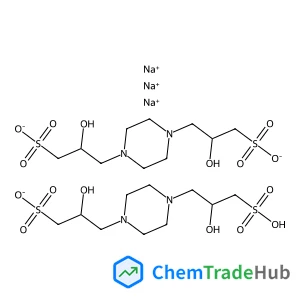
3,3'-(Piperazine-1,4-diyl)bis(2-hydroxypropane-1-sulfonic acid) Sodium Salt
CAS Number:
108321-08-0
Molecular Formula:
C20H41N4Na3O16S4
Recommended Suppliers





Disclaimer
This page provides academic journal information for reference and research purposes only. We are not affiliated with any journal publishers and do not handle publication submissions. For publication-related inquiries, please contact the respective journal publishers directly.
If you notice any inaccuracies in the information displayed, please contact us at support@chemtradehub.com. We will promptly review and address your concerns.