












Regulation of transport properties by polytypism: a computational study on bilayer MoS2
Literature Information
Publication Date
2017-07-20
DOI
10.1039/C7CP02973J
Impact Factor
3.676
Authors
Swastika Banerjee, Cheol Seong Hwang, Jung-Hae Choi, Seung-Cheol Lee
View Original
Abstract
Being a member of the van der Waals class of solids, bilayer MoS2 exhibits polytypism due to different possible stacking arrangements, namely, 2Hc, 2Ha and 3R-polytypes. Unlike monolayer MoS2, these bilayers exhibit indirect band gaps. Band extrema states originate from a linear combination of Mo-(d) and S-(p) orbitals which are sensitive to the interlayer interactions. We have studied the impact of stacking pattern on the electronic structure and electron/hole transport properties of these polytypes. Based on first-principles computations coupled with the Boltzmann transport formalism, we found that a strong electron–hole anisotropy can be realised in the 2Ha-MoS2 polytype unlike in a monolayer which is isotropic in nature. A staggered arrangement between two layers results in a higher relaxation time for electrons compared to holes leading to anisotropy which is of importance in device engineering.
Related Literature
Application of an addition–fragmentation-chain transfer monomer in di(meth)acrylate network formation to reduce polymerization shrinkage stress
Parag K. Shah, Christopher N. Bowman
2017-06-21
Paper
DOI: 10.1039/C7PY00702G
Stereochemical effects on the mechanical and viscoelastic properties of renewable polyurethanes derived from isohexides and hydroxymethylfurfural
Robert J. Kieber, III, Samantha A. Silver, Justin G. Kennemur
2017-07-24
Paper
DOI: 10.1039/C7PY00949F
Sustainable polyvinyl acetals from bioaromatic aldehydes
Mayra Rostagno, Steven Shen, Ion Ghiviriga, Stephen A. Miller
2017-03-24
Paper
DOI: 10.1039/C7PY00205J
Protein–polymer conjugates prepared via host–guest interactions: effects of the conjugation site, polymer type and molecular weight on protein activity
Xiujuan Shi, Yuecheng Cui, Weikang Yang, Lin Yuan, Hong Chen
2016-07-22
Paper
DOI: 10.1039/C6PY00882H
Oxygen tolerant photopolymerization for ultralow volumes
Robert Chapman
2017-02-16
Paper
DOI: 10.1039/C7PY00007C
Ultrafast diffusion-controlled thiol–ene based crosslinking of silicone elastomers with tailored mechanical properties for biomedical applications
2016-08-02
Paper
DOI: 10.1039/C6PY01134A
Aqueous RAFT at pH zero: enabling controlled polymerization of unprotected acyl hydrazide methacrylamides
Emily A. Hoff, Brooks A. Abel, Chase A. Tretbar, Charles L. McCormick, Derek L. Patton
2016-10-17
Communication
DOI: 10.1039/C6PY01563H
A facile route to well-defined imidazolium-based poly(ionic liquid)s of enhanced conductivity via RAFT
Karol Erfurt, Anna Chrobok, Andrzej Zięba
2017-08-02
Paper
DOI: 10.1039/C7PY01046J
You might also like
Compound Q&A
What are the main uses of 4-Nitrophenyl phosphate disodium salt hexahydrate (CAS: 333338-18-4)?
4-Nitrophenyl phosphate disodium salt hexahydrate is primarily used as a substra...
333338-18-44-Nitrophenyl phosph...
Compound Q&A
What are the main uses of 2-(Trifluoromethyl)-1,3-oxazole-4-carboxylic Acid (CAS: 1060816-01-4)?
2-(Trifluoromethyl)-1,3-oxazole-4-carboxylic Acid (CAS: 1060816-01-4) is widely ...
1060816-01-42-(Trifluoromethyl)-...
Compound Q&A
How should 2-Fluoro-4-biphenylcarboxylic acid (CAS: 137045-30-8) be stored?
2-Fluoro-4-biphenylcarboxylic acid should be stored in a cool, dry place at room...
137045-30-82-Fluoro-4-biphenylc...
Compound Q&A
What industries use Prednisolone-21-Carboxylic Acid (CAS: 61549-70-0)?
Prednisolone-21-Carboxylic Acid is primarily used in the pharmaceutical industry...
61549-70-0Prednisolone-21-Carb...
Compound Q&A
How should 4-(Hydrazinomethyl)-1,2,3-benzenetriol (CAS: 3614-72-0) be stored?
4-(Hydrazinomethyl)-1,2,3-benzenetriol (CAS: 3614-72-0) should be stored in a co...
3614-72-04-(Hydrazinomethyl)-...
Compound Q&A
What industries use 4-Amino-1-methyl-1H-pyrazole-5-carboxylic acid hydrochloride (CAS: 92534-70-8)?
4-Amino-1-methyl-1H-pyrazole-5-carboxylic acid hydrochloride (CAS: 92534-70-8) i...
92534-70-84-Amino-1-methyl-1H-...
Compound Q&A
What regulatory guidelines apply to dehydropachymic acid (CAS: 77012-31-8)?
Dehydropachymic acid (CAS: 77012-31-8) is regulated by various agencies. It fall...
77012-31-8Dehydropachymic acid
Compound Q&A
What is the market or research trend for 6-[(2,2-Dimethylpropanoyl)amino]nicotinic acid (CAS: 898561-66-5)?
The market and research trends for 6-[(2,2-Dimethylpropanoyl)amino]nicotinic aci...
898561-66-56-[(2,2-Dimethylprop...
Compound Q&A
How should 1,10-Phenanthroline-2,9-dicarbaldehyde (CAS: 57709-62-3) be stored?
1,10-Phenanthroline-2,9-dicarbaldehyde should be stored in a cool, dry place awa...
57709-62-31,10-Phenanthroline-...
Compound Q&A
How is 5-Carbamoyl-11-oxo-10,11-dihydro-5H-dibenzo[b,f]azepin-10-yl acetate (CAS: 113952-21-9) typically synthesized?
5-Carbamoyl-11-oxo-10,11-dihydro-5H-dibenzo[b,f]azepin-10-yl acetate can be synt...
113952-21-95-Carbamoyl-11-oxo-1...
Source Journal
Physical Chemistry Chemical Physics

CiteScore:
5.5
Self-citation Rate:
10.3%
Articles per Year:
3036
Physical Chemistry Chemical Physics (PCCP) is an international journal co-owned by 19 physical chemistry and physics societies from around the world. This journal publishes original, cutting-edge research in physical chemistry, chemical physics and biophysical chemistry. To be suitable for publication in PCCP, articles must include significant innovation and/or insight into physical chemistry; this is the most important criterion that reviewers and Editors will judge against when evaluating submissions. The journal has a broad scope and welcomes contributions spanning experiment, theory, computation and data science. Topical coverage includes spectroscopy, dynamics, kinetics, statistical mechanics, thermodynamics, electrochemistry, catalysis, surface science, quantum mechanics, quantum computing and machine learning. Interdisciplinary research areas such as polymers and soft matter, materials, nanoscience, energy, surfaces/interfaces, and biophysical chemistry are welcomed if they demonstrate significant innovation and/or insight into physical chemistry. Joined experimental/theoretical studies are particularly appreciated when complementary and based on up-to-date approaches.
Recommended Compounds

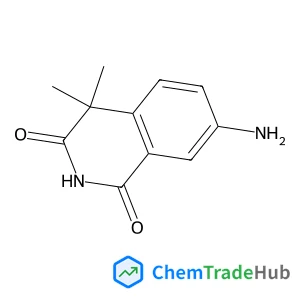
1,3(2H,4H)-Isoquinolinedione, 7-amino-4,4-dimethyl-
CAS Number:
14576-22-8
Molecular Formula:
C11H12N2O2
Recommended Suppliers





Disclaimer
This page provides academic journal information for reference and research purposes only. We are not affiliated with any journal publishers and do not handle publication submissions. For publication-related inquiries, please contact the respective journal publishers directly.
If you notice any inaccuracies in the information displayed, please contact us at support@chemtradehub.com. We will promptly review and address your concerns.