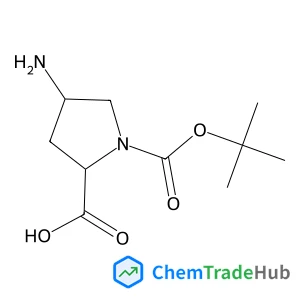
(2R,4R)-1-Boc-4-Aminopyrrolidine-2-carboxylic acid
CAS Number:
132622-98-1
Molecular Formula:
C10H18N2O4
Sheikha Lardhi, Antton Curutchet, Luigi Cavallo, Moussab Harb, Tangui Le Bahers
The investigation of the BiCuOCh (Ch = S, Se and Te) semiconductor family for thermoelectric or photovoltaic materials is a topic of increasing research interest. These materials can also be considered for photochemical water splitting if one representative having a bandgap, Eg, at around 2 eV can be developed. With this aim, we simulated the solid solutions Bi1−xRExCuOS (RE = Y, La, Gd and Lu) from pure BiCuOS (Eg ∼ 1.1 eV) to pure RECuOS compositions (Eg ∼ 2.9 eV) by DFT calculations based on the HSE06 range-separated hybrid functional with the inclusion of spin–orbit coupling. Starting from the thermodynamic stability of the solid solution, several properties were computed for each system including bandgaps, dielectric constants, effective masses and exciton binding energies. We discussed the variation of these properties based on the relative organization of Bi and RE atoms in their common sublattice to offer a physical understanding of the influence of the RE doping of BiCuOS. Some compositions were found to give appropriate properties for water splitting applications. Furthermore, we found that at low RE fractions the transport properties of BiCuOS are improved that can find applications beyond water splitting.

Chemical Communications

Nature Medicine

Saudi Pharmaceutical Journal

Russian Journal of Applied Chemistry

Russian Journal of General Chemistry

Russian Journal of Coordination Chemistry

Russian Journal of Organic Chemistry

Current Opinion in Colloid & Interface Science

Organic Process Research & Development

Crystallography Reports
Xinyu Hu, Liandong Feng, Aming Xie, Wei Wei, Shiming Wang, Jianfa Zhang, Wei Dong
DOI: 10.1039/C3TB21711F
Xiaoyu Wu, Songmei Li, Bo Wang, Jianhua Liu, Mei Yu
DOI: 10.1039/C7CP00509A
Yi-jun Zhang, Wen-qi Bai, Xiu-li Wang, Xin-hui Xia, Chang-dong Gu, Jiang-ping Tu
DOI: 10.1039/C6TA06612G
Sajid Ali Ansari, Nazish Parveen, Thi Hiep Han, Mohammad Omaish Ansari, Moo Hwan Cho
DOI: 10.1039/C6CP00159A
Manali Banerjee, Sisira Saraswatula, Laura Grace Willows, Hannah Woods, Blair Brettmann
DOI: 10.1039/C8TB01554F
Suresh Kumar Vasa, Petra Rovó, Karin Giller, Stefan Becker, Rasmus Linser
DOI: 10.1039/C5CP06601H
Raheleh Mohammadpour, Azam Iraji zad, Anders Hagfeldt, Gerrit Boschloo
DOI: 10.1039/C1CP21517E
Markus Hammann, Dante Castillo, Christian Anger, Bernhard Rieger
DOI: 10.1039/C4TA03696D
Xin Li, Fangyu Shen, Kebing Wang, Shuang Lin, Lei Zhou, Si Chen, Jin Wang, Nan Huang
DOI: 10.1039/C8TB01976B
When considering alternatives to 1-(4-Chlorophenyl)-N-hydroxymethanimine (CAS: 3...
This compound should be stored in a cool, dry place away from direct sunlight. I...
3-(4-Bromophenyl)-5-(2-fluorophenyl)-1,2,4-oxadiazole is synthesized through a m...
5-Chloro-2-(4-chlorophenyl)-4-methyl-6-[3-(1-piperidinyl)propoxy]pyrimidine (CAS...
2-Chloro-4-(difluoromethoxy)pyridine is used in the pharmaceutical industry for ...
3-Chloro-6-methylpyridazine (CAS: 1121-79-5) is classified under the Globally Ha...
Several alternatives can be used in the synthesis of Methyl 4,5-dimethyl-2-nitro...
Alternatives to (2E,2'E)-3,3'-(1,4-Phenylene)bisacrylaldehyde include other acry...
3-Amino-5-chloropyridin-2-ol hydrochloride is an organic compound with the CAS n...
When handling 6,7-Difluoro-2,3-dihydro-4H-chromen-4-one, it is essential to wear...

Physical Chemistry Chemical Physics (PCCP) is an international journal co-owned by 19 physical chemistry and physics societies from around the world. This journal publishes original, cutting-edge research in physical chemistry, chemical physics and biophysical chemistry. To be suitable for publication in PCCP, articles must include significant innovation and/or insight into physical chemistry; this is the most important criterion that reviewers and Editors will judge against when evaluating submissions. The journal has a broad scope and welcomes contributions spanning experiment, theory, computation and data science. Topical coverage includes spectroscopy, dynamics, kinetics, statistical mechanics, thermodynamics, electrochemistry, catalysis, surface science, quantum mechanics, quantum computing and machine learning. Interdisciplinary research areas such as polymers and soft matter, materials, nanoscience, energy, surfaces/interfaces, and biophysical chemistry are welcomed if they demonstrate significant innovation and/or insight into physical chemistry. Joined experimental/theoretical studies are particularly appreciated when complementary and based on up-to-date approaches.