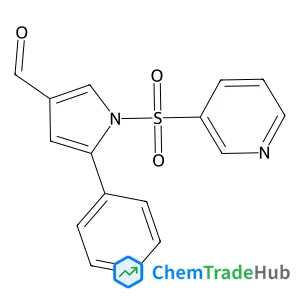
5-Phenyl-1-(pyridin-3-ylsulfonyl)-1H-pyrrole-3-carbaldehyde
CAS Number:
881676-90-0
Molecular Formula:
C16H12N2O3S
Markus Hammann, Dante Castillo, Christian Anger, Bernhard Rieger
A series of phenolate-containing polyelectrolytes were prepared via post-polymerization treatment of poly(4-vinylphenol) with tetraalkylphosphonium hydroxides (tetrabutylphosphonium hydroxide [P4444][OH], tributyltetradecylphosphonium hydroxide [P44414][OH] and trihexyltetradecylphosphonium hydroxide [P66614][OH]) or with tributylmethylphosphonium methylcarbonate [P4441][CO3CH3]. Also, mono- and dimethoxy-substituted vinylphenols were synthesized, polymerized and treated with [P66614][OH] to gain the corresponding polyelectrolytes. CO2 absorption capacity was measured as a function of the cation species and as a function of methoxy-substituents at the phenyl ring. ATR-IR and 13C MAS NMR spectroscopy confirmed chemisorption of CO2via formation of a phenol–carbonate complex at room temperature and 1 bar CO2 partial pressure. The introduction of an oligo(ethylene glycol) methacrylate co-monomer proved to suppress the formation of crystalline domains in the resulting material, enhancing CO2 absorption capacity and thin film stability. The polyelectrolytes reached a reversible CO2 absorption capacity of up to 0.65 in terms of CO2 molecule per phenolate group at 35 °C and 1 bar CO2 pressure, making them promising candidates for CO2-selective polymeric membrane materials. Thin coatings of the polyelectrolytes atop of a polysiloxane-based membrane support exhibited excellent adhesion and homogeneity as well as a highly competitive ideal CO2/N2 permeability selectivity of up to 67.7 at 15 °C and 1 bar transmembrane pressure.
Tong Liu, Danqing Zheng
DOI: 10.1039/C7QO00075H
Da-Liang Zhu, Hong-Xi Li, Ze-Ming Xu, Hai-Yan Li, David J. Young, Jian-Ping Lang
DOI: 10.1039/C9QO00536F
Wei Guo, Panwang Zhou, Zhe Tang
DOI: 10.1039/C9QO00295B
Irazema J. Islas, Dillan Stengel, Cesar A. Garcia, J. Bennett Addison, George N. Samaan, Gregory P. Holland
DOI: 10.1039/C9QO00232D
Ya Ding, Hao Li, Yunge Meng, Te Zhang, Jiawen Li, Qiu-Yun Chen
DOI: 10.1039/C7QO00276A
Ze-Feng Xu, Lihong Shan, Wan Zhang, Mengjie Cen, Chuan-Ying Li
DOI: 10.1039/C9QO00126C
Jinzhong Yao, Linlin Chen, Linfeng Hu, Xiaofang Li, Hongwei Zhou
DOI: 10.1039/C9QO00028C
Yang Wang, Bingnan Du, Wanxing Sha, Haibo Mei, Jianlin Han, Yi Pan
DOI: 10.1039/C7QO00168A
Solène Collin, Nicolas Giraud, Elise Dumont, Olivia Reinaud
DOI: 10.1039/C9QO00263D
When considering alternatives to 1-(4-Chlorophenyl)-N-hydroxymethanimine (CAS: 3...
This compound should be stored in a cool, dry place away from direct sunlight. I...
3-(4-Bromophenyl)-5-(2-fluorophenyl)-1,2,4-oxadiazole is synthesized through a m...
5-Chloro-2-(4-chlorophenyl)-4-methyl-6-[3-(1-piperidinyl)propoxy]pyrimidine (CAS...
2-Chloro-4-(difluoromethoxy)pyridine is used in the pharmaceutical industry for ...
3-Chloro-6-methylpyridazine (CAS: 1121-79-5) is classified under the Globally Ha...
Several alternatives can be used in the synthesis of Methyl 4,5-dimethyl-2-nitro...
Alternatives to (2E,2'E)-3,3'-(1,4-Phenylene)bisacrylaldehyde include other acry...
3-Amino-5-chloropyridin-2-ol hydrochloride is an organic compound with the CAS n...
When handling 6,7-Difluoro-2,3-dihydro-4H-chromen-4-one, it is essential to wear...

Journal of Materials Chemistry A, B & C cover high quality studies across all fields of materials chemistry. The journals focus on those theoretical or experimental studies that report new understanding, applications, properties and synthesis of materials. The journals have a strong history of publishing quality reports of interest to interdisciplinary communities and providing an efficient and rigorous service through peer review and publication. The journals are led by an international team of Editors-in-Chief and Associate Editors who are all active researchers in their fields. Journal of Materials Chemistry A, B & C are separated by the intended application of the material studied. Broadly, applications in energy and sustainability are of interest to Journal of Materials Chemistry A, applications in biology and medicine are of interest to Journal of Materials Chemistry B, and applications in optical, magnetic and electronic devices are of interest to Journal of Materials Chemistry C. More than one Journal of Materials Chemistry journal may be suitable for certain fields and researchers are encouraged to submit their paper to the journal that they feel best fits for their particular article. Example topic areas within the scope of Journal of Materials Chemistry A are listed below. This list is neither exhaustive nor exclusive. Artificial photosynthesis Batteries Carbon dioxide conversion Catalysis Fuel cells Gas capture/separation/storage Green/sustainable materials Hydrogen generation Hydrogen storage Photocatalysis Photovoltaics Self-cleaning materials Self-healing materials Sensors Supercapacitors Thermoelectrics Water splitting Water treatment
![4-[(3-Chloro-2-fluorophenyl)amino]-7-methoxy-6-quinazolinyl acetate structure](https://static.chemtradehub.com/structs/740/740081-22-5-f58f.webp "4-[(3-Chloro-2-fluorophenyl)amino]-7-methoxy-6-quinazolinyl acetate structure")