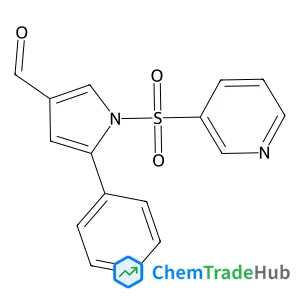
5-Phenyl-1-(pyridin-3-ylsulfonyl)-1H-pyrrole-3-carbaldehyde
CAS Number:
881676-90-0
Molecular Formula:
C16H12N2O3S
Manali Banerjee, Sisira Saraswatula, Laura Grace Willows, Hannah Woods, Blair Brettmann
A significant research focus in the pharmaceutical industry is on methods to improve drug uptake into the body by increased dissolution of poorly water soluble active pharmaceutical ingredients (APIs) or sustained drug release behavior, which results in higher overall uptake. Production of higher energy, higher solubility polymorphs is one approach to address this problem. Here we utilize natural materials, cellulose nanocrystals (CNCs), that have a high surface area covered with readily-modified hydroxyl groups to form organogels that promote API crystallization into polymorphs that differ from the as-received materials. We form the gels by oxidizing the CNCs and mixing them with an amine-containing surfactant, octadecylamine (ODA) in dimethylsulfoxide (DMSO) and we optimize the composition and preparation conditions for these gels. The APIs, sulfamethoxazole, sulfapyridine, and sulfamerazine, are added to the mixture prior to the gelation step and are expected to localize in the solvophobic regions of the physical gel and crystallize. We found that sulfamethoxazle recovered from the gels is in the amorphous state, while sulfapyridine crystallizes into a mixture of forms I, III and IV, and sulfamerazine crystallizes into forms I and II, which are different from the as-received materials. This system shows promise for rational design of nanocellulose organogel supports for heterogeneous crystallization of pharmaceutical materials with desired polymorphs.
Jian Xu, Hui-Lin Zhu, Jie Zhang, Wen-Yuan Liu, Jian-Guang Luo, Ke Pan, Wen-Yuan Cao, Qi-Rui Bi
DOI: 10.1039/C9QO00174C
Kewen Sun, Shiyi Jin, Shuaishuai Fang, Rui Ma, Xinmiao Zhang, Maoyu Gao, Wanqi Zhang, Tao Lu, Ding Du
DOI: 10.1039/C9QO00468H
Ze-Feng Xu, Lihong Shan, Wan Zhang, Mengjie Cen, Chuan-Ying Li
DOI: 10.1039/C9QO00126C
Kuntal Pal, Chandra M. R. Volla
DOI: 10.1039/C7QO00101K
Meng Yan, Xu-Bo Liu, Zhong-Zheng Gao, Yi-Peng Wu, Jun-Li Hou, Hui Wang, Dan-Wei Zhang, Yi Liu, Zhan-Ting Li
DOI: 10.1039/C9QO00382G
Xiao-Rui Ren, Jun-Bing Lin, Xiu-Qin Hu, Peng-Fei Xu
DOI: 10.1039/C9QO00357F
Weisai Zu, Shuai Liu, Xin Jia, Liang Xu
DOI: 10.1039/C8QO01313F
Jose R. Correa, Karen L. R. Paiva, Michele Baril, Daniel F. S. Machado, Jackson D. Scholten, Paulo E. N. de Souza, Fabiane H. Veiga-Souza, John Spencer
DOI: 10.1039/C9QO00428A
Qiang Zhang, Jianxin Ji, Wei Wei
DOI: 10.1039/C7QO00202E
Ya Ding, Hao Li, Yunge Meng, Te Zhang, Jiawen Li, Qiu-Yun Chen
DOI: 10.1039/C7QO00276A
When considering alternatives to 1-(4-Chlorophenyl)-N-hydroxymethanimine (CAS: 3...
This compound should be stored in a cool, dry place away from direct sunlight. I...
3-(4-Bromophenyl)-5-(2-fluorophenyl)-1,2,4-oxadiazole is synthesized through a m...
5-Chloro-2-(4-chlorophenyl)-4-methyl-6-[3-(1-piperidinyl)propoxy]pyrimidine (CAS...
2-Chloro-4-(difluoromethoxy)pyridine is used in the pharmaceutical industry for ...
3-Chloro-6-methylpyridazine (CAS: 1121-79-5) is classified under the Globally Ha...
Several alternatives can be used in the synthesis of Methyl 4,5-dimethyl-2-nitro...
Alternatives to (2E,2'E)-3,3'-(1,4-Phenylene)bisacrylaldehyde include other acry...
3-Amino-5-chloropyridin-2-ol hydrochloride is an organic compound with the CAS n...
When handling 6,7-Difluoro-2,3-dihydro-4H-chromen-4-one, it is essential to wear...
Journal of Materials Chemistry A, B & C cover high quality studies across all fields of materials chemistry. The journals focus on those theoretical or experimental studies that report new understanding, applications, properties and synthesis of materials. The journals have a strong history of publishing quality reports of interest to interdisciplinary communities and providing an efficient and rigorous service through peer review and publication. The journals are led by an international team of Editors-in-Chief and Associate Editors who are all active researchers in their fields. Journal of Materials Chemistry A, B & C are separated by the intended application of the material studied. Broadly, applications in energy and sustainability are of interest to Journal of Materials Chemistry A, applications in biology and medicine are of interest to Journal of Materials Chemistry B, and applications in optical, magnetic and electronic devices are of interest to Journal of Materials Chemistry C. More than one Journal of Materials Chemistry journal may be suitable for certain fields and researchers are encouraged to submit their paper to the journal that they feel best fits for their particular article. Example topic areas within the scope of Journal of Materials Chemistry B are listed below. This list is neither exhaustive nor exclusive. Antifouling coatings Biocompatible materials Bioelectronics Bioimaging Biomimetics Biomineralisation Bionics Biosensors Diagnostics Drug delivery Gene delivery Immunobiology Nanomedicine Regenerative medicine & Tissue engineering Scaffolds Soft robotics Stem cells Therapeutic devices image block All articles published in Journal of Materials Chemistry B from 2019 onwards will be indexed in MEDLINE®. Articles that primarily focus on providing insight into the underlying science and performance of biomaterials within a biological environment are more suited to our companion journal, Biomaterials Science.