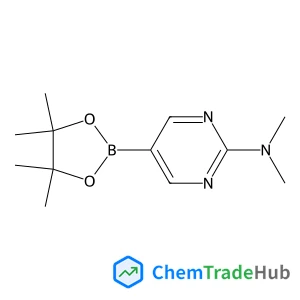
N,N-Dimethyl-5-(4,4,5,5-tetramethyl-1,3,2-dioxaborolan-2-yl)-2-pyrimidinamine
CAS Number:
1032759-30-0
Molecular Formula:
C12H20BN3O2
Monofunctional arylazophosphonates p-X–C6H4N12N2PO(OCH3)21a–f with X=H (1a, 1b), Cl (1c), CH3O 2a–c with X=–(2a), O (2b) and CO (2c) were prepared. They showed relatively high photochemical and thermal stability. Monofunctional compounds 1a–f were reversibly reduced at the cathode in the region -0.85 to -1.35 V (vs. SCE) and the corresponding peak potentials correlated well with Hammett constants of the substituents. Bifunctional compounds 2a–c were reversibly reduced at -0.68 to -1.34 V. The first peak was reversible, and the second peak, following closely, was quasireversible. Generally, the anodic oxidation was irreversible. Using EPR spectroscopy, stable anion radicals were generated from the monomeric arylazophosphonates 1a–f. The unpaired spin density was centred on the azo and phosphonate group, with average splitting constants aN10.80, aN20.37 and aP0.88 mT, and nonequivalent ortho and meta protons aHo,o0.31 and 0.39 mT, aHm,m0.11 and 0.12 mT. Splitting constants aN1, aN2 and aP correlated well with the Hammett constants of the substituents X with a positive slope for aN2 and aP and a negative one for aN1. The EPR spectra of anion radicals from the bifunctional compounds 2a–c are more complex and indicate a consecutive rearrangement of primary anion radicals.
Chunying Gao, Han Zhang, Ming Wu, Yang Liu, Yipan Wu, Xinlin Yang, Xizeng Feng
DOI: 10.1039/C2PY20012K
Mitsuhiro Ebara, Naokazu Idota, Ravin Narain
DOI: 10.1039/C2PY00589A
Derek L. Patton, Kirt A. Page, Emily A. Hoff, Michael J. Fasolka, Kathryn L. Beers
DOI: 10.1039/C2PY20023F
Samuel Aleksanian, Behnoush Khorsand, Rolf Schmidt, Jung Kwon Oh
DOI: 10.1039/C2PY20154B
Ian M. Henderson, Ryan C. Hayward
DOI: 10.1039/C2PY20042B
Robert Quintana, Olivier Persenaire, Leila Bonnaud, Philippe Dubois
DOI: 10.1039/C1PY00421B
Guillaume Delaittre, Maud Save, Marianne Gaborieau, Patrice Castignolles, Jutta Rieger, Bernadette Charleux
DOI: 10.1039/C2PY20084H
When considering alternatives to 1-(4-Chlorophenyl)-N-hydroxymethanimine (CAS: 3...
This compound should be stored in a cool, dry place away from direct sunlight. I...
3-(4-Bromophenyl)-5-(2-fluorophenyl)-1,2,4-oxadiazole is synthesized through a m...
5-Chloro-2-(4-chlorophenyl)-4-methyl-6-[3-(1-piperidinyl)propoxy]pyrimidine (CAS...
2-Chloro-4-(difluoromethoxy)pyridine is used in the pharmaceutical industry for ...
3-Chloro-6-methylpyridazine (CAS: 1121-79-5) is classified under the Globally Ha...
Several alternatives can be used in the synthesis of Methyl 4,5-dimethyl-2-nitro...
Alternatives to (2E,2'E)-3,3'-(1,4-Phenylene)bisacrylaldehyde include other acry...
3-Amino-5-chloropyridin-2-ol hydrochloride is an organic compound with the CAS n...
When handling 6,7-Difluoro-2,3-dihydro-4H-chromen-4-one, it is essential to wear...

Physical Chemistry Chemical Physics (PCCP) is an international journal co-owned by 19 physical chemistry and physics societies from around the world. This journal publishes original, cutting-edge research in physical chemistry, chemical physics and biophysical chemistry. To be suitable for publication in PCCP, articles must include significant innovation and/or insight into physical chemistry; this is the most important criterion that reviewers and Editors will judge against when evaluating submissions. The journal has a broad scope and welcomes contributions spanning experiment, theory, computation and data science. Topical coverage includes spectroscopy, dynamics, kinetics, statistical mechanics, thermodynamics, electrochemistry, catalysis, surface science, quantum mechanics, quantum computing and machine learning. Interdisciplinary research areas such as polymers and soft matter, materials, nanoscience, energy, surfaces/interfaces, and biophysical chemistry are welcomed if they demonstrate significant innovation and/or insight into physical chemistry. Joined experimental/theoretical studies are particularly appreciated when complementary and based on up-to-date approaches.
![6-Bromo-2,3-dihydro-1H-pyrido[2,3-b][1,4]oxazine structure](https://static.chemtradehub.com/structs/120/1203499-17-5-b4d1.webp "6-Bromo-2,3-dihydro-1H-pyrido[2,3-b][1,4]oxazine structure")
![[4-(Isobutyrylamino)phenyl]boronic acid structure](https://static.chemtradehub.com/structs/874/874219-50-8-6ab5.webp "[4-(Isobutyrylamino)phenyl]boronic acid structure")