












Access to aliphatic protons as reporters in non-deuterated proteins by solid-state NMR
Literature Information
Publication Date
2015-11-20
DOI
10.1039/C5CP06601H
Impact Factor
3.676
Authors
Suresh Kumar Vasa, Petra Rovó, Karin Giller, Stefan Becker, Rasmus Linser
View Original
Abstract
Interactions within proteins, with their surrounding, and with other molecules are mediated mostly by hydrogen atoms. In fully protonated, inhomogeneous, or larger proteins, however, aliphatic proton shifts tend to show little dispersion despite fast Magic-Angle Spinning. 3D correlations dispersing aliphatic proton shifts by their better resolved amide N/H shifts can alleviate this problem. Using inverse second-order cross-polarization (iSOCP), we here introduce dedicated and improved means to sensitively link site-specific chemical shift information from aliphatic protons with a backbone amide resolution. Thus, even in cases where protein deuteration is impossible, this approach may enable access to various aspects of protein functions that are reported on by protons.
Recommended Journals
Related Literature
When the strategies for cellular selectivity fail. Challenges and surprises in the design and application of fluorescent benzothiadiazole derivatives for mitochondrial staining
Jose R. Correa, Karen L. R. Paiva, Michele Baril, Daniel F. S. Machado, Jackson D. Scholten, Paulo E. N. de Souza, Fabiane H. Veiga-Souza, John Spencer
2019-05-06
Research Article
DOI: 10.1039/C9QO00428A
Correction: Copper-catalyzed direct C–H phosphorylation of N-imino isoquinolinium ylides with H-phosphonates
Xin-Chen Zhan, Yu-Yuan Hei, Jian-Lan Song, Peng-Cheng Qian, Xing-Guo Zhang, Chen-Liang Deng
2019-05-15
Correction
DOI: 10.1039/C9QO90046B
Copper-catalyzed highly diastereoselective cross-dehydrogenative coupling between 8-hydroxyisochromanes and 1,3-dicarbonyl compounds
Zhen Zhang, Xiao-Ming Zhang, Fu-Min Zhang, Shao-Hua Wang
2019-05-08
Research Article
DOI: 10.1039/C9QO00353C
A modular approach to highly functionalized 3-sulfonylfurans via conjugate addition of 3-cyclopropylideneprop-2-en-1-ones with sodium sulfinates and sequential 5-endo-trig iodocyclization
Maozhong Miao, Huaping Xu, Yi Luo, Mengchao Jin, Zhengkai Chen, Jianfeng Xu, Hongjun Ren
2017-06-14
Research Article
DOI: 10.1039/C7QO00362E
The effects of the heteroatom and position on excited-state intramolecular proton transfer of new hydroxyphenyl benzoxazole derivatives: a time-dependent density functional theory study
Wei Guo, Panwang Zhou, Zhe Tang
2019-04-01
Research Article
DOI: 10.1039/C9QO00295B
Why electrostatically enhanced thiourea is better than Schreiner's thiourea in both catalytic activity and regioselectivity?
Chao-Xian Yan, Rui-Zhi Wu, Ka Lu, Fang-Ling Yang, Xiao-Shan Yang, Rui Wang, Xing Yang, Pan-Pan Zhou, Xiangfeng Shao
2019-04-04
Research Article
DOI: 10.1039/C9QO00251K
2H NMR reveals liquid state-like dynamics of arene guests inside hexameric pyrogallol[4]arene capsules in the solid state‡
Irazema J. Islas, Dillan Stengel, Cesar A. Garcia, J. Bennett Addison, George N. Samaan, Gregory P. Holland
2019-04-01
Research Article
DOI: 10.1039/C9QO00232D
Selective synthesis of N-protected exo-spiro[oxirane-3,2′-tropanes]
Iryna Vashchenko, Andrii Gerasov, Mykhaylo Vovk, Eduard Rusanov, Volodymyr Fetyukhin, Oleg Lukin
2019-04-11
Research Article
DOI: 10.1039/C9QO00377K
I2-Catalyzed sulfenylation of indoles and pyrroles using triethylammonium thiolates as sulfenylating agents
Wei Fan, Zhen Yang
2017-02-20
Research Article
DOI: 10.1039/C6QO00851H
You might also like
Compound Q&A
Are there alternatives to 1-(4-Chlorophenyl)-N-hydroxymethanimine (CAS: 3848-36-0) in synthesis?
When considering alternatives to 1-(4-Chlorophenyl)-N-hydroxymethanimine (CAS: 3...
3848-36-01-(4-Chlorophenyl)-N...
Compound Q&A
How should (1R,9S,10S,12S,14E,16S,19R,20R,21S,22R)-3,9,21-Trihydroxy-5,10,12,14,16,20,22-heptamethyl-23,24-dioxatetracyclo[17.3.1.1~6,9~.0~2,7~]tetracosa-2,5,7,14-tetraen-4-one (CAS: 183202-73-5) be stored?
This compound should be stored in a cool, dry place away from direct sunlight. I...
183202-73-5(1R,9S,10S,12S,14E,1...
Compound Q&A
How is 3-(4-Bromophenyl)-5-(2-fluorophenyl)-1,2,4-oxadiazole (CAS: 419553-16-5) typically synthesized?
3-(4-Bromophenyl)-5-(2-fluorophenyl)-1,2,4-oxadiazole is synthesized through a m...
419553-16-53-(4-Bromophenyl)-5-...
Compound Q&A
How is 5-Chloro-2-(4-chlorophenyl)-4-methyl-6-[3-(1-piperidinyl)propoxy]pyrimidine (CAS: 1639220-19-1) typically synthesized?
5-Chloro-2-(4-chlorophenyl)-4-methyl-6-[3-(1-piperidinyl)propoxy]pyrimidine (CAS...
1639220-19-15-Chloro-2-(4-chloro...
Compound Q&A
What industries use 2-Chloro-4-(difluoromethoxy)pyridine (CAS: 1206978-15-5)?
2-Chloro-4-(difluoromethoxy)pyridine is used in the pharmaceutical industry for ...
1206978-15-52-Chloro-4-(difluoro...
Compound Q&A
What regulatory guidelines apply to 3-Chloro-6-methylpyridazine (CAS: 1121-79-5)?
3-Chloro-6-methylpyridazine (CAS: 1121-79-5) is classified under the Globally Ha...
1121-79-53-Chloro-6-methylpyr...
Compound Q&A
Are there alternatives to Methyl 4,5-dimethyl-2-nitrobenzoate in synthesis?
Several alternatives can be used in the synthesis of Methyl 4,5-dimethyl-2-nitro...
90922-74-0Methyl 4,5-dimethyl-...
Compound Q&A
Are there alternatives to (2E,2'E)-3,3'-(1,4-Phenylene)bisacrylaldehyde in synthesis?
Alternatives to (2E,2'E)-3,3'-(1,4-Phenylene)bisacrylaldehyde include other acry...
63405-68-5(2E,2'E)-3,3'-(1,4-P...
Compound Q&A
What is 3-Amino-5-chloropyridin-2-ol hydrochloride (CAS: 1261906-29-9)?
3-Amino-5-chloropyridin-2-ol hydrochloride is an organic compound with the CAS n...
1261906-29-93-Amino-5-chloropyri...
Compound Q&A
What precautions should be taken when handling 6,7-Difluoro-2,3-dihydro-4H-chromen-4-one (CAS: 1092349-93-3)?
When handling 6,7-Difluoro-2,3-dihydro-4H-chromen-4-one, it is essential to wear...
1092349-93-36,7-Difluoro-2,3-dih...
Source Journal
Physical Chemistry Chemical Physics

CiteScore:
5.5
Self-citation Rate:
10.3%
Articles per Year:
3036
Physical Chemistry Chemical Physics (PCCP) is an international journal co-owned by 19 physical chemistry and physics societies from around the world. This journal publishes original, cutting-edge research in physical chemistry, chemical physics and biophysical chemistry. To be suitable for publication in PCCP, articles must include significant innovation and/or insight into physical chemistry; this is the most important criterion that reviewers and Editors will judge against when evaluating submissions. The journal has a broad scope and welcomes contributions spanning experiment, theory, computation and data science. Topical coverage includes spectroscopy, dynamics, kinetics, statistical mechanics, thermodynamics, electrochemistry, catalysis, surface science, quantum mechanics, quantum computing and machine learning. Interdisciplinary research areas such as polymers and soft matter, materials, nanoscience, energy, surfaces/interfaces, and biophysical chemistry are welcomed if they demonstrate significant innovation and/or insight into physical chemistry. Joined experimental/theoretical studies are particularly appreciated when complementary and based on up-to-date approaches.
Recommended Compounds
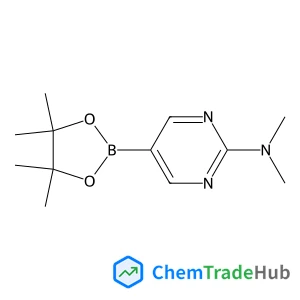
N,N-Dimethyl-5-(4,4,5,5-tetramethyl-1,3,2-dioxaborolan-2-yl)-2-pyrimidinamine
CAS Number:
1032759-30-0
Molecular Formula:
C12H20BN3O2
Recommended Suppliers





Disclaimer
This page provides academic journal information for reference and research purposes only. We are not affiliated with any journal publishers and do not handle publication submissions. For publication-related inquiries, please contact the respective journal publishers directly.
If you notice any inaccuracies in the information displayed, please contact us at support@chemtradehub.com. We will promptly review and address your concerns.