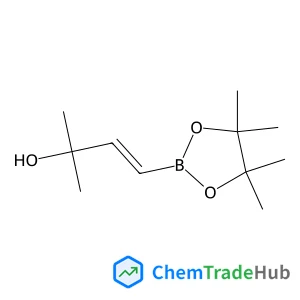
(E)-2-methyl-4-(4,4,5,5-tetramethyl-1,3,2-dioxaborolan-2-yl)but-3-en-2-ol
CAS Number:
581802-26-8
Molecular Formula:
C11H21BO3
Zhangping Shi, Yangxia Wang, Huanlei Lin, Hongbin Zhang, Meikun Shen, Songhai Xie, Yahong Zhang, Qingsheng Gao, Yi Tang
The hydrogen evolution reaction using noble-metal free electrocatalysts has captured increasing attention due to its importance in renewable hydrogen production. Herein, a highly active and stable electrocatalyst of MoC encapsulated by graphitized carbon shells (nanoMoC@GS) has been developed via an in situ carburization of a Mo-based metal–organic framework (Mo-MOF) with the atomic periodic structure. The ultrafine MoC nanoparticles (∼3 nm) confined by 1–3 layered graphite shells significantly favor the efficient HER in both acidic and basic media. In particular, a low overpotential (η10 = 124 and 77 mV at a current density of −10 mA cm−2), a small Tafel slope (43 and 50 mV dec−1) and a high exchange current density (j0 = 0.015 and 0.212 mA cm−2) are achieved on nanoMoC@GS in 0.5 M H2SO4 and 1.0 M KOH, respectively. Such remarkable activity, outperforming most current noble-metal-free electrocatalysts, stems from the cooperative/synergistic effects of ultrafine MoC nanostructure, ultrathin and conductive graphitized carbon shells, and enriched porosity. This work demonstrates a feasible way to design high-performance electrocatalysts via converting “atomic contact” hybrid structures (e.g., MOFs), illustrating a new perspective for developing nanocatalysts in the energy chemistry field.

Bioorganic & Medicinal Chemistry

Topics in Catalysis

Herald of the Russian Academy of Sciences

Biocatalysis and Biotransformation

Journal of Asian Natural Products Research

Journal of the Indian Institute of Science

NDT & E International

Cellulose

Critical Reviews in Solid State and Materials Sciences

Chinese Journal of Chemistry
Jie Liu, Dan Ding, Junlong Geng, Bin Liu
DOI: 10.1039/C2PY20113E
Shogo Takamuku, Patric Jannasch
DOI: 10.1039/C2PY00611A
Christoph Herfurth, Paula Malo de Molina, Christoph Wieland, Sarah Rogers, Michael Gradzielski
DOI: 10.1039/C2PY20126G
Silvie A. Meeuwissen, Marjoke F. Debets, Jan C. M. van Hest
DOI: 10.1039/C2PY00466F
DOI: 10.1039/C2PY20014G
Maribel Hernández-Guerrero, Martina H. Stenzel
DOI: 10.1039/C1PY00219H
Marios Neophytou, Heraklidia A. Ioannidou, Christos L. Chochos, Solon P. Economopoulos, Panayiotis A. Koutentis, Grigorios Itskos, Stelios A. Choulis
DOI: 10.1039/C2PY20198D
Yi Zhang, Mingming Ding, Lijuan Zhou, Hong Tan, Jiehua Li, Huining Xiao, Jianshu Li, James Snow
DOI: 10.1039/C2PY00558A
Shaojie Chen, Qiuyu Zhang, Hepeng Zhang, Junwei Gu, Mingliang Ma, Tiejun Xin, Yanyang Zhou, Jian Zhou, Qing Liu
DOI: 10.1039/C2PY20122D
When considering alternatives to 1-(4-Chlorophenyl)-N-hydroxymethanimine (CAS: 3...
This compound should be stored in a cool, dry place away from direct sunlight. I...
3-(4-Bromophenyl)-5-(2-fluorophenyl)-1,2,4-oxadiazole is synthesized through a m...
5-Chloro-2-(4-chlorophenyl)-4-methyl-6-[3-(1-piperidinyl)propoxy]pyrimidine (CAS...
2-Chloro-4-(difluoromethoxy)pyridine is used in the pharmaceutical industry for ...
3-Chloro-6-methylpyridazine (CAS: 1121-79-5) is classified under the Globally Ha...
Several alternatives can be used in the synthesis of Methyl 4,5-dimethyl-2-nitro...
Alternatives to (2E,2'E)-3,3'-(1,4-Phenylene)bisacrylaldehyde include other acry...
3-Amino-5-chloropyridin-2-ol hydrochloride is an organic compound with the CAS n...
When handling 6,7-Difluoro-2,3-dihydro-4H-chromen-4-one, it is essential to wear...

Journal of Materials Chemistry A, B & C cover high quality studies across all fields of materials chemistry. The journals focus on those theoretical or experimental studies that report new understanding, applications, properties and synthesis of materials. The journals have a strong history of publishing quality reports of interest to interdisciplinary communities and providing an efficient and rigorous service through peer review and publication. The journals are led by an international team of Editors-in-Chief and Associate Editors who are all active researchers in their fields. Journal of Materials Chemistry A, B & C are separated by the intended application of the material studied. Broadly, applications in energy and sustainability are of interest to Journal of Materials Chemistry A, applications in biology and medicine are of interest to Journal of Materials Chemistry B, and applications in optical, magnetic and electronic devices are of interest to Journal of Materials Chemistry C. More than one Journal of Materials Chemistry journal may be suitable for certain fields and researchers are encouraged to submit their paper to the journal that they feel best fits for their particular article. Example topic areas within the scope of Journal of Materials Chemistry A are listed below. This list is neither exhaustive nor exclusive. Artificial photosynthesis Batteries Carbon dioxide conversion Catalysis Fuel cells Gas capture/separation/storage Green/sustainable materials Hydrogen generation Hydrogen storage Photocatalysis Photovoltaics Self-cleaning materials Self-healing materials Sensors Supercapacitors Thermoelectrics Water splitting Water treatment