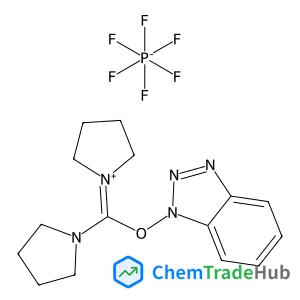
(1H-Benzotriazol-1-yloxy)(di-1-pyrrolidinyl)methylium hexafluorophosphate
CAS Number:
105379-24-6
Molecular Formula:
C15H21F6N5OP
Périne Landois, Tianlin Wang, Abir Nachawaty, Maxime Bayle, Jean-Manuel Decams, Wilfried Desrat, Ahmed-Azmi Zahab, Benoît Jouault, Matthieu Paillet, Sylvie Contreras
Silicon carbide (SiC) sublimation is the most promising option to achieve transfer-free graphene at the wafer-scale. We investigated the initial growth stages from the buffer layer to monolayer graphene on SiC(0001) as a function of annealing temperature at low argon pressure (10 mbar). A buffer layer, fully covering the SiC substrate, forms when the substrate is annealed at 1600 °C. Graphene formation starts from the step edges of the SiC substrate at higher temperature (1700 °C). The spatial homogeneity of the monolayer graphene was observed at 1750 °C, as characterized by Raman spectroscopy and magneto-transport. Raman spectroscopy mapping indicated an AG-graphene/AG-HOPG ratio of around 3.3%, which is very close to the experimental value reported for a graphene monolayer. Transport measurements from room temperature down to 1.7 K indicated slightly p-doped samples (p ≃ 1010 cm−2) and confirmed both continuity and thickness of the monolayer graphene film. Successive growth processes have confirmed the reproducibility and homogeneity of these monolayer films.
Mengjiao Cheng, Chao Jiang, Zhiyi Ding, Yajun Zhang, Yu Fu, Feng Shi
DOI: 10.1039/C3CP52217B
Jhenny F. Galan, Chi Ngong Tang, Shubhashis Chakrabarty, Zhiwei Liu, Vojislava Pophristic
DOI: 10.1039/C3CP50353D
Chang-Lyoul Lee, Shinuk Cho, Seung-Hwan Oh, Seung-Hyeon Moon, Ahmed Elbarbary
DOI: 10.1039/C3CP52151F
Zhenhuan Lu, Xin Zhang, Chuanlang Zhan, Bo Jiang, Xinliang Zhang, Lili Chen, Jiannian Yao
DOI: 10.1039/C3CP51475G
Masato Morita, Kaito Takahashi
DOI: 10.1039/C3CP51903A
Daeil Yoon, Qing Su, Haiyan Wang, Arumugam Manthiram
DOI: 10.1039/C3CP52679H
S. Ramakumar, L. Satyanarayana, Sunkara V. Manorama, Ramaswamy Murugan
DOI: 10.1039/C3CP50991E
Chunlei Wang, Fanning Meng, Mingxing Wu, Xiao Lin, Tonghua Wang, Jieshan Qiu, Tingli Ma
DOI: 10.1039/C3CP52525B
Waste containing N-Methoxy-N-methyl-1,3-thiazole-5-carboxamide (CAS: 898825-89-3...
N-(4-Biphenylyl)dibenzo[b,d]furan-4-amine should be stored in a tightly sealed c...
The market for 3-Acetamido-5-amino-2,4,6-triiodobenzoic acid (CAS: 1713-07-1) is...
Benzyl 2-O-acetyl-3,4,6-tri-O-benzyl-beta-D-galactopyranoside (CAS: 61820-03-9) ...
2-Ethylpiperazine dihydrochloride (CAS: 438050-52-3) is regulated under the Glob...
1,1'-[1,3-Phenylenebis(methylene)]bis(3-methyl-1H-pyrrole-2,5-dione) (CAS: 11946...
Several alternatives can be used in the synthesis of 5-Fluoro-2-(1-pyrrolidinyl)...
Proper personal protective equipment (PPE) must be worn when handling this compo...
When handling 6-Bromoimidazo[1,2-a]pyridin-8-amine, it is important to wear appr...
Alternatives to (2S,4R)-4-(4-Nitrobenzyl)pyrrolidine-2-carboxylic acid hydrochlo...

Physical Chemistry Chemical Physics (PCCP) is an international journal co-owned by 19 physical chemistry and physics societies from around the world. This journal publishes original, cutting-edge research in physical chemistry, chemical physics and biophysical chemistry. To be suitable for publication in PCCP, articles must include significant innovation and/or insight into physical chemistry; this is the most important criterion that reviewers and Editors will judge against when evaluating submissions. The journal has a broad scope and welcomes contributions spanning experiment, theory, computation and data science. Topical coverage includes spectroscopy, dynamics, kinetics, statistical mechanics, thermodynamics, electrochemistry, catalysis, surface science, quantum mechanics, quantum computing and machine learning. Interdisciplinary research areas such as polymers and soft matter, materials, nanoscience, energy, surfaces/interfaces, and biophysical chemistry are welcomed if they demonstrate significant innovation and/or insight into physical chemistry. Joined experimental/theoretical studies are particularly appreciated when complementary and based on up-to-date approaches.