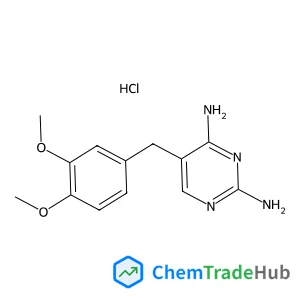
5-(3,4-Dimethoxybenzyl)-2,4-pyrimidinediamine hydrochloride (1:1)
CAS Number:
2507-23-5
Molecular Formula:
C13H17ClN4O2
Chunlei Wang, Fanning Meng, Mingxing Wu, Xiao Lin, Tonghua Wang, Jieshan Qiu, Tingli Ma
A novel bio-inspired Pt- and FTO-free integrated pure carbon counter electrode (CE) for dye-sensitized solar cells (DSSCs) has been designed and fabricated using a porous carbon sheet as a conducting substrate and ordered mesoporous carbon (OMC) as the catalytic layer. A rigid, crustose lichen-like, integrated carbon–carbon composite architecture with a catalytic layer rooted in a porous conducting substrate was formed by a process of polymer precursor spin coating, infiltration and pyrolysis. The integrated pure carbon CE shows very low series resistance (Rs), owing to the high conductivity of the carbon sheet (sheet resistance of 488 mΩ □−1) and low charge-transfer resistance (Rct), due to the large specific surface area of the OMC layer that is accessible to the redox couple. The values of Rs and Rct are much lower than those of a platinized fluorine-doped thin oxide glass (Pt/FTO) electrode. Cells with this CE show high solar-to-electricity conversion efficiencies (8.11%), comparable to that of Pt/FTO based devices (8.16%).
Duo Lin, Jiahui Zhou, Yun Yu, Weiwei Chen, Pei-Hsuan Liao, Hao Huang, Kien Voon Kong
DOI: 10.1039/C9AY01466G
Ping Qu, Jianping Lei, Jin Sheng, Lei Zhang, Huangxian Ju
DOI: 10.1039/C0AN00559B
Alex H. Wrede, Faisal Al-Masri, Reza Montazami
DOI: 10.1039/C9AY01576K
Xiaoqing Zhu, Lianglan Wu, Divyesh C. Mungra, Sijing Xia, Jin Zhu
DOI: 10.1039/C2AN35074B
Rui Chen, Sam Williamson, Kelly M. Fulton, Susan M. Twine, Jianjun Li
DOI: 10.1039/C9AY01756A
Xin-Yue Chen, Wei Ha, Xiao-Jie Jin, Yan-Ping Shi
DOI: 10.1039/D0AN01460E
Thakshila Liyanage, Adrianna N. Masterson, Sumon Hati, Greta Ren, Nicholas E. Manicke, Daniel E. Rusyniak
DOI: 10.1039/D0AN01372B
Jiajing Zhu, Yanling Tian, Xianping Liu
DOI: 10.1039/D1AY00649E
When considering alternatives to 1-(4-Chlorophenyl)-N-hydroxymethanimine (CAS: 3...
This compound should be stored in a cool, dry place away from direct sunlight. I...
3-(4-Bromophenyl)-5-(2-fluorophenyl)-1,2,4-oxadiazole is synthesized through a m...
5-Chloro-2-(4-chlorophenyl)-4-methyl-6-[3-(1-piperidinyl)propoxy]pyrimidine (CAS...
2-Chloro-4-(difluoromethoxy)pyridine is used in the pharmaceutical industry for ...
3-Chloro-6-methylpyridazine (CAS: 1121-79-5) is classified under the Globally Ha...
Several alternatives can be used in the synthesis of Methyl 4,5-dimethyl-2-nitro...
Alternatives to (2E,2'E)-3,3'-(1,4-Phenylene)bisacrylaldehyde include other acry...
3-Amino-5-chloropyridin-2-ol hydrochloride is an organic compound with the CAS n...
When handling 6,7-Difluoro-2,3-dihydro-4H-chromen-4-one, it is essential to wear...

Physical Chemistry Chemical Physics (PCCP) is an international journal co-owned by 19 physical chemistry and physics societies from around the world. This journal publishes original, cutting-edge research in physical chemistry, chemical physics and biophysical chemistry. To be suitable for publication in PCCP, articles must include significant innovation and/or insight into physical chemistry; this is the most important criterion that reviewers and Editors will judge against when evaluating submissions. The journal has a broad scope and welcomes contributions spanning experiment, theory, computation and data science. Topical coverage includes spectroscopy, dynamics, kinetics, statistical mechanics, thermodynamics, electrochemistry, catalysis, surface science, quantum mechanics, quantum computing and machine learning. Interdisciplinary research areas such as polymers and soft matter, materials, nanoscience, energy, surfaces/interfaces, and biophysical chemistry are welcomed if they demonstrate significant innovation and/or insight into physical chemistry. Joined experimental/theoretical studies are particularly appreciated when complementary and based on up-to-date approaches.