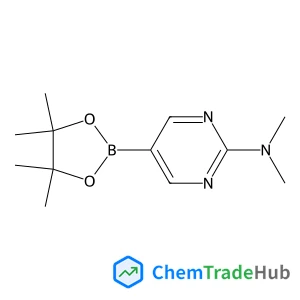
N,N-Dimethyl-5-(4,4,5,5-tetramethyl-1,3,2-dioxaborolan-2-yl)-2-pyrimidinamine
CAS Number:
1032759-30-0
Molecular Formula:
C12H20BN3O2
Daeil Yoon, Qing Su, Haiyan Wang, Arumugam Manthiram
In an effort to boost the power densities of solid oxide fuel cells (SOFCs) operating at intermediate temperatures (600–750 °C), novel powder synthesis methods have been studied with the goal of increasing the three-phase boundary region of the anode. Porous anodes composed of Ni and Ce0.8Gd0.2O1.9 (GDC) cermet are commonly studied in SOFCs, but the cell performance is limited by their dependency on the three-phase boundaries at which the electrochemical oxidation reaction takes place. This paper presents a remarkable improvement in the electrochemical performance through a significant enlargement of the three-phase boundary region by an optimization of the surface structure. The strategy starts with the premise that the oxide powder particles in aqueous solution carry a positive or negative electrical charge depending upon the pH of the solution, and the charge can be exploited to attach chelated metal ions to their surface, extending the three-phase boundary region. This modified NiO–GDC composite powder resulted in not only an extension of both electronic and O2− ionic conduction pathways, but also a suppression of grain growth in the anode during the process of cell fabrication. As the final outcome, the modified Ni–GDC anode-supported cells show far superior power densities (1.85 W cm−2 at 750 °C and 0.83 W cm−2 at 600 °C) in H2 compared to the conventional Ni–GDC anode-supported cells (0.61 W cm−2 at 750 °C and 0.26 W cm−2 at 600 °C).
Takuya Isono, Kana Miyachi, Yusuke Satoh, Shin-ichiro Sato, Toshifumi Satoh
DOI: 10.1039/C7PY01238A
Huajun Huang, Song Hong, Junya Liang, Yan Shi, Jianping Deng
DOI: 10.1039/C7PY00729A
C. Cannas, G. Concas, D. Gatteschi, A. Falqui, A. Musinu, G. Piccaluga, C. Sangregorio, G. Spano
DOI: 10.1039/B008645M
Marie A. F. Delgove, Juandré Luchies, Iris Wauters, Geert G. P. Deroover, Stefaan M. A. De Wildeman, Katrien V. Bernaerts
DOI: 10.1039/C7PY00976C
Ji Liu, Dominique Hoogland, Emma-Rose Janeček, Eric A. Appel, Oren A. Scherman
DOI: 10.1039/C7PY00574A
Coralie Teulère, Renaud Nicolaÿ
DOI: 10.1039/C7PY00875A
Vincent T. G. Tan, Duyen H. T. Nguyen, Robert H. Utama, Mohaddeseh Kahram, Francesca Ercole, John F. Quinn, Michael R. Whittaker, J. Justin Gooding
DOI: 10.1039/C7PY01038A
Renhua Deng, Yin Ning, Elizabeth R. Jones, Victoria J. Cunningham, Nicholas J. W. Penfold, Steven P. Armes
DOI: 10.1039/C7PY01242J
Stefan Sauter, Gunther Wittstock, Rüdiger Szargan
DOI: 10.1039/B008430L
O. R. Monaghan, S. J. Holder
DOI: 10.1039/C7PY01170A
When considering alternatives to 1-(4-Chlorophenyl)-N-hydroxymethanimine (CAS: 3...
This compound should be stored in a cool, dry place away from direct sunlight. I...
3-(4-Bromophenyl)-5-(2-fluorophenyl)-1,2,4-oxadiazole is synthesized through a m...
5-Chloro-2-(4-chlorophenyl)-4-methyl-6-[3-(1-piperidinyl)propoxy]pyrimidine (CAS...
2-Chloro-4-(difluoromethoxy)pyridine is used in the pharmaceutical industry for ...
3-Chloro-6-methylpyridazine (CAS: 1121-79-5) is classified under the Globally Ha...
Several alternatives can be used in the synthesis of Methyl 4,5-dimethyl-2-nitro...
Alternatives to (2E,2'E)-3,3'-(1,4-Phenylene)bisacrylaldehyde include other acry...
3-Amino-5-chloropyridin-2-ol hydrochloride is an organic compound with the CAS n...
When handling 6,7-Difluoro-2,3-dihydro-4H-chromen-4-one, it is essential to wear...

Physical Chemistry Chemical Physics (PCCP) is an international journal co-owned by 19 physical chemistry and physics societies from around the world. This journal publishes original, cutting-edge research in physical chemistry, chemical physics and biophysical chemistry. To be suitable for publication in PCCP, articles must include significant innovation and/or insight into physical chemistry; this is the most important criterion that reviewers and Editors will judge against when evaluating submissions. The journal has a broad scope and welcomes contributions spanning experiment, theory, computation and data science. Topical coverage includes spectroscopy, dynamics, kinetics, statistical mechanics, thermodynamics, electrochemistry, catalysis, surface science, quantum mechanics, quantum computing and machine learning. Interdisciplinary research areas such as polymers and soft matter, materials, nanoscience, energy, surfaces/interfaces, and biophysical chemistry are welcomed if they demonstrate significant innovation and/or insight into physical chemistry. Joined experimental/theoretical studies are particularly appreciated when complementary and based on up-to-date approaches.
![(2S)-2-{[(9H-Fluoren-9-ylmethoxy)carbonyl]amino}-4-(methylselanyl)butanoic acid structure](https://static.chemtradehub.com/structs/121/1217852-49-7-f252.webp "(2S)-2-{[(9H-Fluoren-9-ylmethoxy)carbonyl]amino}-4-(methylselanyl)butanoic acid structure")