












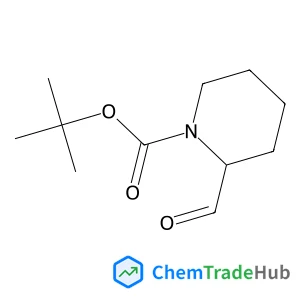
2-Methyl-2-propanyl (2R)-2-formyl-1-piperidinecarboxylate
CAS Number:
134526-69-5
Molecular Formula:
C11H19NO3
Xiya Wang, Hao Su, Yongjun Liu
Fumitremorgin B endoperoxidase (FtmOx1) from Aspergillus fumigatus is the first reported α-ketoglutarate-dependent mononuclear non-haem iron enzyme that catalyzes the endoperoxide formation reaction, converting Fumitremorgin B to verruculogen. Experiments reveal that the molecular oxygen (O2) is incorporated into verruculogen without O–O bond scission, which differs from the currently known non-haem iron enzymes, but the mechanistic details are still unclear. In this paper, on the basis of the crystal structures of FtmOx1 in complex with either the co-substrate (α-ketoglutarate) or the substrate (fumitremorgin B), a ternary complex model of the enzyme-α-ketoglutarate-substrate has been constructed, and combined quantum mechanics and molecular mechanics (QM/MM) calculations have been performed to unravel the novel mechanism of FtmOx1. Our calculations indicate the quintet of the FeIVO complex as the ground state. The FeIVO complex firstly abstracts a hydrogen from the hydroxyl of Tyr228 to initiate the reaction, which corresponds to a lower energy barrier (9.1 kcal mol−1). If the FeIVO complex directly abstracts a hydrogen from C21 of the substrate, the energy barrier would increase to 33.9 kcal mol−1. When Tyr228 was mutated to Ala228, this energy barrier decreases to 24.0 kcal mol−1. In the subsequent reaction, the generated Tyr228 radical abstracts the hydrogen (H2) from C21 of the substrate with an energy barrier of 23.8 kcal mol−1. The second molecular oxygen binds to the C21 radical of the substrate in the active pocket and further completes the epoxidation with an energy barrier of 4.8 kcal mol−1. These results may provide useful information for understanding the reaction mechanism of FtmOx1 and provide guidance for further experimental investigations.
Alexi K. Nedeltchev, Haesook Han, Pradip K. Bhowmik
DOI: 10.1039/C0PY00037J
Yoshifumi Amamoto, Hiroyasu Masunaga, Hiroki Ogawa, Sono Sasaki
DOI: 10.1039/C0PY00304B
M. Baklar, S. Barard, D. Sparrowe, R. M. Wilson, T. Kreouzis
DOI: 10.1039/C0PY00056F
Satyananda Barik, W. G. Skene
DOI: 10.1039/C0PY00394H
Rong Fu, Guo-Dong Fu
DOI: 10.1039/C0PY00174K
Satu Strandman, Julien E. Gautrot, X. X. Zhu
DOI: 10.1039/C0PY00328J
DOI: 10.1039/C0PY00156B
Martin E. Levere, Ian Willoughby, Stephen O'Donohue, Anne de Cuendias, Anthony J. Grice, Christopher Fidge, C. Remzi Becer, David M. Haddleton
DOI: 10.1039/C0PY00113A
6-(3-Fluorophenyl)picolinic acid is generally considered safe for laboratory use...
(3R)-3-Pyrrolidinol is used in the pharmaceutical industry as a precursor for dr...
When handling (4R,5R)-4,5-Diethoxycarbonyl-2,2-dimethyldioxolane (CAS: 59779-75-...
1-(6-Chloroimidazo[1,2-b]pyridazin-3-yl)ethanone is often synthesized via a mult...
The market for N-Ethyl-3,4-dimethylbenzylamine (CAS: 39180-83-1) remains steady,...
Tert-butyl 3-(pyrrolidin-1-yl)azetidine-1-carboxylate is a chemical compound wit...
1-Bromo-3-chloro-2,4-dimethoxybenzene (CAS: 1228956-93-1) falls under the classi...
The safety of 8-Bromo-2-methyl-3,4-dihydroisoquinolin-1(2H)-one (CAS: 1368622-07...
Benzyl [(3S)-2,6-dioxo-3-piperidinyl]carbamate is generally safe when handled wi...
1-{[4-(4,4,5,5-Tetramethyl-1,3,2-dioxaborolan-2-yl)phenyl]sulfonyl}pyrrolidine s...

Physical Chemistry Chemical Physics (PCCP) is an international journal co-owned by 19 physical chemistry and physics societies from around the world. This journal publishes original, cutting-edge research in physical chemistry, chemical physics and biophysical chemistry. To be suitable for publication in PCCP, articles must include significant innovation and/or insight into physical chemistry; this is the most important criterion that reviewers and Editors will judge against when evaluating submissions. The journal has a broad scope and welcomes contributions spanning experiment, theory, computation and data science. Topical coverage includes spectroscopy, dynamics, kinetics, statistical mechanics, thermodynamics, electrochemistry, catalysis, surface science, quantum mechanics, quantum computing and machine learning. Interdisciplinary research areas such as polymers and soft matter, materials, nanoscience, energy, surfaces/interfaces, and biophysical chemistry are welcomed if they demonstrate significant innovation and/or insight into physical chemistry. Joined experimental/theoretical studies are particularly appreciated when complementary and based on up-to-date approaches.
![2-Methyl-2-propanyl [(2S)-1-hydroxy-3-(4-hydroxyphenyl)-2-propanyl]carbamate structure](https://static.chemtradehub.com/structs/833/83345-46-4-eec2.webp "2-Methyl-2-propanyl [(2S)-1-hydroxy-3-(4-hydroxyphenyl)-2-propanyl]carbamate structure")
![[4-Chloro-3-(diethylcarbamoyl)phenyl]boronic acid structure](https://static.chemtradehub.com/structs/871/871332-68-2-0e3b.webp "[4-Chloro-3-(diethylcarbamoyl)phenyl]boronic acid structure")
![Benzyl spiro[indole-3,4'-piperidine]-1(2H)-carboxylate hydrochloride (1:1) structure](https://static.chemtradehub.com/structs/159/159635-46-8-8de0.webp "Benzyl spiro[indole-3,4'-piperidine]-1(2H)-carboxylate hydrochloride (1:1) structure")



