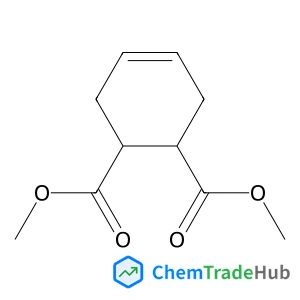
4-Cyclohexene-1,2-dicarboxylic acid, 1,2-dimethyl ester, (1R,2R)-rel-
CAS Number:
17673-68-6
Molecular Formula:
C10H14O4
Satyananda Barik, W. G. Skene
A conjugated all-fluorene polyazomethine (6) was prepared from the condensation of 9,9′-dioctyl fluorene dialdehyde and 9,9′-dihexyl fluorene diamine. The resulting polymer was soluble in common organic solvents courtesy of the solubilizing alkyl groups in the 9,9′ positions. Determination of the polymer's molecular weight was subsequently possible using standard characterization methods. Polymer formation was confirmed both by GPC and NMR with average number molecular weights ranging from 9 to 145 kg mol−1. The absolute fluorescence quantum yield (Φfl) of 6 in dichloromethane was 0.19 while in thin films the value increased to 0.40. The fluorescence could further be restored to unity at 77 K while Φfl = 0.76 was possible by protonating 6 with trifluoroacetic acid. 6 underwent stark color changes from yellow to red upon doping with TFA and FeCl3 and the resulting intermediates could be neutralized with Et3N and hydrazine hydrate, respectively. Reversible protonation/deprotonation was possible both in solution and thin films. Meanwhile, electrochemical oxidation of 6 at ca. 1.5 V resulted in a 120 nm bathochromic change in the absorbance. The intermediate could be reduced at −0.2 V to regenerate the neutral 6 that absorbed at 425 nm. The Job method confirmed that the oxidized intermediate was the radical cation.
Jesús Carrete, Vu Ngoc Tuoc, Georg K. H. Madsen
DOI: 10.1039/C9CP00052F
Andreas Hajduk, Mikhail V. Lebedev, Bernhard Kaiser, Wolfram Jaegermann
DOI: 10.1039/C8CP03337D
Bastiaan Molleman, Tjisse Hiemstra
DOI: 10.1039/C8CP02346H
Shenli Zhang, Yihan Huang, Gulcin Tetiker, Saravanapriyan Sriraman, Alex Paterson, Roland Faller
DOI: 10.1039/C9CP00125E
Esther Heid
DOI: 10.1039/C8CP07623E
Yu Zhang, Tao Li, Dongshuai Hou, Jinglin Zhang, Jinyang Jiang
DOI: 10.1039/C8CP02469C
Jianghao Li, Yihang Fan, Xiaotian Xue, Lingwei Ma, Sumeng Zou, Zhu Fei, Zheng Xie
DOI: 10.1039/C8CP05533E
Issei Suzuki, Leonard Gura, Andreas Klein
DOI: 10.1039/C8CP07872F
James A. Jarvis, Maria Concistre, Richard W. Bounds, Ilya Kuprov, Marina Carravetta, Philip T. F. Williamson
DOI: 10.1039/C8CP06276E
Clément Maheu, Luis Cardenas, Eric Puzenat, Pavel Afanasiev, Christophe Geantet
DOI: 10.1039/C8CP04614J
6-(3-Fluorophenyl)picolinic acid is generally considered safe for laboratory use...
(3R)-3-Pyrrolidinol is used in the pharmaceutical industry as a precursor for dr...
When handling (4R,5R)-4,5-Diethoxycarbonyl-2,2-dimethyldioxolane (CAS: 59779-75-...
1-(6-Chloroimidazo[1,2-b]pyridazin-3-yl)ethanone is often synthesized via a mult...
The market for N-Ethyl-3,4-dimethylbenzylamine (CAS: 39180-83-1) remains steady,...
Tert-butyl 3-(pyrrolidin-1-yl)azetidine-1-carboxylate is a chemical compound wit...
1-Bromo-3-chloro-2,4-dimethoxybenzene (CAS: 1228956-93-1) falls under the classi...
The safety of 8-Bromo-2-methyl-3,4-dihydroisoquinolin-1(2H)-one (CAS: 1368622-07...
Benzyl [(3S)-2,6-dioxo-3-piperidinyl]carbamate is generally safe when handled wi...
1-{[4-(4,4,5,5-Tetramethyl-1,3,2-dioxaborolan-2-yl)phenyl]sulfonyl}pyrrolidine s...

Polymer Chemistry welcomes submissions in all areas of polymer science that have a strong focus on macromolecular chemistry. Manuscripts may cover a broad range of fields, yet no direct application focus is required.