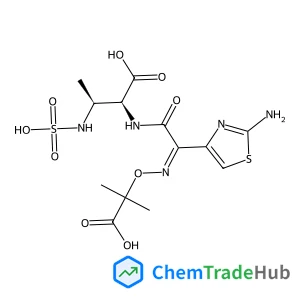
Aztreonam USP Related Compound A (Open-ring Aztreonam)
CAS Number:
87500-74-1
Molecular Formula:
C13H19N5O9S2
Yoshifumi Amamoto, Hiroyasu Masunaga, Hiroki Ogawa, Sono Sasaki
Mesh-size control of network structures of chemical gels, i.e. mesh expansion by insertion of styrene derivatives and mesh shrinking by insertion of divinylbenzene in the gels, was carried out. Chemical gels with alkoxyamine at their cross-linking points were synthesized by radical copolymerization of methyl methacrylate and divinyl monomer with alkoxyamine units. The monomers were inserted by heating the gels with each monomer separately, and the network size was evaluated by small-angle X-ray scattering (SAXS) measurements. Since a living polymerization procedure was adopted for the reactions, network mesh sizes were controlled precisely by controlling the reaction time and selecting an appropriate monomer. In addition, gel properties such as swelling degree and phase separation could also be controlled by employing functional monomers such as hydrophilic and fluorinated monomers. These reorganizable chemical gels combine the advantages of high stability of chemical gels with ease of structural changeability of physical gels.
Alonso W. P. Sanches, Marco A. T. da Silva, Neusmar J. A. Cordeiro, Alexandre Urbano, Sidney A. Lourenço
DOI: 10.1039/C8CP06916F
Francis Kirby B. Burnea, Kyoung Chul Ko
DOI: 10.1039/C8CP03689F
Jesús Carrete, Vu Ngoc Tuoc, Georg K. H. Madsen
DOI: 10.1039/C9CP00052F
Deepak Ojha, Amalendu Chandra
DOI: 10.1039/C8CP07121G
Michael Barclay, Ragnar Bjornsson, Maicol Cipriani, Andreas Terfort, D. Howard Fairbrother, Oddur Ingólfsson
DOI: 10.1039/C8CP07785A
Maria Chiara di Gregorio, Emilia Severoni, Leana Travaglini, Marta Gubitosi, Simona Sennato, Francesco Mura, Carlos Redondo-Gómez, Aida Jover, Nicolae Viorel Pavel, Luciano Galantini
DOI: 10.1039/C8CP02745E
Ling Huang, Jian Zhou, Anmin Zheng
DOI: 10.1039/C8CP04872J
Bastiaan Molleman, Tjisse Hiemstra
DOI: 10.1039/C8CP02346H
DOI: 10.1039/C8CP07241H
6-(3-Fluorophenyl)picolinic acid is generally considered safe for laboratory use...
(3R)-3-Pyrrolidinol is used in the pharmaceutical industry as a precursor for dr...
When handling (4R,5R)-4,5-Diethoxycarbonyl-2,2-dimethyldioxolane (CAS: 59779-75-...
1-(6-Chloroimidazo[1,2-b]pyridazin-3-yl)ethanone is often synthesized via a mult...
The market for N-Ethyl-3,4-dimethylbenzylamine (CAS: 39180-83-1) remains steady,...
Tert-butyl 3-(pyrrolidin-1-yl)azetidine-1-carboxylate is a chemical compound wit...
1-Bromo-3-chloro-2,4-dimethoxybenzene (CAS: 1228956-93-1) falls under the classi...
The safety of 8-Bromo-2-methyl-3,4-dihydroisoquinolin-1(2H)-one (CAS: 1368622-07...
Benzyl [(3S)-2,6-dioxo-3-piperidinyl]carbamate is generally safe when handled wi...
1-{[4-(4,4,5,5-Tetramethyl-1,3,2-dioxaborolan-2-yl)phenyl]sulfonyl}pyrrolidine s...

Polymer Chemistry welcomes submissions in all areas of polymer science that have a strong focus on macromolecular chemistry. Manuscripts may cover a broad range of fields, yet no direct application focus is required.